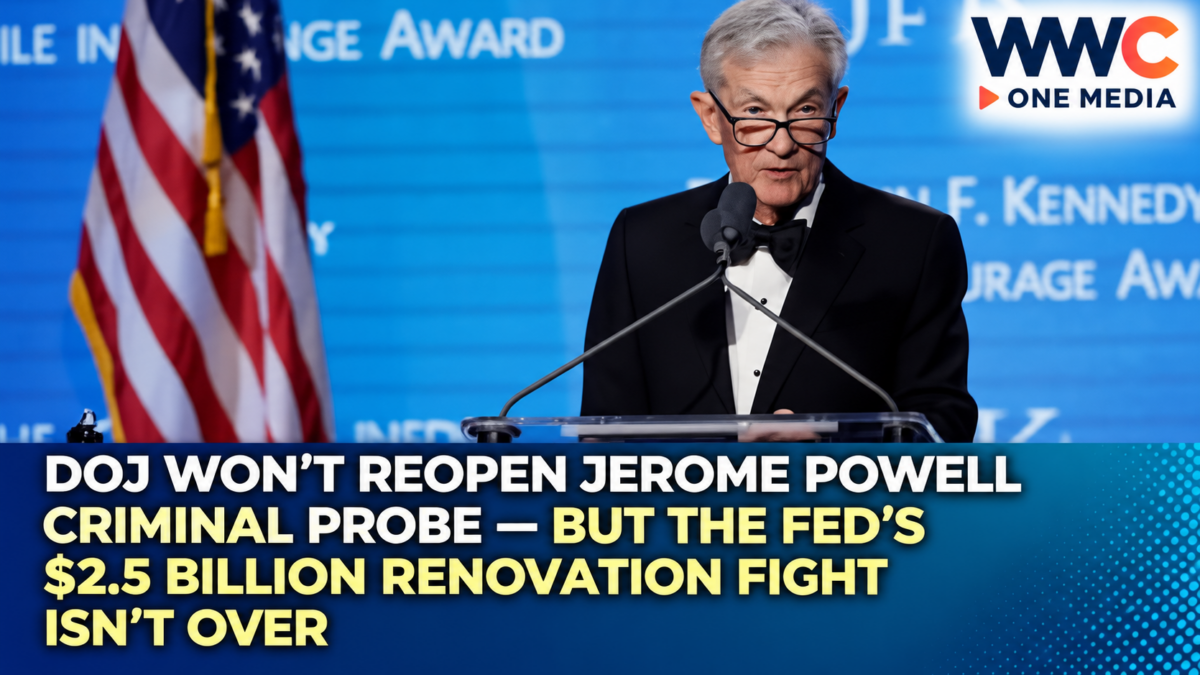
WASHINGTON — The U.S. Justice Department says it will not reopen its criminal investigation into former Federal Reserve Chair Jerome Powell over the central bank’s multibillion-dollar headquarters renovation, effectively clearing one of the most serious legal threats hanging over the former Fed chief.
Attorney General Todd Blanche said the department is satisfied there is currently no basis for reopening the criminal case following a lengthy review of the controversial project.
But the decision is not necessarily the final chapter.
Blanche said the Justice Department could still investigate if a new independent audit ordered by current Federal Reserve Chair Kevin Warsh uncovers evidence of criminal wrongdoing.
That distinction matters.
Powell is no longer facing an active criminal investigation.
But the Federal Reserve’s roughly $2.4 billion to $2.5 billion renovation project remains under intense scrutiny for cost overruns, management failures and delays that have turned an office-construction project into a much larger political fight over Federal Reserve independence.
Fed Watchdog Found Mismanagement — But No Crime
The immediate trigger for the Justice Department’s decision was a report released by the Federal Reserve’s independent Office of Inspector General.
The watchdog found significant problems in the way the Federal Reserve managed the renovation of its Washington headquarters.
But it found no reasonable basis for a criminal referral and no evidence of administrative misconduct requiring legal action.
That conclusion substantially weakened calls to revive the criminal investigation against Powell.
The inspector general’s findings did not portray the project as well managed.
Far from it.
The report said the Federal Reserve failed to establish sufficient cost controls, allowed the project to proceed without a guaranteed maximum construction price and did not take several steps that might have limited the eventual overruns.
In other words:
the project was badly managed, according to the watchdog — but bad management is not the same thing as criminal conduct.
The Renovation Cost More Than Doubled
The scale of the overruns explains why the project became politically explosive.
The renovation was initially estimated at about $921 million in 2020.
By 2024, projected costs had more than doubled, eventually reaching approximately $2.4 billion to $2.5 billion.
The project involves the renovation of historic Federal Reserve buildings near the National Mall in Washington.
Completion has also been pushed back, with the project now expected to extend into 2027.
The inspector general identified several reasons for the increased cost.
They included:
inflation,
construction-price increases,
design revisions,
asbestos remediation,
unexpected site conditions,
limited bidding competition,
and the Federal Reserve’s decision to break construction into dozens of separate packages rather than using a single contract with a guaranteed maximum price.
The report said some of the project’s most controversial design features contributed relatively little to the overall overruns.
That undercut political claims that luxury finishes were primarily responsible for the enormous cost increase.
Trump Had Accused Powell of ‘Criminality’
President Donald Trump repeatedly attacked the renovation project while Powell was still Fed chair.
Trump accused the central bank of spending excessively and publicly suggested there had been “criminality” associated with the project.
The dispute became especially dramatic in July 2025, when Trump visited the construction site with Powell and publicly challenged him over the project’s rising price tag.
The renovation fight soon became intertwined with another much larger dispute:
interest rates.
Trump had repeatedly criticized Powell for refusing to cut rates as quickly as the president wanted.
Powell argued that monetary policy needed to be based on inflation, employment and broader economic conditions rather than political pressure.
That backdrop made the criminal investigation unusually sensitive.
Powell Said the Criminal Probe Was Really About Fed Independence
When the Justice Department served the Federal Reserve with grand jury subpoenas in January, Powell issued an extraordinary public statement.
He said the investigation was nominally connected with his congressional testimony about the renovation.
But Powell argued that the real issue was political pressure on the Federal Reserve over interest-rate policy.
He said the criminal threat should be viewed in the broader context of administration pressure and attempts to influence the central bank.
Powell argued that the fundamental question was whether the Federal Reserve could continue setting interest rates based on economic evidence — or whether monetary policy would eventually become subject to presidential pressure.
That made the case about far more than building costs.
It became a test of the political independence of the world’s most influential central bank.
DOJ Had Already Dropped the Case Once
The Justice Department originally closed the criminal investigation in April 2026 after failing to find evidence of a federal crime.
A prosecutor had earlier acknowledged during a closed-door court proceeding that investigators lacked evidence of misconduct by Powell.
At the time, U.S. Attorney Jeanine Pirro said the case could potentially be reopened if the Federal Reserve inspector general later uncovered evidence supporting criminal allegations.
The inspector general has now completed that review.
Its conclusion:
there was significant mismanagement, but not evidence warranting criminal charges.
That is why Blanche’s October 2 statement is important.
The administration now has both the DOJ’s earlier review and the Fed watchdog’s independent investigation pointing in the same direction.
Trump Still Wants Powell Gone
The absence of criminal charges has not ended Trump’s criticism.
After the inspector general released its findings, Trump renewed his demand that Powell resign from the Federal Reserve Board.
Powell stepped down as Fed chair in May, when Kevin Warsh succeeded him.
But Powell remains a member of the Federal Reserve Board of Governors.
His current term runs through January 2028.
That continued presence matters because Fed governors vote on monetary policy.
Powell’s decision to stay therefore limits Trump’s immediate ability to reshape the board with another appointment.
Powell Had Said He Would Stay Until the Investigation Was Truly Finished
Powell had already hinted that the legal pressure influenced his decision to remain.
At his final press conference as chair in April, he said he would stay on the board until the investigation was “well and truly over, with transparency and finality.”
Axios later reported that Powell said broader legal attacks on the Federal Reserve had effectively left him no choice but to remain.
That means the DOJ’s latest announcement creates a new question.
If the criminal threat has largely disappeared, will Powell eventually reconsider how long he intends to stay on the board?
So far, he has not announced such a move.
Kevin Warsh Is Ordering Another Audit
Current Fed Chair Kevin Warsh has not simply defended the old management structure.
He announced that the Federal Reserve will hire an independent auditor to review the renovation’s costs for accuracy and compliance.
Warsh has also moved to strengthen outside oversight of the project.
The Washington Post reported that he transferred significant project oversight to the General Services Administration, the federal agency that manages government property and procurement.
That creates a potentially awkward situation for Powell.
The inspector general has found no crime.
The DOJ says it will not reopen the case.
But a separate cost audit is still coming.
And Blanche has explicitly said the Justice Department could reconsider if that audit finds evidence of criminal misconduct.
So while Powell appears legally cleared for now, the project itself remains open to investigation.
The Biggest Failure May Have Been Basic Project Management
One of the most damaging findings in the inspector general’s report had little to do with political allegations.
It involved ordinary project controls.
The Fed reportedly failed to impose a guaranteed maximum price and consistently rated the renovation as “on track” even while costs were escalating dramatically.
The watchdog found repeated departures from normal cost-management procedures.
That suggests the core problem may have been institutional.
A central bank responsible for overseeing trillions of dollars in financial activity struggled to maintain basic discipline over its own construction project.
That may not be criminal.
But politically, it is damaging.
Why the Case Became So Dangerous for the Fed
Central-bank independence is considered an important feature of modern economic policy.
The Federal Reserve sets short-term interest rates that influence:
mortgages,
credit cards,
corporate borrowing,
employment,
inflation,
financial markets,
and the value of the U.S. dollar.
If investors believe presidents can threaten Fed officials with criminal investigations whenever monetary policy becomes politically inconvenient, confidence in the institution could weaken.
That is why Powell’s January statement drew so much attention.
The issue was not simply whether he had accurately described the headquarters renovation.
The issue was whether a criminal investigation could become a tool for pressuring the central bank.
The Timing Was Especially Sensitive
The criminal investigation unfolded during one of the most contentious interest-rate cycles in years.
Trump wanted lower borrowing costs.
The Fed remained focused on persistent inflation.
Those policy disagreements had real political consequences.
High interest rates made mortgages, business borrowing and consumer credit more expensive.
Trump repeatedly blamed Powell.
Powell repeatedly insisted the Fed had to remain independent.
The renovation investigation therefore became inseparable from the larger monetary-policy conflict.
Powell Is No Longer Chair — But the Independence Fight Continues
Kevin Warsh now leads the Federal Reserve.
But political pressure on the institution has not disappeared.
The Fed is currently balancing persistent inflation against a weakening labor market.
September employment data showed only 29,000 new jobs, while unemployment rose to 4.2%, increasing expectations that policymakers could pause before raising rates again.
That means the same tension remains.
The White House wants stronger economic growth and lower borrowing costs.
The Fed must decide whether inflation is under enough control to allow easier policy.
Even without Powell in the chair, the question of political influence over those decisions remains unresolved.
The Renovation Could Still Become a Political Weapon
The inspector general’s report cleared Powell of criminal wrongdoing.
But it did not clear the Federal Reserve of serious mistakes.
That distinction allows critics to continue attacking the institution.
The project:
more than doubled in estimated cost,
suffered repeated management failures,
ran behind schedule,
and lacked sufficient cost controls.
Those facts provide political ammunition even without criminal allegations.
Trump and other critics can argue the episode demonstrates weak management at the central bank.
Fed defenders can argue that management failures should be fixed without using criminal investigations to pressure monetary policymakers.
Both arguments can exist at the same time.
DOJ’s Decision Removes the Biggest Immediate Threat
For Powell personally, however, the latest announcement is significant.
The Justice Department is not reopening the criminal investigation.
The Fed inspector general found no grounds for criminal referral.
The earlier DOJ investigation had already been closed.
And prosecutors previously acknowledged they lacked evidence of wrongdoing.
That makes the possibility of criminal charges substantially more remote.
But not impossible.
Blanche deliberately left one door open:
if the independent audit ordered by Warsh uncovers new evidence, DOJ could investigate again.
The Bigger Question Is What Happens to Powell Now
Jerome Powell entered 2026 facing threats of criminal indictment over a building project.
Nine months later, he is no longer Fed chair — but he remains a governor, the criminal probe is closed, and the central bank’s own watchdog has found no crime.
That is a remarkable reversal.
Yet the controversy leaves behind two unresolved issues.
First:
how did a Federal Reserve construction project initially estimated below $1 billion grow into a roughly $2.5 billion problem?
And second:
will presidents now view criminal investigations as a legitimate tool for pressuring future Federal Reserve leaders?
The first question may be answered by Kevin Warsh’s independent audit.
The second may shape the institution for years.
Because while Jerome Powell appears to have survived the criminal investigation, the political fight over how independent the Federal Reserve should remain is far from over.