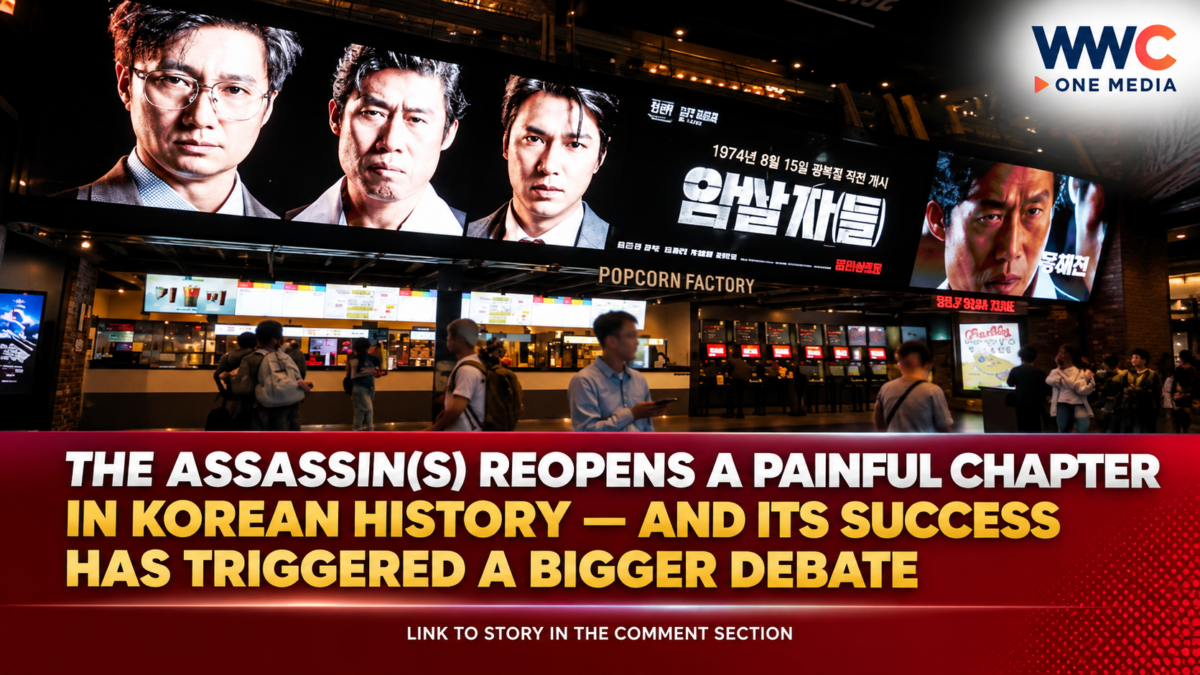
SEOUL — A Korean historical thriller has become a major box-office draw while simultaneously reigniting a politically charged debate over how painful episodes from the country’s past should be portrayed on screen.
“The Assassin(s)”, directed by Hur Jin-ho, focuses on the 1974 shooting that killed then-first lady Yuk Young-soo during a National Liberation Day ceremony. The film has attracted large audiences during the Chuseok holiday while facing criticism over its fictionalized interpretation of the historical events.
The controversy has now moved beyond movie reviews, with a former People Power Party city councilor filing a police complaint against the director and producers. The complaint alleges that the film defamed historical figures by suggesting a level of government involvement in the assassination that critics say is unsupported by established history.
When history becomes entertainment
The dispute centers on a difficult question: how far can filmmakers go when transforming a real tragedy into commercial entertainment?
“The Assassin(s)” uses real historical events as its foundation but introduces fictional characters, investigative scenarios and imagined elements. The production team has said the movie was based on publicly available records, including declassified documents, books and documentaries, while using cinematic imagination to reconstruct the period.
The filmmakers have also rejected the idea that the movie was intended to establish a new historical conclusion or deliberately distort known facts.
That distinction has not ended the criticism.
Some viewers and political figures argue that movies dealing with real victims and traumatic events carry a responsibility to clearly distinguish established facts from fictional speculation. Others maintain that historical fiction necessarily involves creative interpretation and that audiences should be allowed to assess the work themselves.
Political controversy fuels public attention
The backlash has divided political reactions.
Conservative politicians and the Park Chung-hee Memorial Foundation have criticized the film’s portrayal and demanded action, while members of the ruling Democratic Party have defended the movie as fiction and opposed political interference in artistic expression.
The controversy itself has also generated additional public attention around the movie.
“The Assassin(s)” attracted about 1.4 million viewers during the four-day Chuseok holiday, with its cumulative audience exceeding 1.63 million by Monday, according to Korean Film Council data cited by The Korea Times.
The bigger issue is not only the box office
The debate highlighted by The Korea Times editorial goes beyond whether the film succeeds commercially.
When stories draw on real deaths, political violence and historical trauma, commercial success can collide with questions about accuracy, artistic freedom and the treatment of victims and their families.
That tension becomes particularly complicated when controversy itself increases public curiosity.
In this case, the film’s popularity and the political dispute are unfolding simultaneously, leaving audiences to confront two separate questions: where creative freedom ends when real history begins — and whether controversy surrounding a painful past can become part of a film’s commercial momentum.
For South Korea, the debate surrounding “The Assassin(s)” is therefore not simply about one movie. It reflects a continuing argument over how a society should remember, dramatize and commercially portray its most difficult chapters of history.
WWC ONE MEDIA G,A