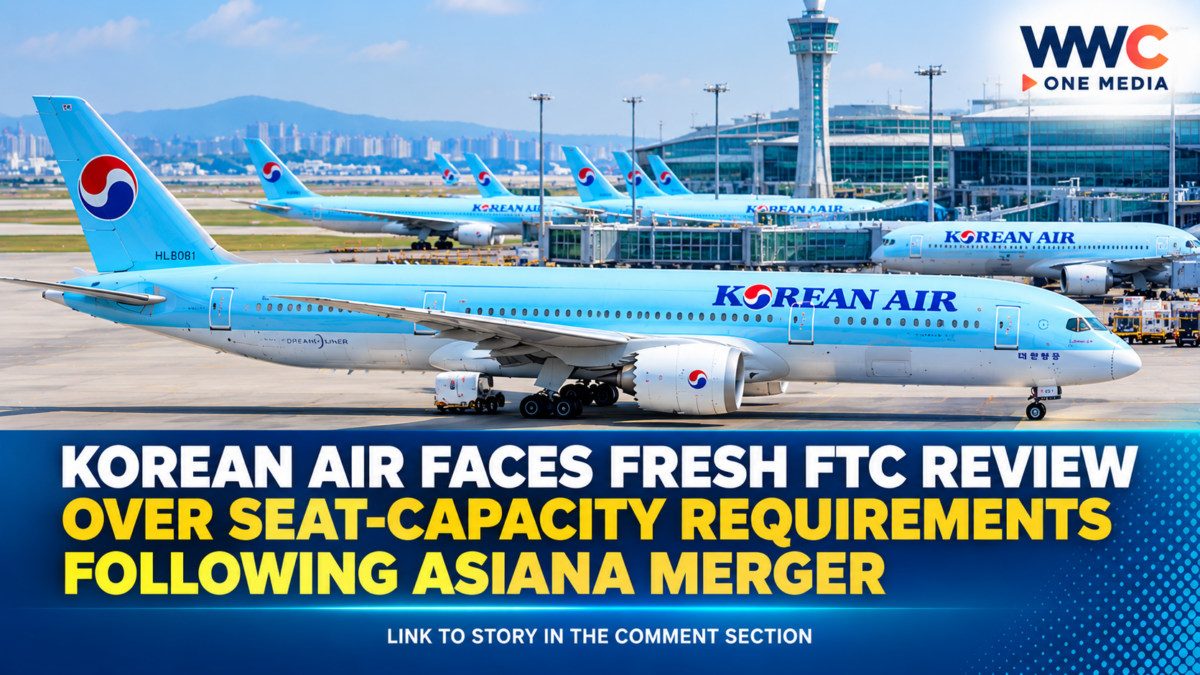
SEOUL — Korean Air is facing fresh scrutiny from South Korea’s antitrust watchdog over allegations that it failed to meet seat-capacity requirements imposed as part of its acquisition of Asiana Airlines.
The Fair Trade Commission (FTC) said Wednesday that its examiner’s report found Korean Air, Jin Air and Asiana Airlines provided fewer than 90% of their 2019 seat capacity on routes connecting Cheongju and Jeju between December 2024 and December 2025.
The findings could lead to penalties and a referral for criminal investigation, although the FTC has not yet made a final decision.
Why the 90% rule matters
The seat-capacity requirement was imposed as a condition of Korean Air’s takeover of Asiana.
Under the corrective measures, the airlines are required to maintain at least 90% of the corresponding 2019 seat capacity on designated routes. The measure was designed to prevent the merger from reducing competition and limiting options for air passengers.
The latest examiner’s report concluded that the airlines failed to satisfy the requirement on the Cheongju-Jeju routes during the period under review.
The report recommended that action be taken for noncompliance, including penalties and a referral for criminal investigation.
Airlines also sought a lower requirement for Guam routes
The FTC is separately reviewing a request from Korean Air and four affiliated airlines to reduce the minimum seat-capacity requirement from 90% to 70% of 2019 levels on routes linking Incheon and Busan with Guam.
The airlines cited declining demand for Guam as a tourism destination as a reason for seeking the change.
FTC examiners recommended rejecting the request, concluding that the circumstances did not satisfy the criteria for modifying the existing requirement.
No final ruling yet
The latest developments are recommendations from FTC examiners rather than a final ruling by the commission.
The affected airlines will have an opportunity to present their defenses before the FTC’s full commission conducts its final deliberations.
That distinction is important because the allegations and recommendations have not yet resulted in a final determination of liability.
Asiana merger enters its final stage
The regulatory dispute comes as Korean Air moves toward completing the integration of Asiana Airlines.
Asiana currently operates as a subsidiary of Korean Air, and the two airlines are scheduled to merge into a single corporate entity on December 17, 2026, according to Yonhap.
The FTC’s latest review therefore puts renewed attention on whether Korean Air and its affiliated carriers are complying with the conditions attached to the landmark airline merger.
The commission’s eventual decision will determine what action, if any, follows from the alleged seat-capacity shortfall — making the next stage of the review a closely watched development for the airlines and passengers using the affected routes.
WWC ONE MEDIA G,A