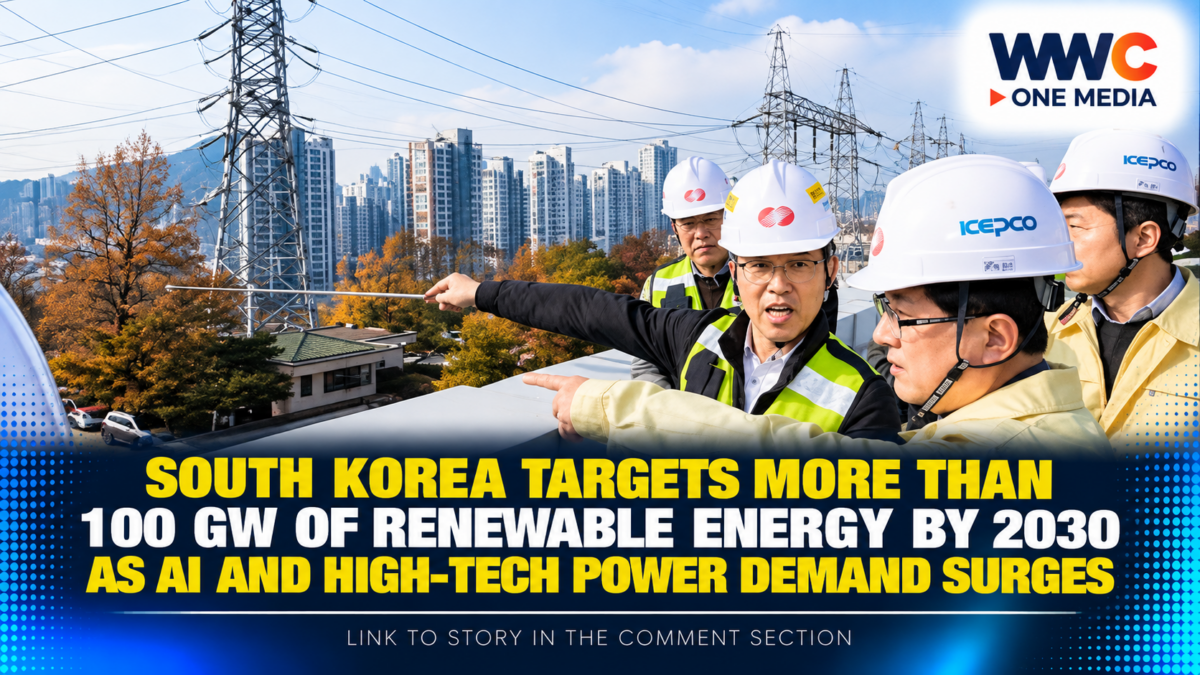
SEOUL — South Korea is preparing for a major expansion of renewable energy, with the government targeting more than 100 gigawatts of renewable-energy capacity by 2030 as electricity demand from artificial intelligence, semiconductors and broader electrification continues to grow.
The target would more than double the country’s current renewable capacity of roughly 40 GW, according to the Ministry of Climate, Energy and Environment.
The government says the expansion will require not only more solar and other renewable generation but also a major upgrade of the country’s electricity infrastructure.
AI and High-Tech Industries Add Pressure
South Korea’s push comes as high-tech industries expand rapidly, increasing the need for reliable electricity.
The government has identified AI infrastructure and semiconductor manufacturing as major sources of future power demand. Earlier plans called for large-scale electricity supplies to support new industrial projects, while renewable energy is expected to form an increasingly important part of the country’s power mix.
But producing more renewable electricity is only part of the challenge.
Much of South Korea’s renewable generation is expected to be concentrated outside the Seoul metropolitan area, while a large share of electricity consumption remains concentrated around the capital region. That geographic mismatch is putting additional pressure on the national transmission network.
The Grid Is Becoming the Critical Test
The government says existing transmission and distribution networks have become a major obstacle to bringing additional renewable power online.
To address the problem, officials plan to build new transmission and distribution infrastructure while expanding energy-storage systems (ESS).
The storage systems are intended to absorb excess renewable electricity when production is high and release it later when grid capacity is available. The government says this could allow additional renewable projects to connect without waiting entirely for new transmission infrastructure.
Officials are also moving toward more flexible grid connections, allowing renewable projects to connect under normal conditions while temporarily limiting output when local networks become congested.
A Race Against the Clock
The scale of the challenge is significant.
South Korea’s renewable-energy plan calls for capacity to rise from around 37 GW in 2025 to 100 GW by 2030, requiring an average addition of roughly 12.6 GW annually through the end of the decade.
At the same time, transmission infrastructure can take years to complete. A 345-kilovolt transmission line can require about nine years from site selection to completion, according to government-related data cited by Seoul Economic Daily.
That creates a race between renewable-energy construction and the infrastructure needed to deliver that electricity to consumers.
What Comes Next
The government’s latest measures are designed to make greater use of existing grid capacity while new infrastructure is developed.
The strategy combines renewable generation, expanded energy storage and grid upgrades as South Korea attempts to meet rising electricity demand without allowing network bottlenecks to slow the country’s industrial ambitions.
With the 100-GW milestone now set for 2030, the next major test will be whether South Korea can build enough renewable power — and the grid needed to carry it — quickly enough to keep pace with its rapidly expanding AI and high-tech economy.
The target is clear. The harder question is whether the power grid can get there in time.
WWC ONE MEDIA G,A