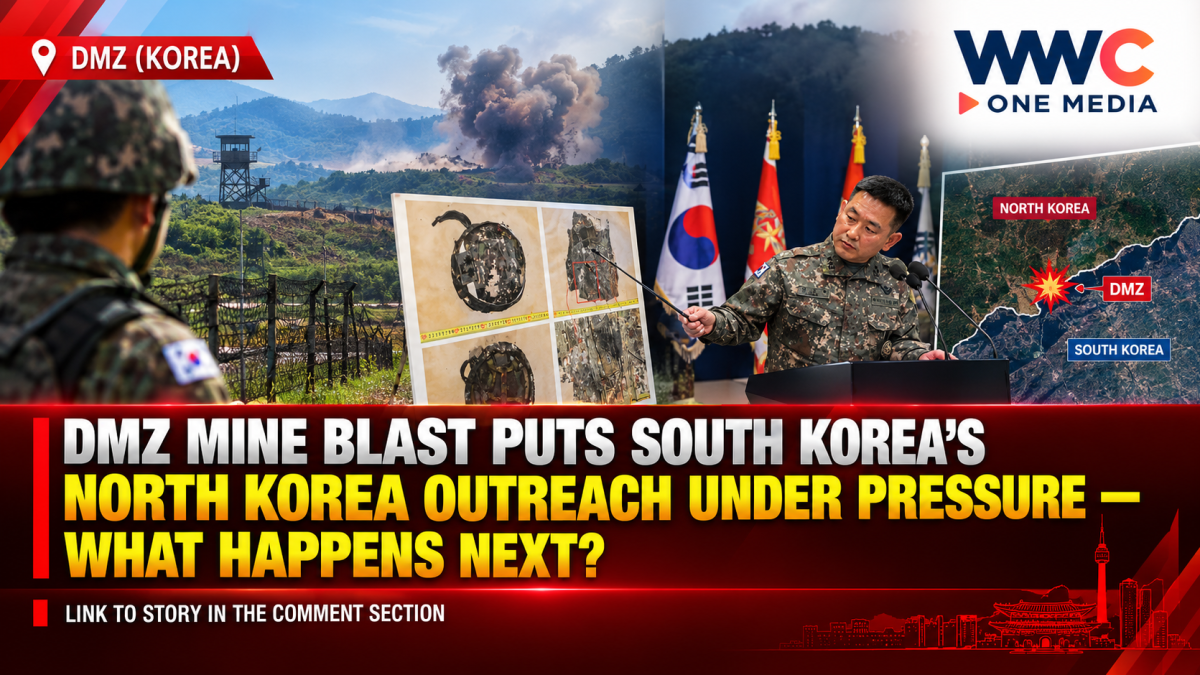
SEOUL — South Korea’s efforts to reopen dialogue with North Korea are facing a new test after a Sept. 21 land mine explosion in the Demilitarized Zone (DMZ) injured three South Korean soldiers and an interim military investigation found a very high likelihood that North Korean mines caused the blasts.
President Lee Jae Myung on Tuesday ordered the military to establish the facts quickly and work closely with the United Nations Command (UNC) before deciding on further measures.
The final investigation has not yet been completed, meaning responsibility has not been formally established.
What happened in the DMZ?
The explosions occurred while an 18-member South Korean military team was clearing a new route near the Military Demarcation Line (MDL).
The operation was intended to establish a route that would allow future inspections with the UNC after South Korea detected changes in the terrain that it suspected could be linked to North Korean mine-laying activity.
Two explosions occurred during the operation, seriously injuring two soldiers and leaving another with minor injuries.
South Korea’s military said forensic analysis found TNT and foreign brown-colored material on equipment belonging to the injured soldiers. Investigators also reported no metal fragments or shrapnel, while witnesses reported seeing a suspected mine near the blast site.
Seoul is weighing its response
The government has not announced a specific response.
President Lee instructed the military to conduct a thorough investigation with the UNC and said necessary measures would follow once the facts are established.
Defense Minister Kang Shin-chul and the Joint Chiefs of Staff have said corresponding measures would be considered if the final investigation confirms that North Korean forces planted the mines.
Possible options discussed publicly include changes to DMZ operations and the potential resumption of loudspeaker broadcasts toward North Korea — a measure South Korea has used during previous periods of heightened tensions.
Officials have not said that any of those measures have been decided.
Why the blast matters for Lee’s outreach
The incident comes as Lee’s administration has been pursuing dialogue and measures aimed at reducing tensions with Pyongyang.
That creates a difficult policy situation: Seoul is attempting to maintain channels for engagement while also responding to a serious security incident near the inter-Korean border.
The Korea Times reported that experts see the incident as highlighting the challenge of maintaining a peace initiative while North Korea continues to take a hostile stance toward Seoul.
At the same time, officials have emphasized that the response should depend on the evidence gathered during the investigation.
A return to loudspeaker broadcasts?
One option receiving attention is the possible return of border loudspeaker broadcasts.
South Korea previously resumed such broadcasts following a 2015 land mine incident that Seoul attributed to North Korea. The measure was associated with a period of sharply increased tensions before subsequent inter-Korean talks.
Analyst Moon Seong-mook told The Korea Times that broadcasts could put pressure on Pyongyang, while also acknowledging that restarting them could increase tensions and anxiety among residents near the border.
The military is also reviewing DMZ operations
The military temporarily suspended the next stage of route-clearing operations after the explosions while it reviews safety procedures.
Officials have said existing military operations can be adjusted under established guidelines, but they have not announced a broader change in operations inside the DMZ.
The exact circumstances surrounding the mines also remain important.
Because the soldiers were operating in an area that had rarely been entered for decades, the military has not publicly concluded that the soldiers were deliberately targeted. Investigators are still determining when and how the mines came to be located there.
What comes next?
The investigation now becomes the key factor.
If the final findings confirm that North Korean mines caused the explosions, Seoul has said it will consider corresponding measures. If investigators cannot establish responsibility conclusively, the government’s options and diplomatic calculations could look different.
For Lee’s administration, the challenge is balancing security, military readiness and its effort to reduce tensions through dialogue.
The DMZ incident therefore goes beyond the three injured soldiers and a damaged patrol operation. It has become another test of how Seoul responds when its outreach to Pyongyang collides with unresolved security risks along one of the world’s most heavily fortified borders.
And with the final investigation still pending, the next decision from Seoul could determine whether this remains a contained border incident — or becomes another major setback for inter-Korean engagement.
WWC ONE MEDIA G,A