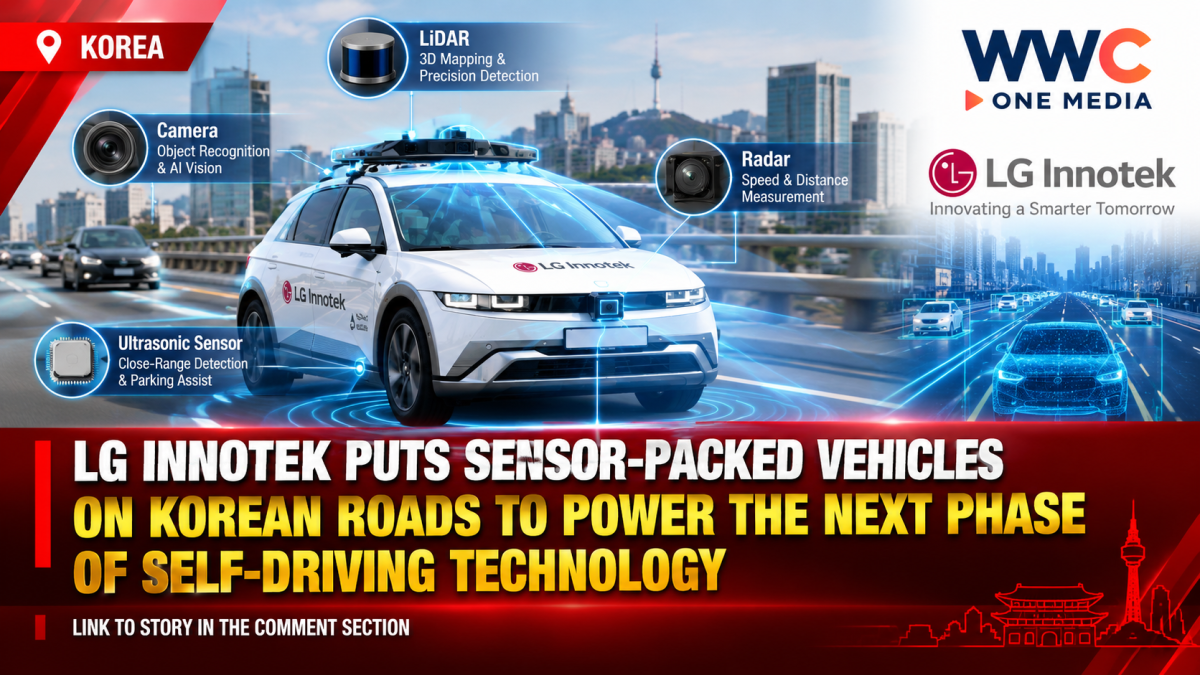
SEOUL — LG Innotek is putting sensor-packed vehicles on Korean roads as it moves beyond simply supplying autonomous-driving hardware and begins collecting the real-world driving data needed to improve the technology itself.
The Korean electronics components maker said Tuesday that it has begun operating autonomous-driving data-collection vehicles in partnership with U.S. software company Applied Intuition.
The fleet will initially operate across Seoul, Incheon and Gyeonggi Province, with the companies planning to expand it to about 20 vehicles by 2028.
LG Innotek wants data from the real world
The vehicles are equipped with cameras, radar and lidar — three key sensing technologies used to help autonomous vehicles understand their surroundings.
During road testing, the vehicles will collect information on road conditions, vehicle movements, object locations and changing weather conditions.
LG Innotek plans to combine that real-world information with digital twin environments, allowing engineers to improve individual sensors while also testing how the systems perform together.
That approach is particularly important for sensor fusion, which combines different types of information rather than relying on a single sensor.
Cameras provide visual information, radar measures factors such as distance and speed, while lidar creates detailed three-dimensional information about the surrounding environment. Combining those inputs can give autonomous-driving systems a broader picture of what is happening around a vehicle.
The hardest driving situations are the real test
LG Innotek is not focusing only on ordinary road conditions.
The company plans to gather so-called “edge case” data — unusual or difficult situations that can expose weaknesses in autonomous-driving sensors.
Examples include a black vehicle driving through heavy rain, strong backlighting when leaving a tunnel and irregular lane markings around construction sites.
These scenarios matter because autonomous-driving systems must interpret their surroundings under conditions that can be very different from controlled testing environments.
By gathering more difficult real-world examples, LG Innotek aims to improve the reliability of its sensing technologies.
The fleet will expand beyond Korea
The company’s data-gathering strategy will not stop at Korean roads.
LG Innotek said vehicles equipped with its sensing modules will also operate in the United States, Europe and Japan, giving the company access to different road layouts, traffic conditions and environments.
That international data could help engineers identify performance differences across markets and refine sensing solutions for customers around the world.
Privacy safeguards are also part of the plan
Because the vehicles will use cameras to observe public roads, the data collection also raises obvious privacy considerations.
LG Innotek said personal information captured by vehicle cameras, including faces and license plates, will be de-identified before the data is used.
From sensor supplier to data-driven AI player
The move represents a broader shift in how LG Innotek is approaching the autonomous-driving market.
Rather than concentrating solely on individual camera, radar or lidar components, the company is combining its sensing hardware with real-world driving data and software-oriented development.
LG Innotek said the strategy will support its push into physical AI sensing markets, including autonomous driving, while helping it pursue customers in North America and Europe.
The partnership with Applied Intuition is part of that effort. The two companies formed their strategic partnership earlier this year, with the collaboration focused on advancing autonomous-driving sensing solutions.
The bigger race is now about data
As autonomous-driving technology develops, better hardware is only one part of the equation.
Vehicles need to recognize an enormous range of road situations, including conditions that engineers cannot easily reproduce in laboratories.
That makes real-world driving data increasingly important for improving sensors, testing systems and identifying weaknesses.
LG Innotek is now building its own pipeline for that data — starting with Korean roads and expanding toward a larger international fleet.
The race to make self-driving cars smarter may increasingly depend not just on better sensors, but on how much real-world experience those sensors can learn from.
WWC ONE MEDIA G,A