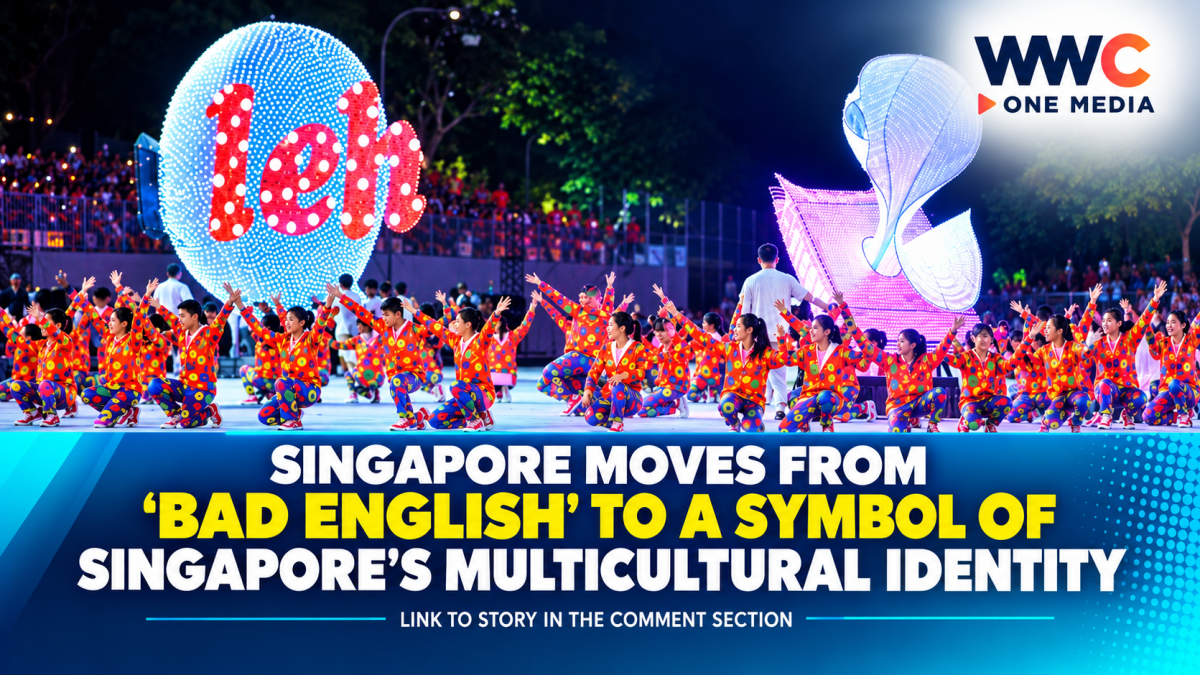
SINGAPORE — For decades, Singaporeans were encouraged to speak “proper” English, with Singlish often dismissed as incorrect or poor usage. But attitudes toward the colloquial language are changing, with younger Singaporeans increasingly embracing it as part of what makes their culture distinctly Singaporean.
The debate over Singlish is no longer simply about grammar. It has increasingly become a conversation about identity, culture and how Singapore’s different linguistic communities have shaped everyday speech.
From “Bad English” to Singapore English
The colloquial variety commonly called Singlish incorporates vocabulary, grammar and sentence structures influenced by English, Malay, Mandarin, Hokkien and Cantonese.
Linguists distinguish it from Singapore Standard English, the more formal variety used when standardized English is expected. This distinction means Singaporeans can switch between different forms of English depending on the setting.
That ability to code-switch has become an important part of the discussion. Standard English remains important in education and professional settings, while Singlish can function as a more informal marker of local identity.
Why “Lah” and “Lor” Mean More Than Slang
Words and expressions associated with Singlish have become recognizable symbols of Singaporean speech.
Even everyday food orders can reveal the country’s linguistic mixture. The commonly used coffee-shop phrase “kopi-C siew dai peng”, for example, combines influences from several languages and describes iced coffee with evaporated milk and less sugar.
This kind of linguistic mixing reflects Singapore’s history as a multicultural society, where communities speaking different languages have interacted for generations.
Younger Singaporeans Are Embracing Singlish
The changing attitude is particularly visible among younger Singaporeans.
The Straits Times report cites an Institute of Policy Studies study in which 80% of younger respondents said they speak Singlish well, suggesting a level of confidence that was less common among earlier generations.
The change does not necessarily mean standard English has become less important. Instead, it highlights the idea that Singaporeans can use different forms of English for different circumstances.
That distinction is increasingly described through code-switching — adapting one’s language according to the audience and situation.
Oxford English Dictionary Adds More Singapore Words
Singapore English has also gained recognition beyond the country.
The Oxford English Dictionary added 11 more Singapore English words in 2026, bringing the number of Singapore English terms featured in the dictionary to more than 30, according to The Straits Times. The additions include words such as “jialat” and “wayang.”
Other Singapore-related entries include “agak-agak,” “boleh,” “kaypoh,” “lepak,” “shiok” and “sabo.”
The inclusion of these words illustrates how expressions that originated in local communities can eventually enter international English-language reference works.
The Challenge: Can Singlish Survive New Slang?
The growing acceptance of Singlish does not mean its future is guaranteed.
Singapore’s younger generations are also absorbing rapidly changing internet language and global slang. Expressions popularized through social media can spread quickly, raising questions about whether some traditional Singapore English expressions could gradually disappear.
Languages naturally evolve, and Singlish is no exception.
The bigger question may therefore be whether Singapore’s distinctive linguistic mixture can continue adapting while retaining the cultural influences that made it unique in the first place.
More Than a Way of Speaking
Singlish has moved far beyond a simple argument about whether certain words or grammar are “correct.”
For many Singaporeans, it represents a connection to home, community and the country’s multicultural history.
At the same time, proficiency in standard English remains important when communicating in formal, educational and international settings.
The result is not necessarily a choice between Singlish and standard English. Instead, Singapore’s linguistic identity increasingly reflects the ability to move between both — depending on who is listening and where the conversation is happening.
And as Singapore’s language continues to evolve, the survival of Singlish may ultimately depend on whether future generations continue to see it not simply as slang, but as part of what makes Singaporean speech unmistakably Singaporean.
WWC ONE MEDIA G,A