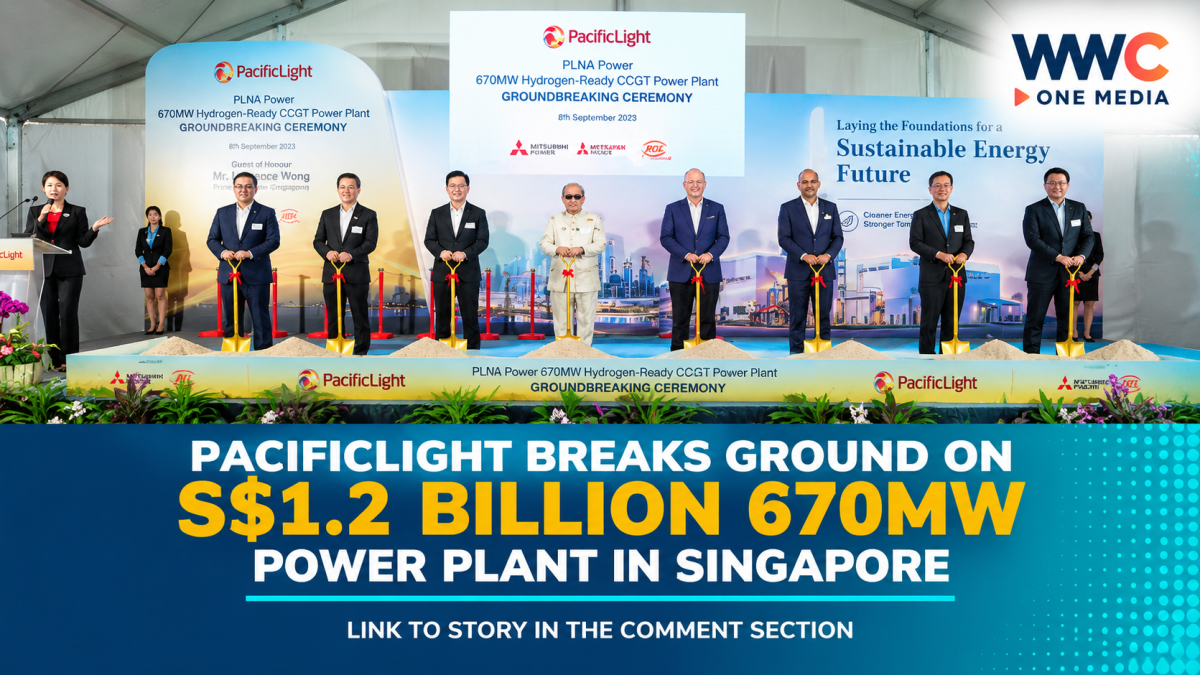
PacificLight has broken ground on a S$1.2 billion power plant on Jurong Island that will become Singapore’s largest single generating unit when it begins operations in 2029.
The 670-megawatt combined-cycle gas turbine facility was officially launched on Sept. 28, with Minister for Trade and Industry (Energy and Industry) Tan See Leng officiating at the groundbreaking ceremony.
The project is designed to strengthen Singapore’s electricity supply as demand is expected to increase with the expansion of advanced manufacturing, digital services, artificial intelligence and transport electrification.
PacificLight said the plant will be the first gas-fired power facility in Singapore to integrate a large-scale battery energy storage system. The battery component is intended to improve operational flexibility, help manage fluctuations in electricity demand and support the wider power grid as Singapore increases solar deployment.
When fully operational in 2029, the plant is expected to generate enough electricity to meet the annual power needs of up to 1.2 million four-room HDB flats. It will also increase PacificLight’s total generation capacity by about 70 percent.
The facility is being developed on Jurong Island by Mitsubishi Power and Jurong Engineering. PacificLight has described it as a hydrogen-ready plant capable of operating with at least 30 percent hydrogen from the beginning, with the potential to transition to 100 percent hydrogen in the future.
The hydrogen capability is part of Singapore’s longer-term effort to prepare its electricity system for lower-carbon energy technologies while continuing to rely on natural gas as a major source of power generation.
The integrated battery system is another significant feature. The planned 80MW lithium-ion battery storage system will provide additional flexibility and resilience, allowing the facility to respond more effectively to changes in electricity supply and demand.
Tan said Singapore’s peak electricity demand is expected to grow faster in the coming years as the economy expands and new industries increase their energy requirements. He also highlighted the importance of adding generation capacity quickly enough to support new investments while maintaining reliable and competitively priced electricity.
Energy security has become an increasingly important concern for Singapore, which relies heavily on imported fuels. The government has said recent global energy disruptions have reinforced the need for multiple layers of protection against supply shocks and geopolitical risks.
PacificLight’s new facility is therefore being built with both immediate and longer-term requirements in mind: additional gas-fired generation to meet rising demand, battery storage to improve flexibility and hydrogen capability to prepare for future changes in the energy system.
The project also adds to Jurong Island’s role as a major centre for Singapore’s energy and industrial activities. The government has been positioning the island not only as a conventional energy hub but also as a base for emerging low-carbon technologies and new-energy investments.
Construction is expected to continue toward a planned 2029 start of operations.
For Singapore, the project represents another major investment in electricity infrastructure at a time when data centres, semiconductor manufacturing, electrification and other energy-intensive industries are increasing pressure on the power system.
The bigger question now is how quickly new generation capacity, battery storage and hydrogen-ready infrastructure can be brought online as Singapore prepares for a more electricity-intensive economy while pursuing its longer-term energy-transition goals.