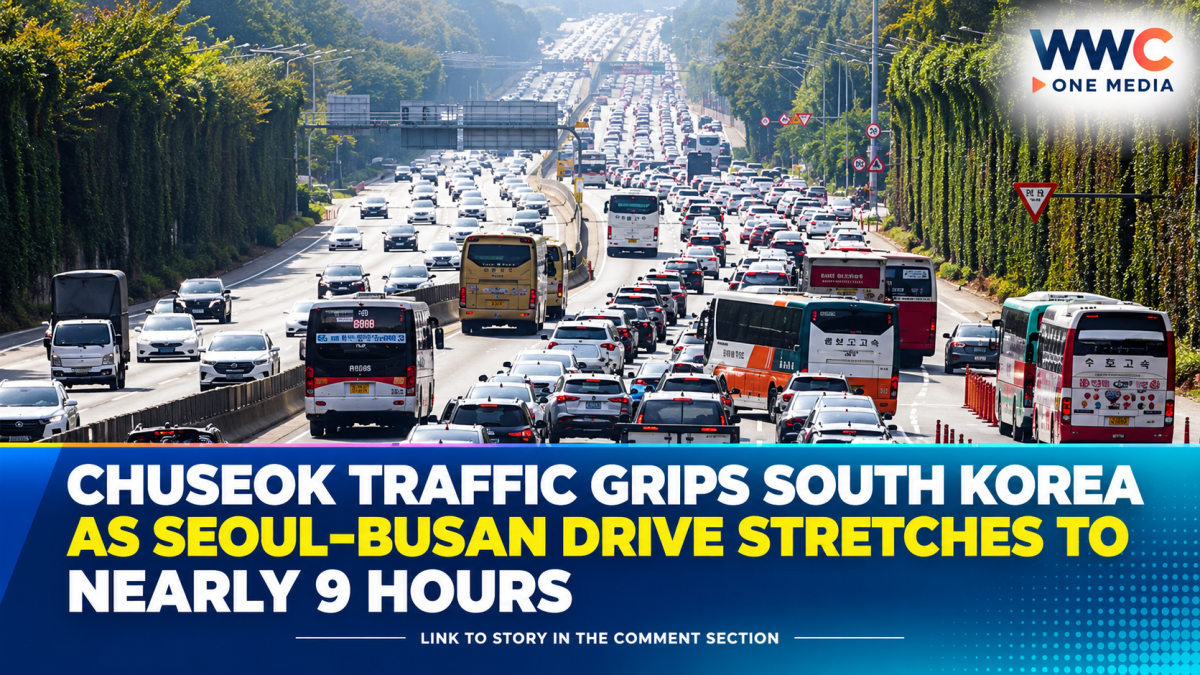
SEOUL — South Korea’s annual Chuseok homecoming rush has once again turned major highways into long stretches of bumper-to-bumper traffic, with millions of vehicles expected on the roads as families travel for the traditional harvest holiday.
On Friday, September 25 — the second day of the Chuseok holiday — the Seoul-to-Busan journey was estimated at 8 hours and 40 minutes as of 9 a.m., according to the Korea Expressway Corporation.
Other major routes were also heavily affected. From Seoul, estimated travel times were 8 hours 20 minutes to Ulsan, 7 hours 40 minutes to Daegu, 6 hours 40 minutes to Mokpo and 6 hours 10 minutes to Gwangju.
6.84 Million Vehicles Expected on the Roads
The Korea Expressway Corporation estimated that approximately 6.84 million vehicles would travel nationwide on Friday.
About 470,000 vehicles were expected to leave the greater Seoul area for other regions, while approximately 460,000 were expected to move toward the capital from elsewhere in the country.
The sheer volume reflects the importance of Chuseok, when families traditionally return to their hometowns, gather with relatives and observe ancestral traditions.
South Korea’s 2026 Chuseok holiday runs from September 24 through September 27.
When Will the Traffic Be Worst?
The Korea Expressway Corporation expects outbound traffic heading away from Seoul to reach its peak between 1 p.m. and 2 p.m. Friday before gradually easing between 7 p.m. and 8 p.m.
The return journey toward Seoul presents another major challenge.
Traffic heading back to the capital is expected to be heaviest between 3 p.m. and 5 p.m., with congestion potentially continuing until the early hours of Saturday.
Major Expressways Feeling the Pressure
The Gyeongbu Expressway toward Busan was experiencing slow-moving traffic along several sections, including stretches around Dongtan Junction, Namsa, Manghyang Rest Area and Cheonan Hodu Rest Area.
Heavy traffic was also reported on the Seoul-Yangyang Expressway, the Seohaean Expressway toward Mokpo and portions of the Gwangju-Wonju Expressway.
The congestion is part of a much larger holiday travel surge. South Korea’s Ministry of Land, Infrastructure and Transport designated September 23–27 as a special transportation measures period, with about 30.93 million people expected to travel during the five-day period.
Chuseok Homecoming Meets South Korea’s Biggest Traffic Test
For millions of South Koreans, the long drive is part of the annual Chuseok tradition — a journey home to reunite with family during one of the country’s most important holidays.
But with millions of vehicles converging on the country’s major expressways, the 2026 Chuseok holiday is once again demonstrating the scale of South Korea’s annual homecoming migration.
And as the outbound rush gives way to the return journey, the biggest traffic test of the holiday may still be ahead.
WWC ONE MEDIA G,A