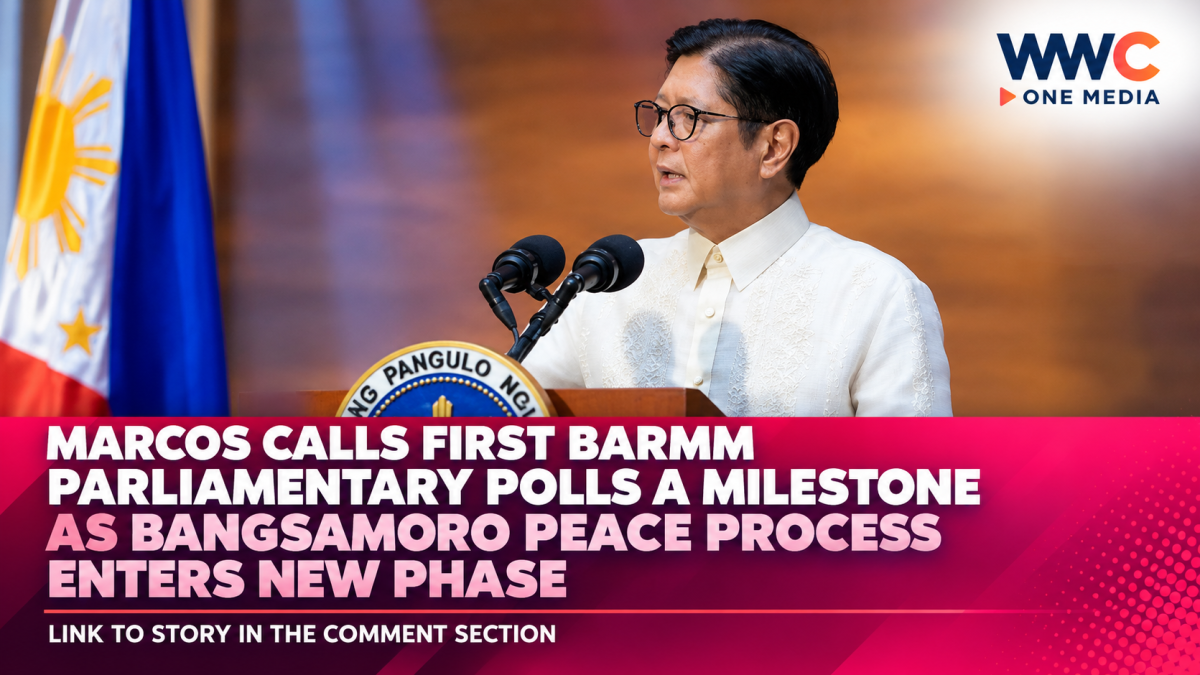
President Ferdinand Marcos Jr. has described the successful conduct of the first parliamentary elections in the Bangsamoro Autonomous Region in Muslim Mindanao as a major milestone in the region’s peace process, as the Bangsamoro moves from interim governance toward its first fully elected parliamentary government.
Marcos made the remarks after meeting Interim BARMM Chief Minister and Bangsamoro Federal Party Chairman Abdulraof Macacua at Malacañang, where they discussed the region’s political transition, development programs, public services and the continuation of the peace process.
The September 14 elections recorded an 84.34% voter turnout, with more than 2 million voters casting ballots. Comelec proclaimed all winners by September 15, completing the first regular parliamentary election for the autonomous region.
The 80-seat Bangsamoro Parliament will replace the interim governance arrangement and is expected to formally organize the region’s new parliamentary government. The newly elected members are scheduled to assume office on October 30 and will participate in the selection of a chief minister.
No single party secured an outright majority. The Bangsamoro Federal Party emerged with the largest number of seats, while the United Bangsamoro Justice Party and other regional parties also secured representation, setting the stage for negotiations and coalition-building within the new parliament.
The elections represent the completion of what the government describes as the political track of the Bangsamoro peace process. The next phase will focus in part on the normalization track, which involves sustaining peace and development gains and continuing efforts connected to the transition of former combatants into civilian and political life.
The political transition has roots stretching back decades. The 1976 Tripoli Agreement laid an important foundation for negotiations involving the Moro struggle, followed by the 1996 Final Peace Agreement with the Moro National Liberation Front and the 2014 Comprehensive Agreement on the Bangsamoro with the Moro Islamic Liberation Front. These developments eventually contributed to the creation of BARMM.
The 2026 parliamentary election also marked a significant shift in how political participation is being pursued in the region. Former combatants and groups that emerged from decades of armed conflict have increasingly entered electoral politics, with parties competing for seats in the new parliament rather than seeking political objectives through armed struggle.
During his meeting with Macacua, Marcos said the national government would continue supporting development programs and the delivery of essential services in BARMM. Both sides also discussed sustaining the normalization process as the region prepares for its new elected government.
The transition nevertheless marks the beginning of a new phase rather than the end of the peace process. The effectiveness of the new parliamentary government, the continuation of normalization efforts, delivery of public services and cooperation among political groups will shape how the region’s new institutions develop.
With the first parliamentary elections completed, the Bangsamoro now moves toward the formation of its regular elected government — putting the next stage of the peace process in the hands of the newly elected parliament and the communities it represents.