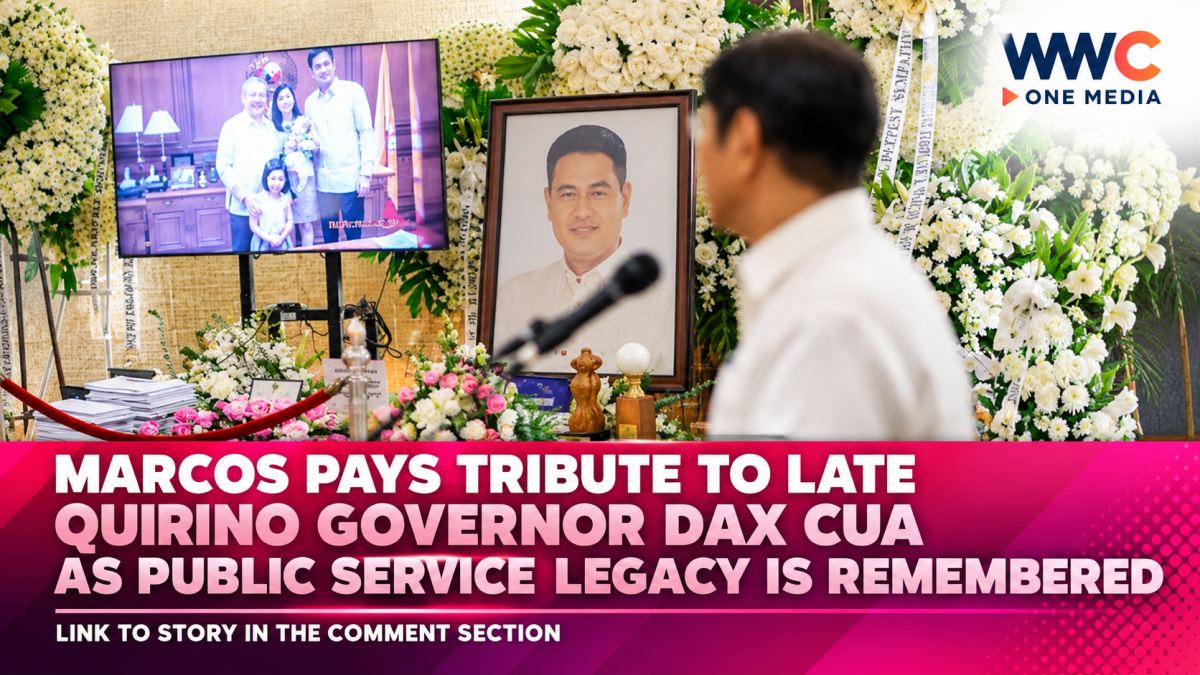
President Ferdinand Marcos Jr. has paid his final respects to the late Quirino Governor Dakila Carlo “Dax” Cua, remembering him as a valued colleague, friend and public servant who devoted 25 years to government service.
Marcos visited Cua’s wake at Heritage Memorial Park in Taguig on September 23, where he led members of the Executive and Cabinet in offering condolences to the governor’s family. Cua died on September 15 at the age of 48.
In a message following the visit, Marcos described Cua as a colleague whose work he valued and relied on, as well as a friend. He extended his condolences to Cua’s wife, Quirino Rep. Midy Cua, his parents Junie and Angela Cua, and his three children.
Marcos also highlighted Cua’s long career in public service, saying his legacy would remain closely tied to Quirino, particularly to the communities he helped build and the people whose lives were affected by his work.
Cua entered politics in 2001 at the age of 23, when he was elected vice governor of Quirino. He later served as governor, represented the province’s lone congressional district from 2010 to 2019, and returned as governor in 2019.
During his years in Congress, Cua held leadership positions in the House and was involved in legislation covering taxation, rice policy, competition and government services. He also served in national and regional organizations representing local governments, including the Union of Local Authorities of the Philippines and United Cities and Local Governments Asia-Pacific.
Cua’s family later disclosed that he had been diagnosed with lung cancer in 2024. Despite his illness, he continued his work as governor and in local-government organizations until his death.
His death has also triggered a transition in the Quirino provincial government. Vice Governor Julius Caesar “Jojo” Vaquilar succeeded Cua as governor under the succession provisions of the Local Government Code, while the highest-ranking member of the provincial board is set to assume the vice-goubernatorial post.
The Commission on Elections has said no special election is needed for the governorship because the vacancy can be filled through the statutory succession process.
As Quirino mourns Cua’s passing, attention now turns to the transition of provincial leadership and the continuation of programs and responsibilities left by a governor who spent more than two decades in public service.