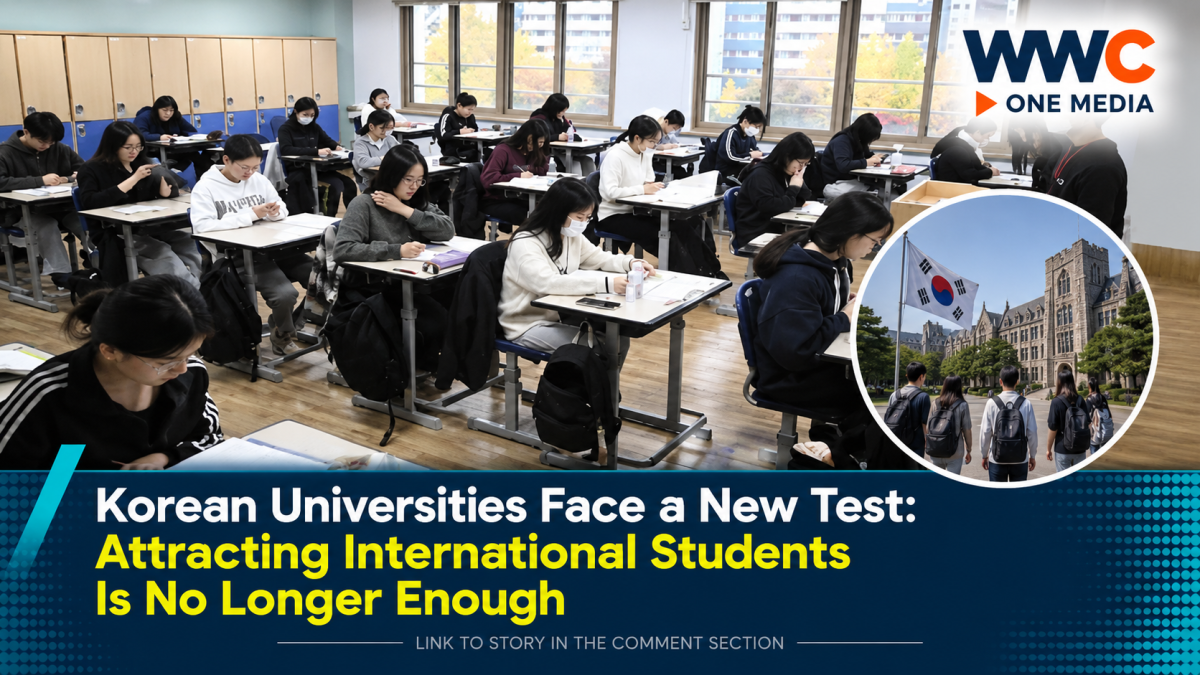
SEOUL — South Korea’s universities are entering a new phase in their race to become more international — and simply increasing the number of foreign students may no longer be enough.
The country’s international student population has surged past 300,000, reaching about 307,000 in April 2026, according to the Ministry of Education. That milestone came ahead of the government’s original 2027 target and has prompted a policy shift from expanding enrollment to improving the quality of international education and long-term outcomes.
The issue is highlighted by The Korea Times University Rankings 2027, released September 18. The ranking evaluates Korean universities not simply by how many foreign students they attract, but by how effectively they build a broader ecosystem for internationalization.
This year’s assessment covered 60 universities and 19 indicators, with a total score of 200 points. Globalization-related indicators account for 65% of the overall assessment.
The next challenge: What happens after students arrive?
The latest evaluation shows a significant gap between attracting international students and giving them the support needed to succeed.
Universities performed relatively strongly in education, but the average scores were considerably lower in student support and graduate outcomes.
Across the 60 institutions, the average score was 35.97 out of 70 in education, compared with 14.84 out of 40 in student support and only 12.85 out of 40 in graduate outcomes.
The results suggest that the internationalization conversation is shifting from the size of a university’s foreign-student population to the quality of the entire student experience.
That includes helping students remain enrolled, access financial and academic assistance, integrate into campus life and eventually transition into employment or wider society.
International faculty remain a weak spot
One of the clearest gaps identified in the 2027 assessment is the presence of international full-time faculty.
The Korea Times introduced a new 10-point indicator this year measuring the proportion of international full-time faculty. Universities recorded an average of only 33.3% of the maximum possible score on that measure.
The finding matters because internationalization is not only about bringing foreign students onto Korean campuses.
A genuinely international university also requires diverse faculty, international research networks and an academic environment in which students can engage with scholars and perspectives from outside Korea.
Research is another major gap
International research collaboration is also emerging as an important weakness.
Universities in the ranking averaged 22.31 out of 50 points in research, while the average performance for overseas research funding was only about 27.4% of the maximum score.
Notably, 22 of the 60 universities received no research funding from foreign governments or overseas institutions, according to the evaluation.
That points to a broader challenge: universities may be increasing international enrollment faster than they are building the global research partnerships needed to support a truly international academic ecosystem.
Korea’s policy is changing, too
The government’s approach is moving in the same direction.
On September 8, the Ministry of Education announced a strategy designed to shift international-student policy from quantity to quality.
Rather than continuing to set numerical recruitment targets, the government plans to put greater emphasis on educational quality, talent development, management and students’ ability to establish careers and lives in Korea.
Universities that fail to meet basic standards could face tighter restrictions on recruiting new international students in the future.
The government has also strengthened its International Education Quality Assurance System (IEQAS). Certified universities are assessed on areas including international-student recruitment, support, management and outcomes, while certification can provide benefits such as simplified visa screening.
At the same time, 20 Korean universities face student-visa issuance restrictions beginning with the September 2026 semester, according to Korea JoongAng Daily. The restrictions apply to both degree-program D-2 visas and language-training D-4 visas.
Korea University holds the top spot
The shift comes as competition among Korean universities for global recognition intensifies.
Korea University retained the No. 1 position in The Korea Times University Rankings 2027, scoring 149.52 out of 200.
It was followed by Seoul National University at 142.22 and Yonsei University at 140.74. Sungkyunkwan University, Hanyang University and Sogang University completed the top six.
Sejong University recorded the biggest move in the top 10, climbing from 13th to seventh. Its education score increased substantially, while its research performance remained among the stronger results in the assessment.
The rankings themselves are deliberately different from conventional global university tables because they place much greater weight on internationalization.
That distinction is important. In the QS World University Rankings 2027, for example, Seoul National University ranked 38th globally, Yonsei 42nd and Korea University 52nd.
The foreign-student boom is changing the stakes
South Korea’s foreign-student population has grown rapidly, from around 182,000 in 2023 to 209,000 in 2024, 253,000 in 2025 and 307,000 in April 2026.
The government has therefore reached a point where maintaining growth in enrollment is no longer the only objective.
The Ministry now wants universities to focus more heavily on whether international students receive meaningful education, find appropriate employment opportunities and are able to contribute to Korean society after graduation.
That could be particularly important for universities outside Seoul, where attracting and retaining international talent could help address regional demographic and economic challenges.
Some universities are already building larger international programs. Keimyung University, for example, welcomed 1,414 international students from 33 countries for its 2026 academic year Korean-language program and reported approximately 4,100 international students across its various programs.
The next definition of a “global university”
The direction of Korean higher education is becoming clearer.
The question is no longer simply:
“How many international students can a university attract?”
It is increasingly:
“How well can that university educate, support and retain international talent?”
The Korea Times plans to expand its evaluation further, adding indicators related to settlement infrastructure and international research diversity in the next assessment. From 2028, the ranking is also expected to incorporate international-student satisfaction surveys and tracking of international graduates’ outcomes.
For Korean universities, that could make the next stage of internationalization much more demanding.
Recruitment can bring students through the gate.
But faculty diversity, research partnerships, financial and academic support — and what happens to students after graduation — may ultimately determine whether Korea’s universities can turn the country’s foreign-student boom into lasting global competitiveness.