
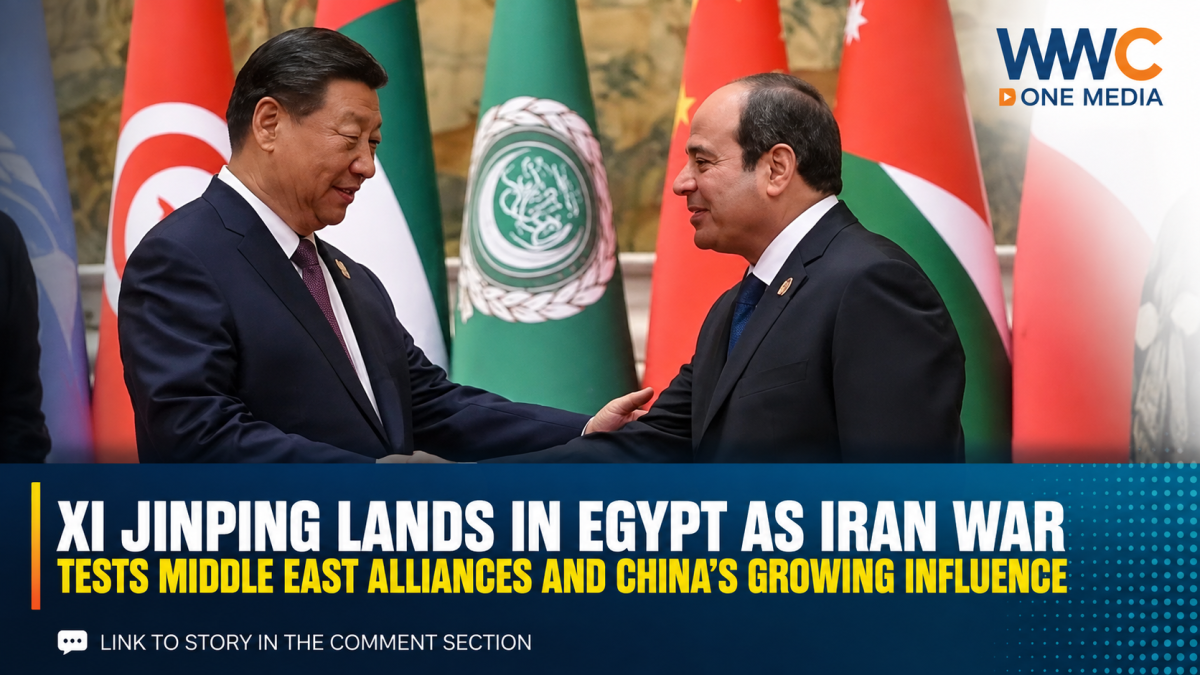
CAIRO — Chinese President Xi Jinping has arrived in Egypt for his first state visit to the country in a decade, stepping into a Middle East reshaped by the ongoing Iran war, disrupted trade routes and growing questions over the region’s long-term security partnerships.
Xi was welcomed by Egyptian President Abdel Fattah al-Sisi in Cairo on Sept. 1. The visit comes as Egypt seeks to maintain strong relations with Washington while simultaneously expanding its strategic and economic partnership with Beijing.
The timing is significant. The conflict involving Iran has disrupted energy markets and maritime trade while raising concerns among regional governments about their economic and security exposure. Against that backdrop, China is presenting itself as a major diplomatic and economic partner rather than simply an outside observer.
Why Xi’s Egypt visit matters
This is Xi’s first visit to Egypt since 2016 and comes as the two countries mark 70 years of diplomatic relations.
Beijing and Cairo have described their relationship as a comprehensive strategic partnership, with cooperation spanning infrastructure, manufacturing, energy, technology and trade. Xi said ahead of the visit that the two countries should deepen their partnership and work together on regional and international issues.
Egypt is particularly important to China because of its location. The country controls the Suez Canal, one of the world’s most important shipping corridors linking the Mediterranean with the Red Sea and Asian markets.
Chinese companies have already established a significant presence in Egypt, including in the Suez Canal Economic Zone, infrastructure and industrial projects. AP reported that Chinese investment in Egypt has surpassed US$10 billion, while bilateral trade is around US$20 billion annually.
China and Egypt are also deepening military ties
The relationship is no longer limited to economics.
In August, Egypt and China conducted their second annual joint air exercise, Eagles of Civilization 2026. Chinese J-16 fighter jets participated, marking their first deployment to Africa, according to Chinese state media and Egyptian authorities. The drills also involved French-made Rafale fighters operated by Egypt.
That does not mean Egypt is abandoning the United States. Cairo remains a major US security partner and receives roughly US$1.3 billion annually in US military assistance.
Instead, analysts describe Egypt’s approach as an attempt to increase strategic autonomy — maintaining its relationship with Washington while developing stronger ties with China, Russia and Europe.
Iran war adds another layer to the summit
The timing of Xi’s visit is perhaps the most important element.
China is a major buyer of Iranian oil and has repeatedly called for a diplomatic solution to the Iran conflict. At the same time, Washington has threatened additional economic pressure against countries and institutions supporting Tehran, creating potential risks for Chinese and Egyptian financial interests.
Egypt has its own reasons for wanting the conflict contained.
The country depends heavily on regional stability and the movement of ships through nearby waterways. Disruptions affecting the Red Sea, the Strait of Hormuz or wider Middle Eastern trade routes can have significant consequences for Egypt’s economy and the Suez Canal.
CNA reported that Xi and Sisi are expected to discuss the fallout from the US-Iran war as well as agreements involving artificial intelligence, transport and energy. Beijing is also looking to expand investment in the Suez Canal Economic Zone.
Is China replacing America in the Middle East?
That may be too simplistic.
The more significant development is that countries such as Egypt appear increasingly interested in diversifying their strategic relationships rather than choosing one superpower over another.
AP described Xi’s visit as part of China’s broader effort to expand its influence in the Middle East and portray Beijing as a stabilizing force. Reuters likewise reported that Egypt is seeking stronger ties with Beijing amid concerns about the reliability and volatility of US policy.
Egypt’s position gives it unusual strategic importance. It borders Israel, Libya and Sudan, controls the Suez Canal and maintains relationships with both Western and non-Western powers.
That makes Cairo a valuable partner for Beijing as China expands its diplomatic and economic footprint across the Middle East and Africa.
Gaza, Iran and regional security on the agenda
The summit is also expected to touch on some of the region’s most sensitive issues, including the war in Gaza, Iran and shipping security around the Red Sea and Strait of Hormuz.
China and Egypt have publicly supported Palestinian statehood and called for political solutions to regional conflicts. Xi has also emphasized cooperation between China and Egypt as members of the Global South.
But Beijing’s growing influence does not automatically translate into the ability to end the Iran war or resolve the region’s conflicts.
Instead, Xi’s visit demonstrates something potentially more consequential: China is positioning itself to have a larger voice in whatever political and economic order emerges after the current Middle East crisis.
The bigger geopolitical picture
Xi’s Cairo visit comes after his participation in the Shanghai Cooperation Organisation summit in Kyrgyzstan, where he met leaders including Russian President Vladimir Putin. It is his second overseas trip of the year, according to China’s Foreign Ministry.
For Egypt, the message is equally clear: Cairo wants options.
The country can continue receiving security support from Washington while attracting Chinese investment, maintaining ties with Russia and strengthening relationships with other emerging powers.
For China, Egypt offers something few countries can match — a strategic gateway connecting Asia, Africa, the Arab world and European trade routes.
And with the Iran war continuing to expose vulnerabilities in the region’s energy and shipping networks, that geographic advantage has become even more valuable.
The real question now
Xi’s arrival in Cairo is about more than a ceremonial state visit.
It is a test of how far China can expand its influence while Middle Eastern governments reassess their relationships with Washington — and how much strategic space Egypt can create between the world’s two biggest powers.
If the current regional crisis continues, Xi’s Egypt visit could mark the beginning of a much bigger shift in how Middle Eastern countries balance China and the United States.
WWC ONE MEDIA J.M.D



Leave a Reply