
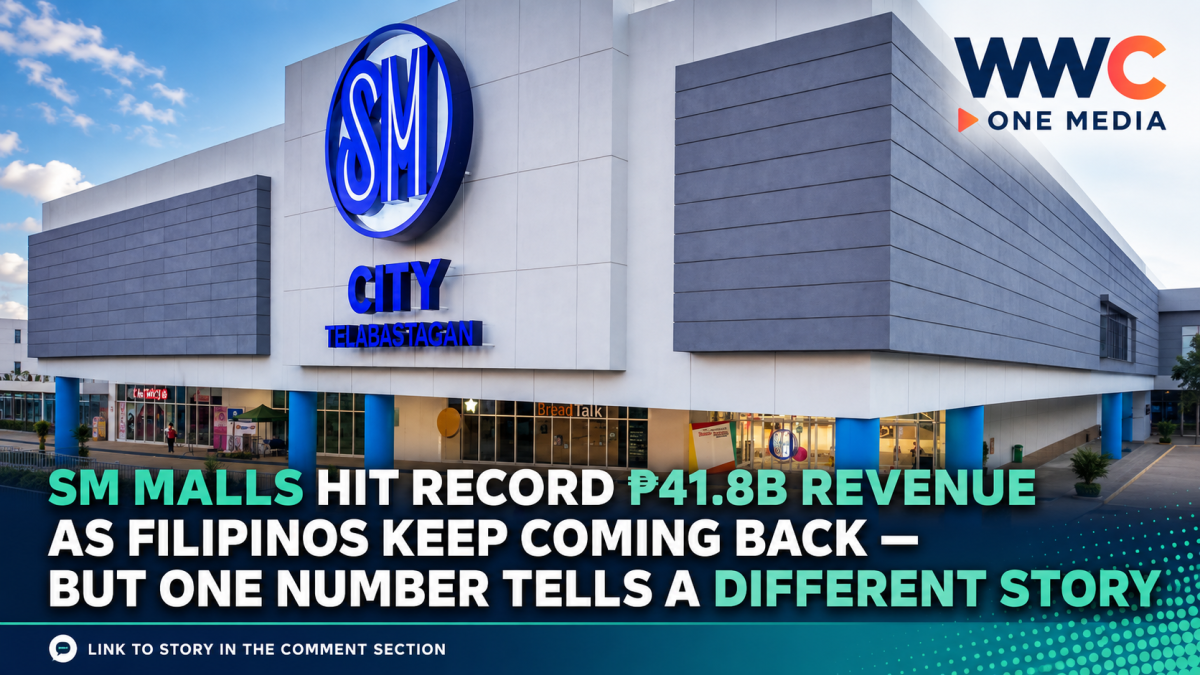
MANILA, Philippines — At a time when inflation, cautious household spending and economic uncertainty are forcing consumers to think twice before opening their wallets, SM Supermalls has delivered a striking counterpoint: Filipinos are still going to the mall — and businesses are still competing for space inside them.
SM Supermalls generated a record ₱41.8 billion in mall revenue during the first half of 2026, an 8% increase from ₱38.6 billion a year earlier, according to figures reported by InsiderPH and confirmed in SM Prime Holdings’ official financial disclosures.
The performance was supported by higher occupancy, stronger tenant sales and improved operating efficiency, according to SM Prime, the listed property company behind the country’s largest mall network.
But there is another number investors may want to watch.
Despite the record performance of the malls, SM Prime’s overall first-half net income remained flat at ₱24.5 billion, as rising expenses offset the company’s revenue gains.
That contrast tells a bigger story about one of the Philippines’ most recognizable consumer businesses: malls remain SM Prime’s growth engine, but the broader property group is still navigating higher operating and construction costs and weakness in parts of its residential business.
More tenants, more space — and 3.7 million daily visitors
SM Supermalls expanded its gross leasable area by roughly 3% to 5.1 million square meters during the first half.
Its tenant count increased 4% to 23,174 businesses, from 22,192 a year earlier.
Perhaps more telling is what did not decline.
Average daily foot traffic held at approximately 3.7 million visitors, despite pressure on household budgets and what analysts have described as a challenging consumer environment.
Separate analysis cited by Philstar showed mall occupancy at around 96%, while tenant sales increased about 8% during the period — evidence that SM’s growth was not simply the result of adding more floor space.
That matters because the modern shopping mall is fighting a very different battle from the one it faced a decade ago.
The competition is no longer another mall across town.
It is e-commerce, food-delivery apps, streaming services, social commerce and practically every digital platform capable of giving consumers a reason to stay home.
SM’s answer appears to be straightforward: give people more reasons to visit that have little to do with traditional shopping.
From shopping centers to places where people spend their day
That strategy is increasingly visible across SM properties.
The company has been adding sports, wellness, entertainment and community-focused activities designed to increase engagement and turn malls into destinations rather than simple retail centers.
One of the clearest examples is pickleball.
SM’s mall-based pickleball network had expanded to 102 courts across 32 malls by August, according to BusinessMirror, reflecting the company’s growing investment in sports-oriented spaces.
SM also partnered in the Galaxy Manila Marathon, which drew roughly 25,000 runners for a historic route along EDSA in June.
Samsung, one of the event’s major partners, confirmed that the race brought 25,000 participants together for what organizers described as the first full marathon route traversing EDSA end-to-end.
These ventures may look far removed from leasing stores, but commercially they address one of the biggest challenges confronting physical retail: getting consumers through the doors and giving them reasons to stay longer.
The mall business is carrying more of SM Prime’s weight
SM Prime’s consolidated results underline just how important that recurring mall income has become.
The property giant generated ₱71.7 billion in total first-half revenue, up 5% from ₱68 billion a year earlier.
Rental income from malls, offices, hotels and convention properties accounted for 61% of revenue.
By contrast, residential revenue slipped about 1% to ₱20.6 billion, while hotels and convention-center revenue climbed to ₱4.4 billion and office and warehouse revenue increased to ₱5 billion.
Costs and expenses, however, rose nearly 6% to ₱35.6 billion, driven partly by depreciation, fixed overhead and construction expenses.
That was enough to keep first-half net profit essentially unchanged at ₱24.5 billion even as the company’s malls continued expanding.
In other words, the record mall revenue is impressive — but the larger SM Prime earnings picture remains more complicated.
SM is preparing an even bigger bet
The next phase could be considerably more ambitious.
SM Supermalls has outlined an investment program exceeding ₱150 billion through 2030, covering 16 major mall redevelopments and 12 new lifestyle malls.
BusinessWorld reported that roughly half of the planned spending is intended for new malls, with the remainder going toward expansion and redevelopment of existing properties.
The company plans to open a flagship development each year through 2030 while modernizing some of the biggest properties in its existing portfolio.
First in that flagship pipeline is SM Nuvali in Santa Rosa, Laguna.
GMA News reported that the mall is scheduled to open on November 27, 2026, becoming SM’s 91st mall.
Among its headline attractions is a one-hectare indoor garden, part of SM’s attempt to combine shopping, dining, recreation and green spaces within a single destination.
The project is particularly significant because Nuvali sits inside one of the fastest-developing economic and residential corridors south of Metro Manila.
It also offers a glimpse at what SM thinks the next generation of Philippine malls should look like.
Brand power remains another advantage
SM’s physical expansion is being matched by strong brand recognition.
Brand Finance ranked SM Supermalls as the Philippines’ strongest brand in 2026, giving it a Brand Strength Index score of 95.3 out of 100 and maintaining its AAA+ rating.
The consultancy said the brand performed particularly strongly in familiarity, consideration, credibility and customer advocacy.
That kind of brand strength becomes especially valuable when consumers have more choices — both online and offline — than ever before.
The bigger question
The first-half numbers suggest the Philippine mall is far from dead.
If anything, SM’s results indicate that the winning formula may simply be changing.
People may visit less often purely to buy a shirt or a pair of shoes. But give them restaurants, cinemas, sports, community events, green spaces, entertainment and experiences they cannot download to a phone, and they may still show up by the millions.
SM Supermalls appears to be betting more than ₱150 billion that this behavior will continue.
For now, its record ₱41.8-billion first-half mall revenue suggests the strategy is working.
The real test will come as SM opens another generation of malls and pours billions into reinventing its older properties — while consumers become increasingly selective about where, and how, they spend their money.
WWC ONE MEDIA MJE



Leave a Reply