
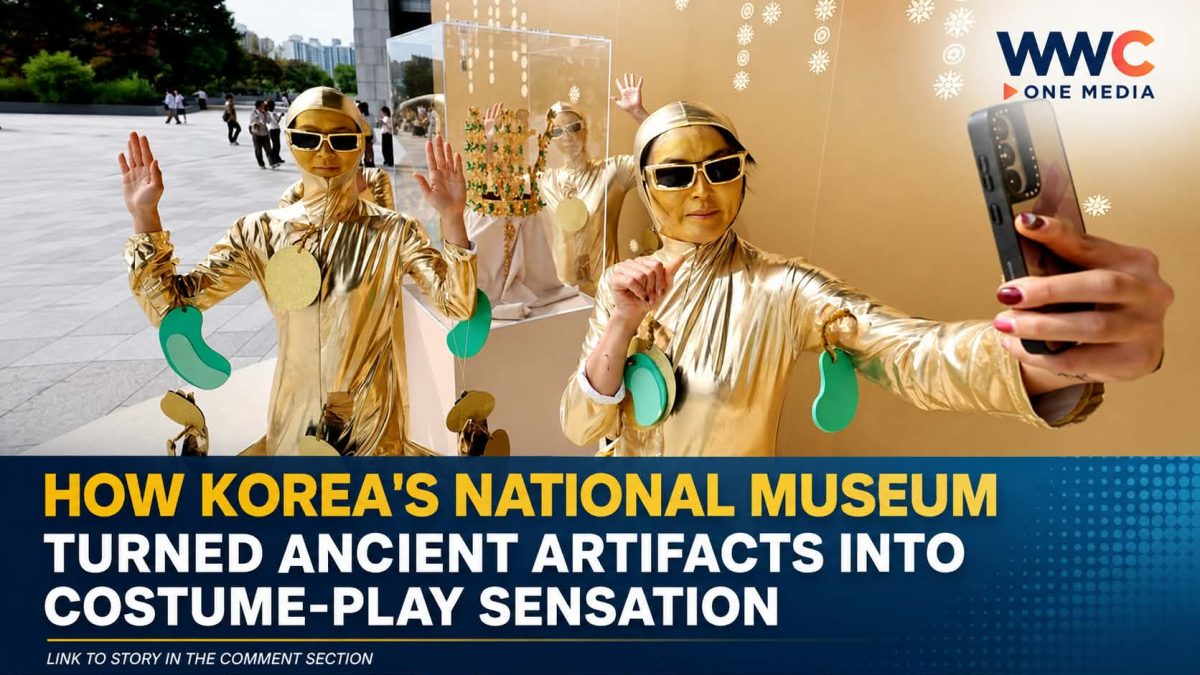
From Buddhist sculptures to Bronze Age bells, Koreans are stepping inside the museum’s most recognizable treasures—and the unusual idea is turning cultural heritage into a viral spectator event.
For decades, museums have largely asked visitors to do one thing: look at the artifacts.
South Korea’s National Museum of Korea is asking visitors to do something very different:
Become them.
Its “Dress Like a Museum Exhibit” event has transformed cultural heritage into a participatory costume-play competition, with contestants recreating historic artifacts through clothing, makeup, props and live performances.
And in 2026, the idea has exploded.
The latest edition attracted 275 teams comprising 643 participants—more than three times the 83 teams that entered the previous year. The museum selected 50 teams for the finals, according to the National Museum of Korea and Yonhap.
What began as a relatively small museum program in 2024 has rapidly evolved into a nationwide cultural event.
THESE AREN’T ORDINARY COSPLAY COSTUMES
The contestants aren’t simply dressing up in traditional Korean clothing.
They’re recreating the objects themselves.
Among the inspirations are the famous Pensive Bodhisattva, the Baekje Gilt-bronze Incense Burner, Bronze Age ritual bells, Silla roof tiles, Goryeo objects and even the enormous Daedongyeojido map.
Some participants use body paint. Others construct elaborate wearable sculptures and props. Teams have even transformed themselves into objects that normally sit motionless behind museum glass.
One particularly striking approach has contestants reproducing the appearance and pose of the Pensive Bodhisattva by covering themselves in gold-colored makeup.
Another team interpreted a Bronze Age ritual bell as a two-person costume.
And an office-worker team recreated the distinctive smiling face of a Silla-era human-face roof tile.
The result is part museum education, part cosplay, part performance art—and highly shareable social-media content.
FROM 36 TEAMS TO A NATIONAL PHENOMENON
The numbers tell the story.
The program began in 2024 with only 36 teams.
By 2025, participation had grown to 83 teams.
This year, the number jumped to 275 teams and 643 people.
The museum has now expanded the competition beyond Seoul, bringing regional national museums into the program.
Regional rounds are being held in Chuncheon, Gongju, Daegu and Jeonju, with the national final scheduled for September 19 at the National Museum of Korea in Seoul.
The expansion was announced by the museum earlier this year as the event moved toward a nationwide format.
WHY IS IT GOING VIRAL?
The secret may be that the museum isn’t treating young audiences as passive visitors.
It is borrowing something familiar from K-pop fandom and cosplay culture: choose something you love, learn everything about it, recreate it and share your interpretation with a community.
The Korea Times described the phenomenon as a new form of heritage fandom, where museum visitors study artifacts closely before turning their interpretations into costumes and performances.
That creates an unexpected educational effect.
To accurately reproduce an artifact, participants have to examine its:
- shape
- colors
- historical period
- symbolism
- decorative patterns
- regional connections
- cultural meaning
In other words, the costume becomes the history lesson.
IT’S NOT JUST ABOUT LOOKING FUNNY
The competition’s judging system also reflects that educational goal.
According to the museum, judges consider participants’ motivation, connections to their region, understanding of the artifact, creativity, reinterpretation and potential to communicate the heritage to wider audiences.
That means a visually spectacular costume isn’t necessarily enough.
Contestants need to show that they understand what they’re recreating and why it matters.
The museum is effectively turning cultural literacy into a performance.
SOCIAL MEDIA CHANGED EVERYTHING
The transformation also fits neatly into today’s visual internet.
A traditional museum display might attract visitors who spend a few minutes studying an artifact.
A person dressed as that artifact can become a photograph, a video, a meme or a short-form social-media clip that reaches thousands of people who may never have walked into the museum.
The Korea Times reported that roughly 6,000 visitors attended the on-site event last year after photographs of contestants spread on social media.
That’s an important shift for museums.
The question is no longer simply:
“How many people visited the museum?”
It is increasingly:
“How many people interacted with the collection?”
KOREA’S MUSEUMS ARE CHANGING THE WAY PEOPLE EXPERIENCE HERITAGE
The costume competition is part of a broader effort by the National Museum of Korea to make its collections more accessible and relevant to contemporary audiences.
The Korea Times noted that the museum has increasingly positioned itself as more than a traditional institution, combining exhibitions with merchandise, photogenic spaces and cultural programs designed to attract wider audiences.
The museum’s own 2026 program confirms the nationwide expansion and describes the event as “Dress Like a Museum Exhibit.”
Meanwhile, Korean media including Yonhap, Korea JoongAng Daily and EDaily have highlighted the dramatic increase in participation and the unusual artifact-inspired designs.
THE BIGGER CULTURAL STORY
There is something much bigger happening beneath the spectacle.
Museums have traditionally protected the distance between people and objects.
This event deliberately closes that distance.
A visitor doesn’t just read about a historic artifact.
They research it.
They build it.
They wear it.
They perform it.
And then they put it in front of an audience.
That changes the relationship between a younger generation and cultural heritage.
Instead of asking:
“Why should I care about something hundreds or thousands of years old?”
The museum is giving them a different invitation:
“What if you could become it?”
And that may be why an idea that started with just 36 teams has grown into a nationwide phenomenon.
WWC ONE MEDIA G.A




Leave a Reply