
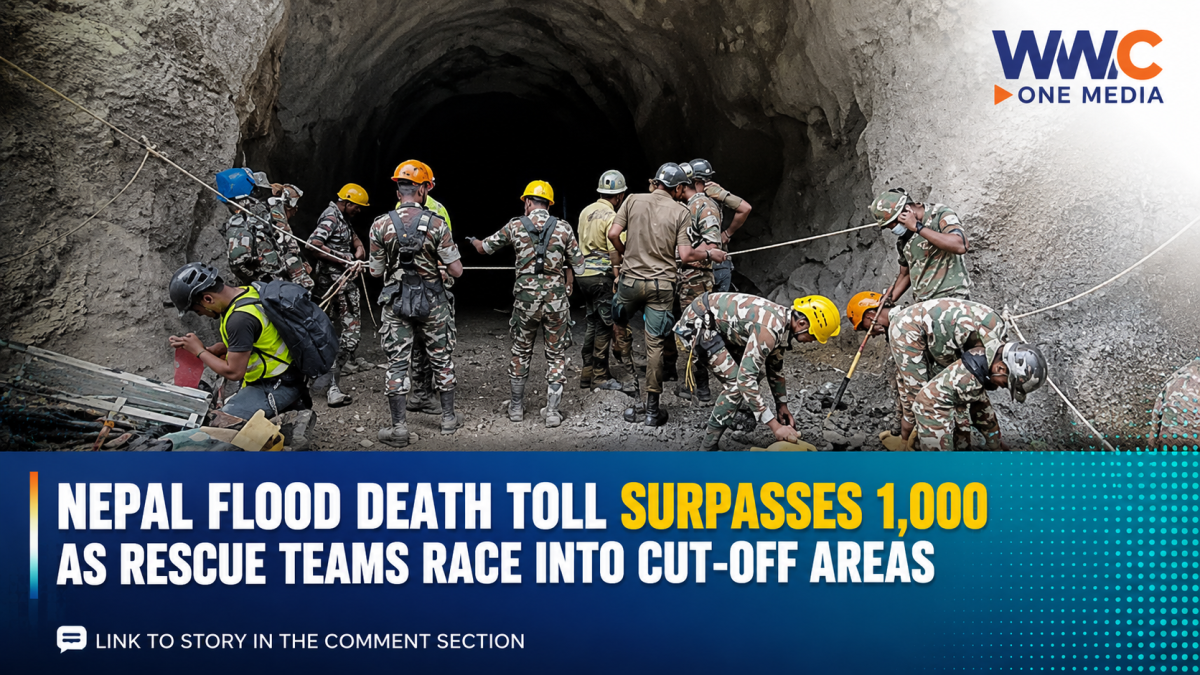
KATHMANDU — Nepal is facing one of its most devastating natural disasters in years after a glacier collapse triggered catastrophic flash floods across the Himalayan region, killing more than 1,000 people and leaving thousands still missing.
The disaster began on Aug. 26, when a massive collapse of ice, rock and debris in the Himalayas sent a powerful surge of water downstream through communities along the Nepal-China border. The resulting floods and landslides destroyed homes, roads, bridges and hydropower infrastructure, leaving some remote areas accessible only by helicopter or temporary bridges.
Death toll continues to change as rescuers reach remote areas
Nepal’s disaster authorities reported 1,003 deaths and 3,916 missing people in a Sept. 1 update, while a preliminary government situation report later put the death toll at 1,050. The discrepancy reflects the rapidly changing situation as rescue teams reach previously isolated areas and recover additional bodies.
Across Nepal and Tibet, the combined toll has exceeded 1,000, with China separately reporting deaths and hundreds of missing people.
More than 11,000 people have been rescued, according to Nepalese authorities, but thousands remain unaccounted for. Officials have warned that the number could change further as teams reach areas cut off by destroyed roads, landslides and debris.
Hundreds of hydropower workers remain trapped
One of the most urgent rescue operations is taking place at damaged hydropower facilities in the Himalayan region.
Authorities say roughly 900 workers from 12 hydropower projects are missing, with about 500 believed to be trapped inside tunnels. Mud and debris have filled sections of the underground facilities, making the search extremely difficult.
Rescue teams from Nepal, India and China are using excavators, helicopters and temporary bridges to reach isolated locations. Search dogs and specialized equipment are also being deployed, while rescuers carefully dig through unstable debris.
The Nepali Army has also used drones equipped with speakers to call out to people stranded in hard-to-reach locations. However, officials say drones are much less effective inside tunnels packed with mud and debris.
A disaster on an enormous scale
The United Nations Development Programme has preliminarily estimated that the disaster generated about 2.2 million tonnes of debris, illustrating the enormous challenge facing communities attempting to clear roads and rebuild.
Nepal’s government says around 1.6 million people have been affected, while more than 21,000 security personnel have been mobilized for search-and-rescue operations.
Power and communications have been restored in some locations, but damaged infrastructure continues to complicate efforts to deliver food, medical supplies and other emergency assistance.
Bodies being identified as families search for missing relatives
The scale of the disaster has created another heartbreaking challenge: identifying victims.
Authorities in Kathmandu have begun temporarily burying unidentified bodies after collecting DNA samples and other identifying information. Families of missing people have been asked to provide DNA samples and photographs to help investigators match remains with relatives.
The situation has been particularly difficult for families of foreign nationals who were in the region for trekking, tourism or religious pilgrimages. Hundreds of foreigners are among those reported missing.
International assistance expands
China has sent additional emergency supplies and plans to provide DNA-testing specialists, drones and water-purification equipment. India and South Korea have also provided specialized assistance, while international teams are supporting Nepal’s increasingly complex rescue operation.
Reuters reported that aid commitments had surpassed $42 million, underscoring the international response to the disaster.
Nepal’s PM warns of a growing climate threat
Prime Minister Balendra Shah has described the catastrophe as a warning about increasing risks in the Himalayan region and called for stronger international action on climate change.
Scientists studying satellite imagery have said the initial collapse appears to have involved the failure of bedrock beneath a glacier. The resulting rock-and-ice collapse generated an enormous surge of water and debris through river systems flowing from the Himalayas into Nepal and Tibet.
The disaster has also highlighted Nepal’s vulnerability as communities, roads and hydropower infrastructure expand in mountainous areas increasingly exposed to extreme environmental events.
The rescue race is far from over
For Nepal, the immediate priority remains finding survivors.
Thousands of people are still missing, hundreds of workers may remain underground, and rescuers are only now reaching some of the most isolated communities.
As roads are reopened and helicopters push deeper into devastated valleys, the next phase of the operation could reveal an even larger human toll — or bring a desperate race against time to find those still alive beneath the debris.
WWC ONE MEDIA J.M.D



Leave a Reply