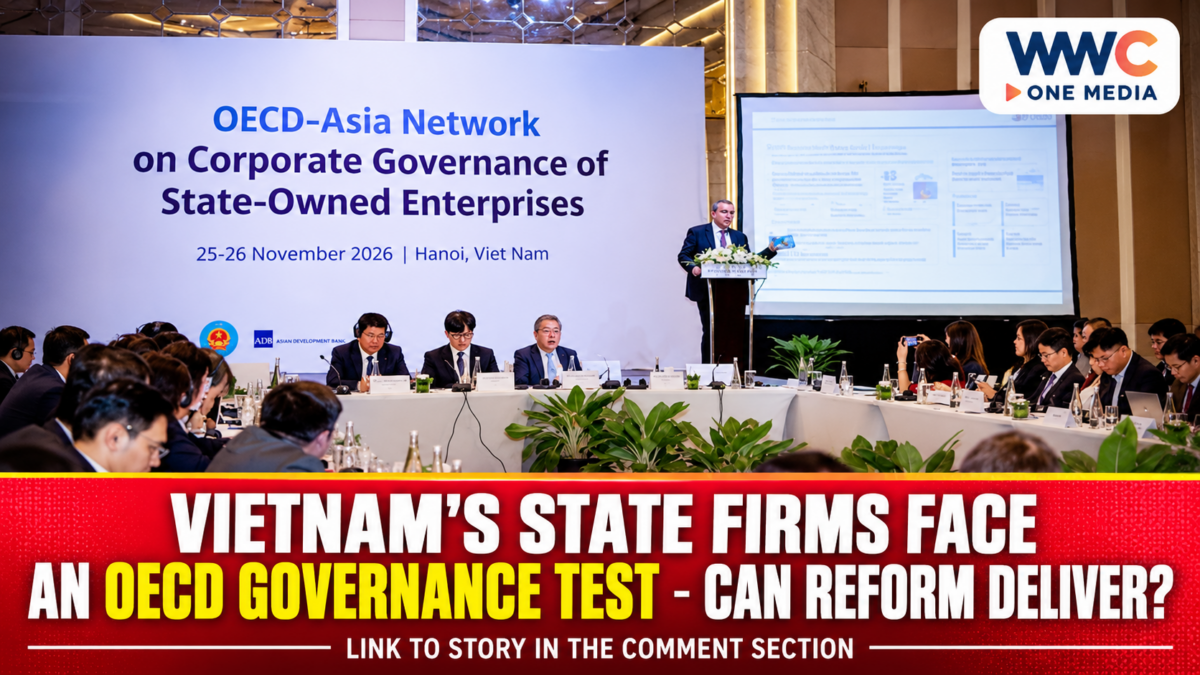
Vietnam is accelerating efforts to modernise its state-owned enterprises, but the next phase of reform may prove more difficult than setting new targets. The country wants all state-owned economic groups and corporations to apply Organisation for Economic Co-operation and Development (OECD) corporate-governance principles by 2030. The challenge is turning that commitment into stronger boards, clearer accountability, transparent public funding and fairer competition.
The issue took centre stage in Hanoi on November 25–26, when Vietnam’s Ministry of Finance and the OECD hosted the 2026 OECD-Asia Network on Corporate Governance of State-Owned Enterprises. The meeting brought together government representatives, state-owned businesses, policymakers and specialists to discuss how public enterprises can improve performance while continuing to fulfil national economic and social responsibilities.
The discussions arrive as the OECD’s latest global assessment highlights persistent weaknesses in state ownership frameworks, regulatory equality and board accountability. For Vietnam, the timing is significant: its state-owned enterprises remain important participants in strategic sectors, while the government is pursuing stronger growth, investment and economic competitiveness.
Vietnam’s 2030 target raises the stakes
Vietnam’s governance target is not simply a conference commitment. Resolution 79-NQ/TW, dated January 6, 2026, sets a goal for 100 per cent of state-owned economic groups and corporations to apply OECD governance principles by 2030.
The policy direction is intended to make state-owned enterprises more modern, transparent and professionally managed. It also reflects a broader effort to improve how the government exercises ownership over public capital invested in businesses.
The distinction matters. A government can own a company without directly managing its daily commercial decisions. Effective governance requires clear ownership objectives, capable boards, measurable performance expectations and transparent reporting on how public resources are used.
Vietnam’s Ministry of Finance has identified the separation of state ownership responsibilities from regulatory and administrative functions as an important part of this process. Clearer responsibilities can reduce overlapping authority and make it easier to determine who is accountable when an enterprise underperforms.
The reform agenda also has implications for minority shareholders. Some state-owned enterprises operate with other investors, meaning that transparency, equal treatment and access to corporate information matter beyond the government itself.
OECD data exposes the wider governance challenge
The OECD’s Ownership and Governance of State-Owned Enterprises 2026 report examines practices across 58 jurisdictions. Its findings show that governance reform remains unfinished even in economies that have already introduced ownership and oversight improvements.
Only 43 per cent of surveyed jurisdictions have a single government-wide ownership policy defining the state’s objectives and rationale as an enterprise owner. The OECD also found that only 42 per cent reported separating ownership, policymaking and regulatory functions.
The competitive environment presents another challenge. Just 57 per cent of jurisdictions apply the same legal frameworks to state-owned enterprises as to private businesses. Differences can involve bankruptcy rules, public procurement, competition requirements and other regulations.
These figures are global findings, not Vietnam-specific scores. However, they help explain why the country’s reform agenda places emphasis on professionalising state ownership and strengthening accountability.
The scale of state ownership makes the issue economically important. The OECD’s dataset covered approximately 33,800 state-owned enterprises in 2024, with combined assets of US$141 trillion, equivalent to 126 per cent of global gross domestic product.
The report also found that state-owned enterprises had a lower median return on equity than non-state-owned companies across six industries examined. Their average median return on equity over 2013–2024 was 4.7 per cent, compared with 6.4 per cent for non-state-owned enterprises.
This does not mean every state-owned company performs poorly. Results vary by industry and region. But the figures reinforce the importance of measuring commercial performance alongside public-policy responsibilities.
Transparency and fair competition are central to reform
A major governance question is how governments account for the public responsibilities assigned to state-owned enterprises.
Some businesses are expected to provide essential services, maintain infrastructure or support national development objectives even when those activities do not produce the same returns as ordinary commercial operations.
The OECD argues that these obligations need transparent disclosure. Governments should identify the services required, explain their costs and disclose the compensation provided. Without clear accounting, investors and the public may struggle to distinguish commercial performance from the cost of fulfilling public mandates.
Vietnam’s own policy discussion has identified similar concerns. An analysis published by the Ministry of Finance’s National Institute for Economics and Finance points to unclear investment objectives in some enterprises, weaknesses in independent oversight, administrative intervention and differences in access to capital and support compared with private businesses.
It also identifies gaps in timely financial disclosure and the protection of minority shareholders.
These issues are important for companies operating in energy, infrastructure and industrial development. For example, Vietnam’s energy sector is attracting international investment, including the proposed Du Long LNG supply station investment involving Lithuania’s KN Energies.
The country’s industrial expansion also includes projects such as the Vietnam wind-turbine blade factory being developed by Zhuzhou Times New Material Technology. These developments illustrate why clear rules, predictable oversight and transparent corporate responsibilities matter to investors and suppliers.
The governance of state-backed utilities can also affect private companies. A recent ACEN disclosure involving a tariff dispute with Vietnam Electricity demonstrates how regulatory and commercial arrangements involving state-owned entities can have financial consequences for businesses operating in Vietnam.
The examples are not evidence that the OECD has identified problems in those individual transactions. Rather, they show why governance standards matter across a business environment where state-owned and private companies interact.
Stronger boards must translate standards into results
The OECD’s governance framework places substantial emphasis on board effectiveness. Directors need the authority, independence and expertise to oversee strategy, assess risk and hold executives accountable.
The global report found that only 54 per cent of surveyed jurisdictions require a minimum number of independent directors on state-owned enterprise boards. It also found that only 43 per cent give boards full authority to define corporate strategy, while in 47 per cent the board’s strategy remains subject to approval by the state shareholder.
For Vietnam, applying OECD principles will therefore require more than updating corporate manuals or introducing new reporting templates. It will involve practical changes in appointments, board responsibilities, performance evaluation, audit controls and disclosure.
The country’s November conference placed these questions within a wider regional discussion. Its programme included Vietnam’s reform experience, sustainability in state ownership, board effectiveness, transparency in public-policy obligations and enterprise risk management.
These subjects are closely connected. A board cannot properly assess financial performance if public-service costs are unclear. Investors cannot evaluate risk if material information is incomplete. And competition becomes harder to assess when state support is not transparently disclosed.
What happens next?
Vietnam’s 2030 target provides a measurable deadline, but the more important test will be whether reforms change how state-owned businesses are managed.
Progress will depend on clearer ownership policies, stronger separation of government functions, more effective boards and consistent disclosure of financial performance and public-policy obligations.
The OECD’s regional network can support that process through technical assistance, policy advice and the exchange of experience. But implementation ultimately rests with Vietnam’s institutions and the enterprises expected to adopt the standards.
The central question is no longer whether Vietnam wants its state-owned enterprises to follow international governance principles. It is whether those principles will become visible in corporate decisions, public accountability and market competition before 2030.
Frequently asked questions
What is Vietnam’s target for state-owned enterprise reform?
Vietnam aims for 100 per cent of its state-owned economic groups and corporations to apply OECD corporate-governance principles by 2030 under Resolution 79-NQ/TW.
What did the OECD’s 2026 report find?
Across 58 jurisdictions, 43 per cent had a single government-wide ownership policy, while 57 per cent applied the same legal frameworks to state-owned enterprises as to private businesses.
Why does SOE governance matter to investors?
Governance affects financial disclosure, board accountability, risk management, public subsidies and whether state-owned and private businesses compete under fair conditions.
Does the OECD report say Vietnam failed its governance standards?
The global report assesses practices across 58 jurisdictions. Its headline percentages are not Vietnam-specific scores. Vietnam’s own reform priorities and challenges are discussed separately in national policy materials and at the Hanoi conference.