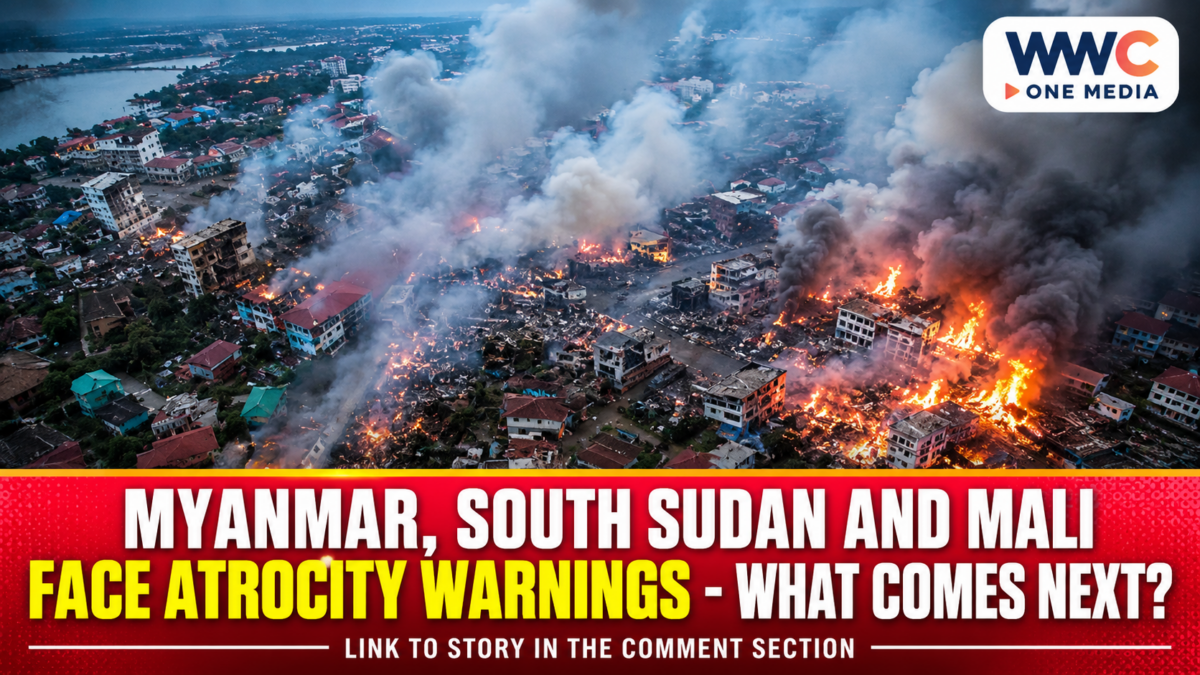
INTERNATIONAL — A landmark genocide judgment against Myanmar, renewed insecurity in South Sudan and attacks affecting civilians and medical facilities in Mali are putting international accountability and civilian protection under renewed pressure.
The three situations are different, but they share a critical question: can governments and international institutions turn warnings, legal decisions and diplomatic commitments into meaningful protection for people facing violence?
The Global Centre for the Responsibility to Protect raised these concerns in its Nov. 25, 2026, Atrocity Alert No. 504, covering Myanmar, South Sudan and Mali. Its assessment comes as the International Court of Justice (ICJ) has issued a historic ruling on the Rohingya genocide, South Sudan faces a fragile political transition and humanitarian organisations report deadly attacks in Mali.
The developments show why atrocity prevention cannot depend on statements alone. Accountability, access to justice, political inclusion and the protection of civilians remain essential tests.
Myanmar: ICJ Delivers a Landmark Genocide Judgment
The most significant legal development concerns Myanmar’s treatment of the Rohingya.
On Nov. 19, the ICJ ruled that Myanmar committed genocide against the Rohingya group in northern Rakhine State during the 2017 clearance operations. The Court reached that finding by nine votes to six in the case brought by The Gambia under the Genocide Convention.
The judgment also found that Myanmar violated its obligations to prevent genocide, punish genocide and enact legislation giving effect to the Convention. It further found that Myanmar failed to comply with an earlier order requiring effective measures to preserve evidence related to allegations of genocide.
The Court ordered Myanmar to take immediate and effective steps to investigate people reasonably suspected of involvement in the 2017 crimes and, where warranted, prosecute and punish them. It also ordered restitution measures, compensation for damage not remedied through restitution and guarantees against repetition.
The amount and arrangements for compensation have not yet been settled. Myanmar must submit a report to the Court within two years of the judgment addressing the required measures.
The ruling establishes the responsibility of the state under international law. It does not amount to criminal convictions of individual military officers or government officials.
That distinction matters. A judgment against a state creates binding legal obligations, but individual criminal responsibility requires separate proceedings.
The ruling also does not automatically make conditions safe for Rohingya refugees to return. The continuing conflict and discrimination in Rakhine State remain central to the question of whether return can be safe, voluntary and dignified.
WWC previously examined the ICJ judgment and the challenge of making safe Rohingya return possible. The next test is whether the legal finding produces practical remedies and stronger protection.
South Sudan: Political Uncertainty Meets Local Violence
South Sudan’s political transition remains fragile as preparations for its first national elections face serious challenges.
In a Nov. 10 briefing to the United Nations Security Council, Anita Kiki Gbeho, the UN Secretary-General’s Special Representative and head of the UN Mission in South Sudan (UNMISS), said the political consensus surrounding the transition had become increasingly fragile.
She identified concerns involving security arrangements, election logistics, the National Elections Commission’s ability to deliver the vote within a compressed timeframe and outstanding provisions of the 2018 Revitalized Peace Agreement.
The political environment has also changed significantly. The Transitional Government of National Unity was dissolved on Sept. 22 and replaced by a caretaker administration. Some opposition groups remained outside the inter-party dialogue, while the SPLM/A-IO maintained that the release of Riek Machar was a prerequisite for its participation.
The security situation adds another layer of concern.
On Nov. 23, UNMISS reported that an armed attack on the Bol-Bol cattle camp in Tonj East County, Warrap State, on Nov. 21 had been followed by further clashes. The mission said casualty figures had yet to be verified, while families had been forced to flee their homes.
UNMISS deployed a peacekeeping patrol and said it was engaging state, county and local authorities to help prevent further violence.
The mission’s Nov. 10 briefing had already warned that communal violence was a major source of civilian harm, accounting for more than 60% of reported casualties that year.
This makes the political transition more than an electoral timetable issue. Without credible dialogue, functioning institutions and local security, an election alone cannot resolve the divisions that threaten communities.
Mali: Attacks Put Healthcare and Civilians at Risk
In Mali, recent attacks have raised urgent concerns about the safety of civilians and medical facilities.
On Nov. 21, attacks targeted the village of Arabebe near Niafounké in northern Mali and Niono in the central Ségou Region.
Médecins Sans Frontières (MSF) reported that two people were killed, including a health worker. Two health workers, two caregivers and a child under five were wounded inside the Niono hospital.
The referral health centre in Niono, where MSF teams work alongside the Ministry of Health, was hit during violent clashes involving gunfire and heavy weapons.
MSF teams and Ministry of Health colleagues treated 26 wounded people. The hospital’s intensive care unit became unusable, other departments sustained partial damage and all four of the facility’s water tanks were damaged.
The consequences extend beyond the immediate casualties. Damage to an intensive care unit and water infrastructure can reduce a hospital’s ability to treat patients long after the attack itself has ended.
In Arabebe, three children aged between seven and eleven were treated at the Niafounké health centre following a drone attack in the village.
These incidents come amid a wider pattern of reported civilian harm in Mali. A separate October investigation by Human Rights Watch documented apparent indiscriminate drone attacks by Malian forces, including a July strike that damaged a health facility in Talahandak and an August attack on a market in Tombonkore that killed six civilians and injured at least 20 others.
Those earlier findings are separate from the Nov. 21 incidents and should not be treated as proof of responsibility for the latest attacks.
The increasing use of drones in conflict raises difficult questions about target identification, civilian protection and accountability. WWC has also examined the civilian consequences of expanding drone attacks in Sudan, a separate conflict that illustrates how aerial attacks can threaten essential services and civilian infrastructure.
Why Accountability Must Go Beyond Warnings
The three situations demonstrate different stages of the atrocity-prevention challenge.
In Myanmar, the international court has made a landmark legal finding and specified obligations that the state must fulfil. The challenge now is implementation, including investigations, remedies and protection for the Rohingya.
In South Sudan, the central concern is preventing political divisions and local violence from undermining the transition. The UN has stressed that elections cannot replace dialogue or implementation of the peace agreement.
In Mali, the immediate concern includes protecting civilians, medical workers and health facilities from attacks. Independent investigations and credible accountability are necessary to establish responsibility for unlawful acts.
The regional diplomatic response also matters. ASEAN leaders have continued to call for civilian protection in Myanmar while acknowledging insufficient progress in implementing the bloc’s Five-Point Consensus. WWC’s coverage of ASEAN’s demands for stronger civilian protection and its decision to maintain restrictions on Myanmar’s political representation provides further context on the regional response.
However, diplomatic pressure and legal decisions must be matched by measurable changes: fewer attacks on civilians, safer humanitarian access, meaningful investigations and conditions that allow displaced people to live without fear.
What Happens Next?
The next developments will test whether international commitments can translate into practical protection.
For Myanmar, attention will turn to compliance with the ICJ judgment, investigations into suspected perpetrators and the Court’s future consideration of reparations.
For South Sudan, the priorities include preventing further communal violence, restoring political dialogue, strengthening election preparedness and implementing outstanding commitments under the peace agreement.
For Mali, the immediate requirements include protecting healthcare facilities and civilians, investigating attacks and ensuring that medical services can continue operating in affected communities.
The three crises are not interchangeable, and their legal circumstances are different. But each demonstrates the consequences when civilian protection, political accountability and justice remain unresolved.
The central question is no longer simply whether the international community recognises the risks. It is whether governments and international institutions will act early enough, and consistently enough, to prevent further harm.