
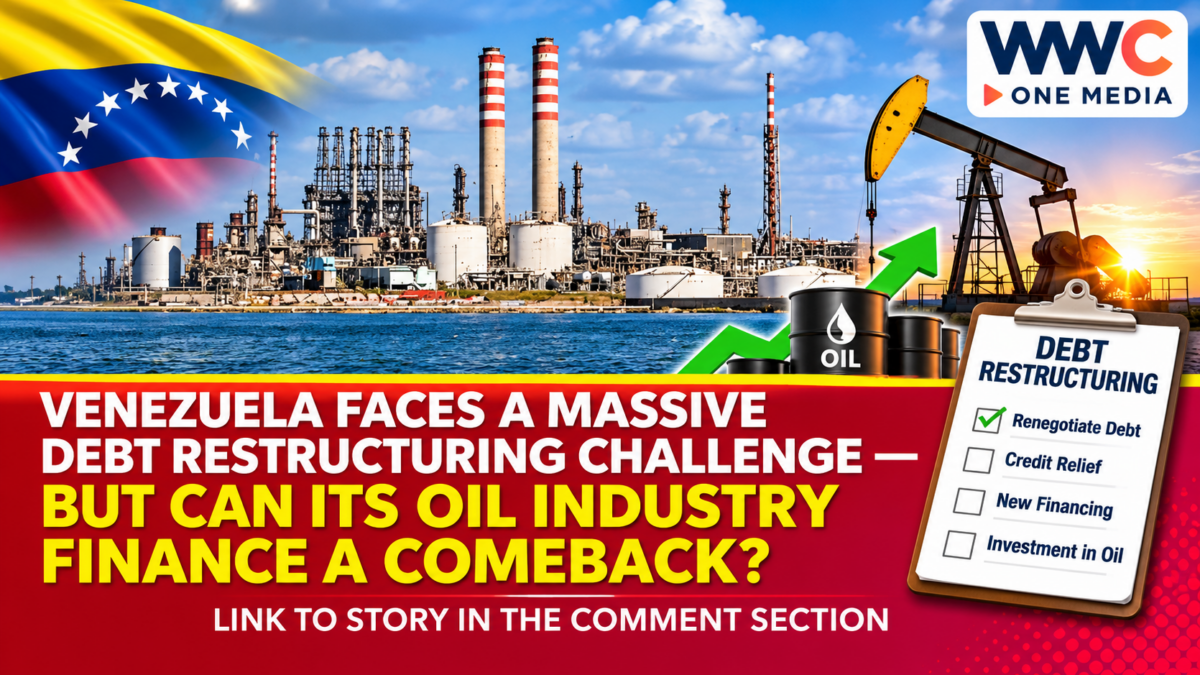
CARACAS, Venezuela — Venezuela’s debt restructuring ambitions face a formidable financial challenge as the South American nation seeks to rebuild international economic relationships, attract foreign investment and restore confidence in its ability to meet financial obligations.
The International Monetary Fund (IMF) resumed dealings with Venezuela in April 2026, while subsequent measures by the United States Treasury opened limited pathways for professional services associated with potential debt restructuring.
However, restoring international financial relationships does not automatically resolve outstanding debts or guarantee access to fresh capital.
The Inter-American Development Bank (IDB) recorded US$2.187 billion in overdue principal and interest on Venezuelan sovereign-guaranteed loans at the end of 2025, illustrating the scale of just one component of the country’s financial difficulties.
For Venezuela, the challenge is not simply negotiating more favourable repayment terms. It must also establish an economic foundation capable of supporting future financial commitments.
Venezuela Debt Restructuring Faces a Multibillion-Dollar Challenge
Venezuela’s outstanding obligations to international financial institutions provide a documented example of the obstacles confronting its economic recovery.
At the end of 2025, the IDB recorded US$2.048 billion in Venezuelan loan arrears that had remained unpaid for more than 180 days.
The bank’s outstanding Venezuelan sovereign-guaranteed loan balance stood at US$2.011 billion, with the entire portfolio classified under nonaccrual status since 2018.
Its individually assessed allowance for credit losses associated with Venezuelan loans increased to US$625 million in 2025 from US$539 million in 2024.
| IDB financial indicator | Amount |
|---|---|
| Overdue principal and interest | US$2.187 billion |
| Arrears exceeding 180 days | US$2.048 billion |
| Outstanding loan principal | US$2.011 billion |
| 2025 credit-loss allowance | US$625 million |
| 2024 credit-loss allowance | US$539 million |
These figures represent different accounting measures and should not be added together to calculate Venezuela’s total public debt.
The country’s multilateral financing difficulties have previously been examined in WWC ONE MEDIA’s analysis of Venezuela’s US$2.19 billion IDB arrears and the requirements for unlocking new development loans.
Resolving such obligations could help remove important barriers to development financing, although each institution maintains its own lending policies and requirements.
IMF Re-engagement Opens a Door — But Not an Automatic Bailout
On April 16, 2026, the IMF announced that it had resumed dealings with Venezuela under the administration of acting President Delcy Rodríguez.
The decision ended an institutional interruption dating back to March 2019.
The restoration of relations allows Venezuela to participate in regular institutional engagement, technical assistance and potential financial support, subject to applicable IMF requirements.
As of April 21, the country’s Special Drawing Rights holdings and reserve tranche position at the IMF amounted to approximately US$4.9 billion.
These assets are distinct from a newly approved IMF loan.
During its May 14 briefing, the IMF stated that Venezuela had not yet requested financial assistance and that the institution had not participated in the country’s announced debt restructuring process at that point.
The immediate priority involved restoring the production and availability of dependable economic statistics.
For international creditors, reliable information about economic output, government revenue, public expenditure and outstanding liabilities is essential when evaluating a country’s repayment capacity.
A credible restructuring process must account for both the amount owed and the resources available to meet future obligations.
US Sanctions Rules Shape the Path Towards Financial Recovery
Venezuela’s access to international financial services also depends on applicable regulatory restrictions.
On May 5, 2026, the US Treasury’s Office of Foreign Assets Control (OFAC) issued General License 58, authorising certain services connected with potential Venezuelan government debt restructuring.
The measure creates a legal pathway for specified preparatory activities within the scope of the licence.
It should not, however, be interpreted as unrestricted authorisation for every financial transaction involving Venezuela or as confirmation that a debt settlement has been completed.
Further regulatory developments occurred on September 28, when OFAC issued amended general licences covering certain activities involving Venezuelan-origin petroleum products, the provision of specified goods and services, and negotiations concerning selected investments.
These measures illustrate the importance of distinguishing permission to negotiate from permission to implement a commercial transaction.
The same distinction is relevant to UCC’s Venezuelan gas project and the regulatory requirements surrounding possible expansion.
For foreign investors, the availability of financing will depend partly on whether proposed investments can satisfy applicable legal, contractual and regulatory requirements.
Can Venezuela’s Oil Industry Generate Enough Revenue?
The economic significance of Venezuela’s petroleum industry extends beyond its potential commercial returns.
An expansion of oil production and exports could increase foreign currency earnings, support industrial activity and potentially improve the government’s capacity to meet financial obligations.
However, greater production does not automatically translate into an equivalent increase in government revenue.
Oil companies must account for operating costs, infrastructure investments, transportation expenses and contractual arrangements before determining the financial returns available to their shareholders or government partners.
The physical condition of production and processing infrastructure also matters.
Recent developments involving the planned rebuilding of Venezuela’s Petrocedeño oil upgrader illustrate why equipment restoration can be an essential component of expanding commercial output.
Investment commitments must eventually translate into completed projects, reliable production and commercially viable export arrangements.
The distribution of petroleum revenue is another important consideration.
WWC ONE MEDIA’s examination of the US–Venezuela oil arrangement and its commercial supply rights highlights why access to petroleum resources should not be confused with unrestricted ownership of future export revenue.
For debt negotiations, the decisive financial measure is how much dependable cash flow remains available after production costs, investment requirements and other contractual commitments have been met.
Why Debt Relief Alone Cannot Guarantee Economic Recovery
Sovereign debt restructuring generally involves negotiations to modify existing financial obligations.
Potential arrangements may include longer repayment periods, revised interest rates, reductions in principal or exchanges of existing securities for new instruments.
The suitability of each mechanism depends on creditor participation, contractual provisions and the country’s projected repayment capacity.
Reducing near-term payment obligations could provide additional flexibility for government expenditure.
However, lasting economic recovery would also require policies capable of supporting productive investment, dependable public revenue and financial stability.
For international creditors, accepting revised repayment arrangements may involve financial losses relative to the original contractual terms.
For Venezuela, obtaining favourable terms without improving its underlying economic performance could simply postpone future repayment difficulties.
The challenge is establishing a restructuring framework that addresses existing obligations while allowing sufficient resources for economic reconstruction.
What Happens Next?
The next important milestones will involve the publication and examination of detailed public-sector liabilities, credible economic forecasts and specific proposals for treating different categories of creditors.
Investors will need to evaluate whether economic growth assumptions are consistent with available investment resources, infrastructure capacity and projected government revenue.
Multilateral lenders will also need to assess whether Venezuela satisfies their respective requirements for renewed financial assistance.
For international energy markets, including major importing economies across Asia-Pacific, a sustained Venezuelan production recovery could eventually influence crude oil availability and commercial sourcing decisions.
The extent of that impact would depend on actual production, export arrangements and prevailing global market conditions.
Venezuela’s petroleum resources may offer an important foundation for recovery. But resources underground are not equivalent to immediately available government funds.
The country’s financial comeback will ultimately depend on transforming its economic potential into dependable revenue while negotiating repayment commitments it can realistically fulfil.
Frequently Asked Questions
What is Venezuela debt restructuring?
It refers to efforts to renegotiate existing public financial obligations and establish repayment arrangements consistent with the country’s economic capacity.
How much does Venezuela owe the IDB?
The IDB recorded US$2.187 billion in overdue principal and interest on Venezuelan sovereign-guaranteed loans as of December 31, 2025.
Has Venezuela restored relations with the IMF?
Yes. The IMF officially resumed dealings with Venezuela on April 16, 2026.
Has the IMF approved a new bailout for Venezuela?
The primary records reviewed do not establish approval of a new IMF lending programme. Institutional re-engagement does not automatically constitute financial assistance.
Can Venezuela repay its debt through oil exports?
Oil exports could contribute to repayment capacity, but the outcome depends on production levels, oil prices, operating costs, investment requirements, contractual arrangements and the eventual restructuring terms.










