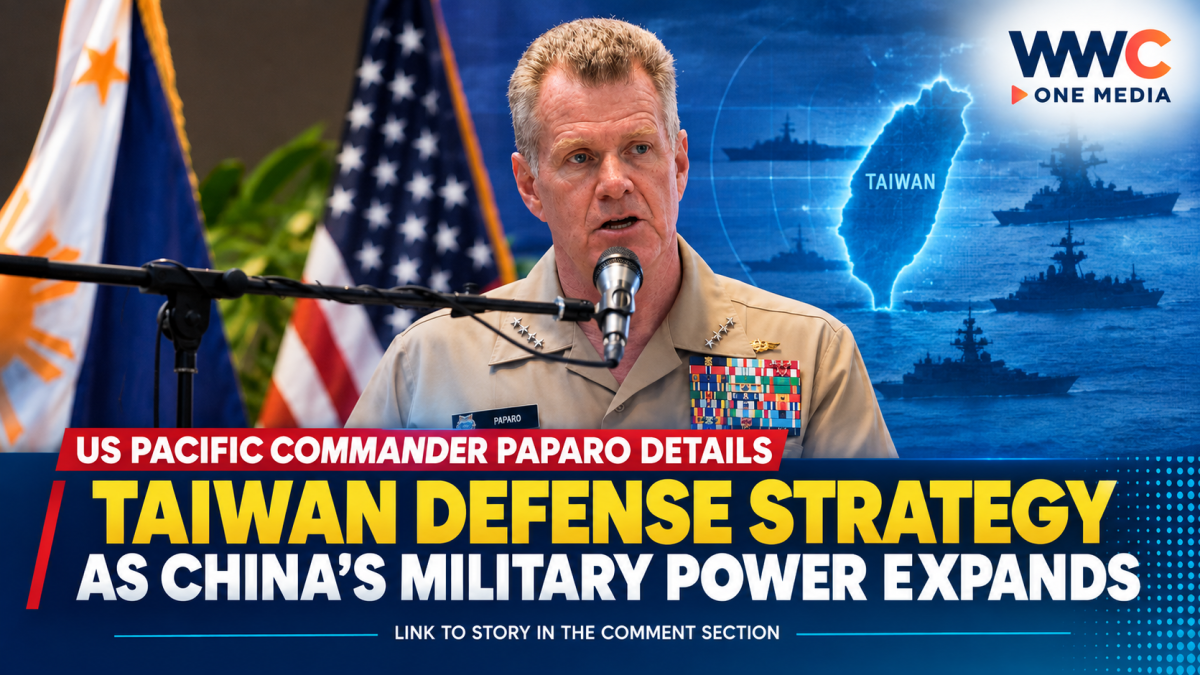
TAIPEI — U.S. Indo-Pacific Commander Admiral Samuel Paparo is putting renewed focus on deterrence in the Taiwan Strait, saying the central objective of U.S. military planning is to prevent a conflict with China from breaking out in the first place.
In a recent interview with TIME, Paparo described the principle as “deterrence by denial” — maintaining enough military capability to convince Beijing that an attack against Taiwan would not achieve its objectives.
Paparo said his goal is not to fight a war but to make the prospect of one sufficiently costly and uncertain that it is never launched.
“Mission success for me is not to fight and win a war; it’s to provide a deterrent capability so that we never go to war in the first place,” he told TIME.
China’s Military Expansion Raises the Stakes
Paparo pointed to the dramatic expansion of China’s naval capabilities over the past 25 years as one of the major challenges facing the United States in the Indo-Pacific.
He said the People’s Liberation Army Navy has grown from roughly 37 warships 25 years ago to about 12 times that number today. He also highlighted recent additions including destroyers, frigates, an aircraft carrier, submarines and amphibious vessels.
Paparo said he is also concerned about China’s advances in missile and space capabilities and the expansion of its nuclear arsenal.
The U.S. Pacific Command oversees approximately 400,000 military and civilian personnel, while the Pacific Fleet has about 200 ships, including five carrier strike groups, and more than 1,000 aircraft, according to TIME and Taiwan News.
What Happens If Deterrence Fails?
Paparo has previously described a concept known as a “hellscape” for a potential Taiwan Strait conflict. The idea centers on combining large numbers of relatively inexpensive unmanned systems with conventional military capabilities to complicate and delay a possible amphibious assault.
The concept was first publicly discussed by Paparo in 2024 and has since become part of broader debate about how drones and other unmanned systems could change warfare in the Indo-Pacific. Reuters has separately reported growing interest in drone technology across Asia as regional governments examine Taiwan-related security scenarios.
Paparo emphasized that the objective would be to deny an aggressor the ability to achieve its military goals rather than necessarily seek complete control of the air or sea.
A Conflict Would Carry Enormous Costs
The discussion comes amid continuing debate over what a Taiwan Strait conflict could mean for the United States, China, Taiwan and the wider region.
A 2023 CSIS war game examined 24 scenarios involving a conventional Chinese amphibious invasion of Taiwan. In most scenarios, U.S., Taiwanese and Japanese forces prevented China from occupying the island, but the simulated conflict produced severe losses for all sides.
The exercise is a scenario analysis rather than a prediction of what would happen in an actual war. Its findings also predate subsequent military developments and changes in U.S. weapons inventories.
Taiwan News noted that the U.S. legal framework governing relations with Taiwan does not automatically require Washington to intervene militarily if Taiwan is attacked. Decisions over any direct U.S. military involvement would ultimately rest with the U.S. president.
The Bigger Picture
Paparo’s comments highlight the difficult balance facing Washington: strengthen deterrence enough to discourage military action while avoiding steps that could unnecessarily increase the risk of confrontation.
Taipei Times likewise reported that Paparo’s strategy centers on “deterrence by denial,” with the aim of demonstrating credible defensive capabilities while maintaining enough uncertainty to prevent an adversary from easily developing countermeasures.
For Taiwan, the debate is increasingly tied not only to conventional military power but also to drones, missiles, intelligence, technology and the ability to sustain defensive capabilities over time.
Paparo’s message is therefore less about predicting whether a Taiwan Strait conflict will happen and more about the effort to prevent one.
As tensions continue to shape security planning across the Indo-Pacific, the question now extends beyond whether military power can win a conflict — and toward whether credible deterrence can keep that conflict from ever beginning.
WWC ONE MEDIA G,A