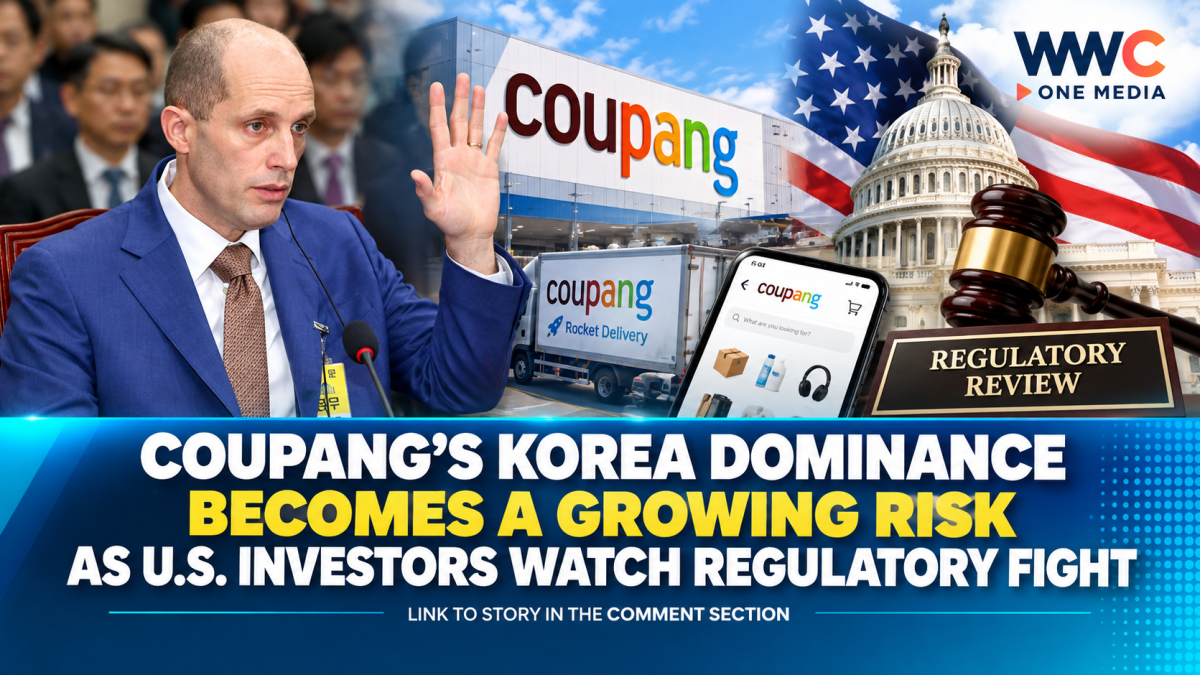
SEOUL — Coupang’s biggest strength in South Korea is increasingly becoming a major source of uncertainty for U.S. investors.
The Nasdaq-listed e-commerce giant generates more than 90% of its sales in Korea, leaving the company highly exposed to regulatory decisions, consumer conditions and legal disputes in the market that remains central to its business.
That concentration has come under renewed scrutiny following the massive customer-data breach disclosed in late 2025 and the regulatory actions that followed.
Coupang has faced investigations, penalties and disputes with Korean authorities, creating a difficult environment for a company whose shares are traded in the United States but whose core business remains overwhelmingly Korean.
Coupang’s unusual U.S.-Korea business structure
Coupang is headquartered in the United States and listed on the New York Stock Exchange, but its business footprint remains heavily concentrated in Korea.
The company operates across several markets, including Korea and Taiwan, while also developing businesses in areas such as food delivery, streaming and fintech. Its latest filing shows that its Korean operations remain the core of its integrated retail and logistics network.
That structure creates a distinctive risk for investors.
Regulatory developments in Korea can have consequences for a company whose stock is primarily held and traded in U.S. markets.
The issue has become more visible since Coupang disclosed that personal information involving more than 33 million customer accounts had been compromised. A joint government investigation subsequently identified weaknesses in the company’s security-management systems.
Record fine and continuing regulatory battles
In June, South Korea’s Personal Information Protection Commission imposed a 624.7 billion won fine on Coupang, described by the Korea Times as a record-high penalty.
Coupang has challenged the regulatory findings and indicated that it plans to contest the data-protection penalties. The company has also sought judicial relief concerning separate actions by the Fair Trade Commission.
A Seoul court in September rejected Coupang’s request to suspend an FTC on-site inspection, allowing the regulatory investigation to proceed.
Coupang had argued that the agency had not provided proper advance notice before the inspection. The FTC, meanwhile, has said it will continue enforcing Korean law regardless of a company’s nationality.
The market impact is already visible
Coupang’s shares have experienced substantial volatility during the dispute.
According to the Korea Times, the stock closed at $13.88 on Sept. 25, down 50.7% from $28.16 on Nov. 28, 2025, the last trading day before the company publicly disclosed the data breach.
The decline cannot be attributed solely to the breach or regulatory actions.
Coupang reported a $266 million net loss in the first quarter of 2026, while its second-quarter results also missed market expectations. In its latest quarterly filing, Coupang reported $8.9 billion in second-quarter revenue, up 4% year over year on a reported basis, but recorded a $570 million net loss.
The company said approximately $410 million in Korean administrative fines affected its second-quarter operating results. Excluding those fines, Coupang still reported an operating loss for the quarter.
The dispute reaches beyond Coupang
The regulatory confrontation has also become part of a broader discussion involving South Korea-U.S. economic relations.
Some U.S. lawmakers have criticized Seoul’s treatment of Coupang and alleged that Korean authorities are discriminating against a U.S.-listed company. Seoul has rejected those allegations, maintaining that its regulatory actions are based on Korean law rather than the nationality of the company.
The issue is particularly sensitive while Seoul and Washington continue working through the details of a planned $350 billion Korean investment framework in the United States. Recent reporting has identified the Coupang dispute as one potential source of additional trade friction between the two countries.
Can Coupang diversify away from Korea?
Coupang has attempted to expand internationally, including through its Taiwan business and other developing offerings.
Its second-quarter results showed Developing Offerings revenue of $1.4 billion, up 20% year over year, compared with 1% reported growth in its Product Commerce segment.
But diversification has not yet changed the fundamental structure of the company.
More than 90% of sales still come from Korea, meaning the country’s consumer market and regulatory environment remain closely tied to Coupang’s financial story.
That creates a complicated situation for investors: Coupang’s Korean market leadership provides the scale behind its business, while the same concentration leaves the company particularly exposed to developments in one country.
For now, the regulatory disputes remain unresolved, and Coupang continues to challenge some of the actions taken against it.
The bigger question is therefore no longer simply how Coupang performs as an e-commerce company.
It is whether a U.S.-listed company with such deep roots in Korea can successfully navigate growing regulatory pressure without reducing the very market dominance that made it a major global e-commerce story.
WWC ONE MEDIA G,A