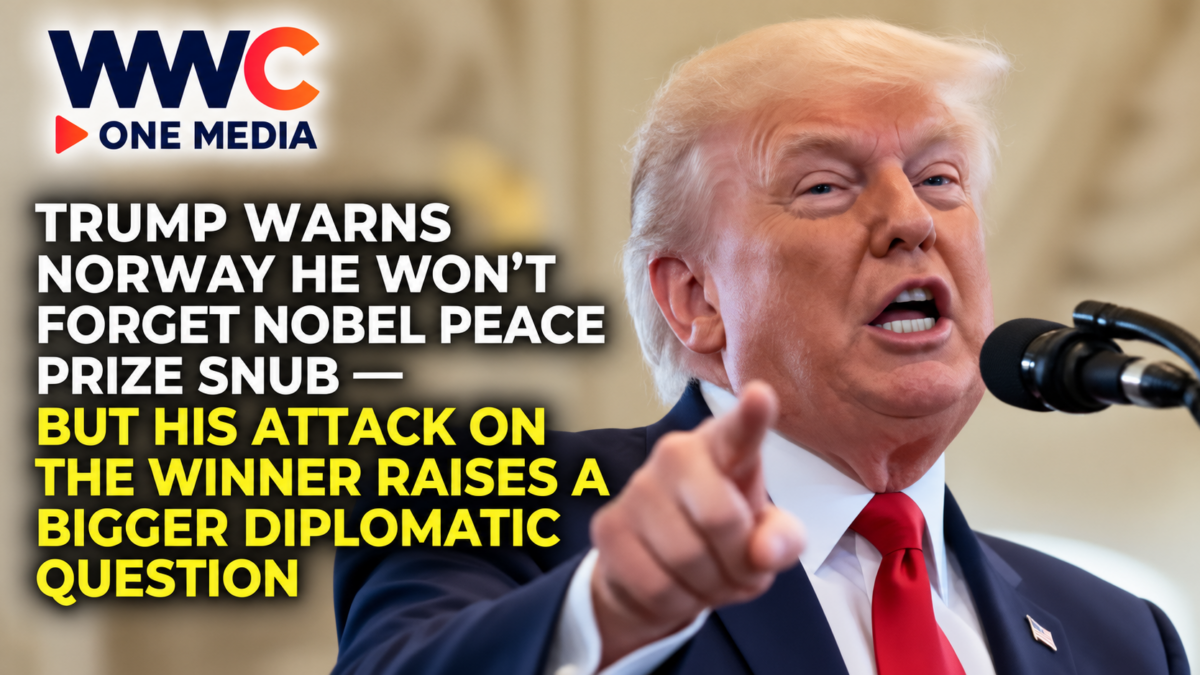
SYRACUSE, NEW YORK — October 10, 2026 — US President Donald Trump has launched a fierce attack on Norway and the Nobel Peace Prize after failing to win the prestigious award, declaring that the country would not be forgotten for what he described as a disgraceful decision.
Speaking at a campaign rally in Syracuse, New York, on Friday night, Trump criticized the Norwegian Nobel Committee for awarding the 2026 Nobel Peace Prize to South African jurist Navanethem “Navi” Pillay instead of him.
Trump argued that his record in international diplomacy deserved recognition and accused the committee of undermining the credibility of the award.
He described the decision as an “indelible stain” on Norway and warned that he would remember the perceived slight.
The unusually forceful comments came just hours after the Nobel Committee named Pillay as the winner for her lifelong efforts to promote peace, international law and accountability for serious human rights abuses.
The confrontation has reignited debate over Trump’s claims of diplomatic success, the independence of the Nobel Peace Prize and the relationship between Washington and European allies.
But the bigger question is whether Trump’s anger will remain political rhetoric — or create new pressure on Norway and the international institutions the Nobel Committee has chosen to recognize.
Trump Lashes Out After Missing Out on the Nobel Peace Prize
Trump’s comments came during an October 9 campaign rally in Syracuse.
The president told supporters that the United States, represented by his administration, deserved the Nobel Peace Prize because of his claimed contributions to international peace.
He argued that the committee had made an embarrassing decision by overlooking him.
Trump also suggested that the award’s reputation had been damaged by the people responsible for selecting its winner.
His strongest criticism was directed at Norway, the country that hosts the Nobel Peace Prize process.
The president went beyond expressing disappointment with the Nobel Committee.
He portrayed the decision as a broader insult to the United States.
That distinction is politically significant because the Nobel Committee operates independently of Norway’s elected government.
Although the award is associated with Norway, its winner is not selected by the Norwegian prime minister or cabinet.
Trump Says the Nobel Committee Has Damaged Its Own Reputation
During the rally, Trump accused the Nobel Committee of being controlled by political ideologues.
He portrayed its decision as evidence that the award had lost credibility.
The remarks reflect his longstanding belief that he deserves recognition for diplomatic efforts undertaken during his presidency.
Trump has repeatedly expressed dissatisfaction over not receiving the Nobel Peace Prize.
His latest criticism was particularly direct because it singled out Norway as responsible for a decision made by an independent committee.
The president did not announce a specific policy response during the remarks reported by Bloomberg and Reuters.
There was no verified announcement of new trade restrictions, diplomatic sanctions or a change in US security commitments toward Norway.
Nevertheless, the comments have raised questions about whether the dispute could create unnecessary tension between longstanding allies.
South African Jurist Navi Pillay Wins the 2026 Nobel Peace Prize
The Norwegian Nobel Committee announced on October 9 that the 2026 Peace Prize would be awarded to Navi Pillay.
The committee recognized her lifelong work strengthening international law and advancing accountability for war crimes, crimes against humanity and genocide.
Pillay, 85, is a South African lawyer and former United Nations High Commissioner for Human Rights.
Her career includes service in South Africa’s judiciary, the International Criminal Tribunal for Rwanda and the International Criminal Court.
She also chaired a United Nations commission investigating human rights violations in Israel and the occupied Palestinian territories.
Her work has placed her at the center of some of the world’s most difficult legal and political disputes.
The Nobel Committee said her commitment to international justice exemplifies the role of law in preventing violence and holding powerful actors accountable.
The selection represents an endorsement of international legal institutions at a time when their authority and legitimacy are being challenged.
Who Is Navi Pillay?
Navanethem Pillay was born in Durban, South Africa, during the apartheid era.
She grew up in a family of Indian Tamil heritage and pursued a legal career despite the discrimination imposed by South Africa’s racial segregation system.
She established a law practice and represented people challenging apartheid-era injustice.
Her professional career later expanded into international law.
Pillay became a judge on South Africa’s High Court and subsequently served at the International Criminal Tribunal for Rwanda.
Her work contributed to important legal developments concerning the prosecution of genocide and wartime sexual violence.
She later served as a judge at the International Criminal Court.
From 2008 to 2014, Pillay was the UN High Commissioner for Human Rights.
These roles established her international reputation long before the 2026 Nobel announcement.
For supporters, her career demonstrates why international legal accountability can contribute to peace.
For critics of international tribunals, her recognition also highlights disputes over how those institutions exercise their authority.
Why Pillay’s Work in Gaza Has Become Controversial
One of the most politically sensitive parts of Pillay’s career involves her leadership of a United Nations inquiry examining Israel and the occupied Palestinian territories.
The commission concluded that Israel had committed genocide in Gaza.
Israel rejected the findings and has criticized the commission’s work.
The Trump administration has also opposed several international legal actions involving Israel.
The Nobel decision therefore carried implications beyond recognizing an individual lawyer.
It highlighted disagreement over international investigations, the conduct of war and the role of judicial institutions in holding governments accountable.
Supporters of Pillay argue that her willingness to investigate politically powerful actors demonstrates her commitment to legal principles.
Opponents argue that some international investigations and institutions have displayed bias or exceeded their proper authority.
These are contested political and legal issues.
A UN commission’s findings should not be confused with a final judgment by an international court.
Trump Dismisses Pillay as an Unknown Figure
During his Syracuse speech, Trump expressed disbelief that the Nobel Committee had selected Pillay.
He described her as someone unfamiliar to him and questioned the decision to honor her.
Those remarks contrasted sharply with the international recognition Pillay has received through decades of legal and human rights work.
The Nobel Committee did not describe the prize as a judgment on Trump’s diplomatic record.
Instead, its official announcement focused on Pillay’s efforts to advance the international rule of law.
This is an important distinction.
The award was not formally presented as a contest between Trump and Pillay.
The committee considered eligible nominations under its own confidential selection process.
Its deliberations are not publicly released.
It is therefore impossible to establish from the announcement how the committee evaluated Trump, whether he appeared on its final shortlist or how individual members compared particular candidates.
Trump Again Claims Credit for Preventing Major Conflicts
Trump used his remarks to repeat claims that he had helped resolve or prevent multiple international conflicts.
He cited tensions involving North Korea, South Korea, Japan, China and Taiwan.
Trump has frequently presented his diplomatic interventions as evidence that he has a stronger peace record than previous American presidents.
Supporters argue that his willingness to engage directly with foreign leaders has sometimes created openings for negotiations and reduced tensions.
Critics contend that he exaggerates the extent of his achievements and overlooks conflicts that remain unresolved.
Reuters reported that Trump did not provide evidence for the specific claims he made about preventing several of the conflicts mentioned at the rally.
The distinction between preventing a war, securing a temporary ceasefire and resolving a longstanding conflict is important.
Those outcomes are not interchangeable.
A claim of diplomatic success requires evidence of what changed, which parties participated and whether the result proved durable.
Why the Nobel Peace Prize Is Different From the Other Nobel Awards
The Nobel Peace Prize is awarded in Oslo, Norway, while most other Nobel Prizes are presented in Sweden.
The arrangement follows the instructions in Alfred Nobel’s will.
A committee of five people, appointed by Norway’s parliament, chooses the Peace Prize recipient.
However, the Norwegian Nobel Committee operates independently of both parliament and the Norwegian government when making its selections.
This means the Norwegian prime minister does not have authority to award the prize to Trump or overturn the committee’s decision.
The arrangement also explains why disputes over the prize can become diplomatically sensitive.
The award is closely associated with Norway internationally, even though the government does not control the selection.
Trump’s criticism of Norway therefore places political pressure on a country whose leaders are institutionally separate from the decision he opposes.
Norway’s Prime Minister Congratulates Pillay
Norwegian Prime Minister Jonas Gahr Støre congratulated Pillay following the announcement.
In an official government statement dated October 9, Støre praised the recognition of international law and accountability for serious crimes.
He described the award as particularly relevant at a time when the international legal order faces significant pressure.
The statement highlighted Pillay’s work in South Africa, Rwanda and Palestine.
It also reaffirmed the importance of institutions that investigate and prosecute serious violations of international law.
The Norwegian government explicitly noted that the Nobel Committee is independent.
This distinction is essential to understanding the diplomatic implications of Trump’s criticism.
Norway can congratulate the winner without having participated in the selection.
Likewise, the government cannot simply change the result in response to pressure from another country.
Could Trump’s Remarks Damage US–Norway Relations?
The United States and Norway maintain a longstanding partnership involving NATO, defense, trade and international security.
The two countries cooperate on issues affecting Europe and the North Atlantic.
Trump’s remarks may create political discomfort because they publicly blame Norway for the actions of an independent institution.
But criticism of the Nobel Prize does not automatically amount to a diplomatic crisis.
There has been no verified announcement that the United States will withdraw security cooperation, impose economic penalties or formally downgrade relations because of the 2026 award.
Such consequences remain speculative unless supported by an official policy decision.
The immediate effect is therefore best described as political and rhetorical.
Nevertheless, repeated criticism by an American president can influence public debate and create pressure for Norwegian officials to defend the committee’s independence.
Norway Has Faced Trump’s Nobel Frustration Before
The 2026 controversy did not emerge suddenly.
Trump has repeatedly voiced disappointment over the Nobel Peace Prize.
The Washington Post reported on October 8 that Norwegian officials and observers had been concerned about the possibility of renewed criticism if Trump failed to win.
Some commentary had even considered whether the prize should be suspended temporarily to avoid political controversy.
However, those discussions did not represent an official decision to postpone or cancel the award.
The Norwegian Nobel Committee proceeded with its scheduled announcement.
The episode demonstrates how a prize intended to recognize peace efforts can become politically contentious when prominent leaders view it as a measure of personal success or international status.
It also illustrates why institutional independence matters.
If award decisions were made primarily to avoid angering powerful political figures, the committee’s credibility would face a different kind of challenge.
A Nobel Prize for International Law at a Time of Global Conflict
The committee’s choice of Pillay carries a broader message about the role of law in international relations.
Its official explanation emphasized the importance of legal accountability in preventing conflict and addressing serious abuses.
The committee argued that stable peace requires institutions capable of applying legal principles even when politically powerful countries disagree with their conclusions.
Supporters of this approach believe international courts and investigations can deter wrongdoing and provide some measure of justice to victims.
Critics argue that international institutions sometimes lack sufficient accountability, apply standards inconsistently or interfere with national sovereignty.
The tensions are particularly pronounced during armed conflicts.
Pillay’s award places those competing perspectives at the center of global attention.
Trump’s reaction illustrates how strongly some national leaders reject the authority and political symbolism of international legal bodies.
World Leaders Welcome Pillay’s Victory
The Nobel announcement received praise from several international leaders and human rights organizations.
UN Secretary-General António Guterres highlighted Pillay’s commitment to justice and human dignity.
South African President Cyril Ramaphosa welcomed the honor as recognition of her contribution to international law.
European Commission President Ursula von der Leyen also praised her work.
Human rights advocates described the award as a statement of support for accountability during wartime.
Israel, however, criticized the selection and Pillay’s role in investigations concerning Gaza.
These reactions demonstrate the international political divide surrounding the 2026 prize.
For many supporters, the award recognizes a career of defending legal principles.
For opponents, it gives additional prominence to institutions and investigations they dispute.
Both responses are relevant to understanding why the decision has generated such intense attention.
What the Dispute Means for American Politics
Trump’s reaction comes during an American political environment in which foreign policy and international institutions remain divisive issues.
Supporters may view his criticism as an example of challenging institutions they believe are politically biased.
Opponents may regard the remarks as evidence that he is turning a symbolic personal disappointment into unnecessary conflict with an ally.
The controversy also raises questions about how political leaders define diplomatic success.
Negotiations, ceasefires and peace agreements can produce important achievements.
But international awards are not automatic entitlements for leaders who claim to have helped resolve conflicts.
The Nobel Committee retains discretion over its selection process.
That independence is central to the award’s credibility, even when its decisions remain controversial.
Why the Story Matters for Asia and the Philippines
The 2026 Nobel controversy has implications for Asian audiences because it touches on the international rules governing conflict, diplomacy and human rights.
Pillay’s legal career includes work involving the Rwandan genocide, the Rohingya crisis in Myanmar and the conflict in Gaza.
These cases involve questions that continue to influence international legal institutions and governments worldwide.
For the Philippines, debates about international courts and accountability have direct relevance because the country has experienced its own disputes over the jurisdiction and authority of international institutions.
The disagreement between Trump and the Nobel Committee also illustrates the different ways governments view international law.
Some leaders emphasize national sovereignty and political negotiation.
Others argue that enforceable international standards are essential to protecting human rights and preventing atrocities.
The dispute is therefore about more than a single award.
It highlights competing visions of how international peace and accountability should be maintained.
The Bigger Question: Can the Nobel Committee Withstand Political Pressure?
The Norwegian Nobel Committee has a long history of making decisions that attract political controversy.
Its members must evaluate candidates with different achievements, backgrounds and political implications.
The 2026 prize presents an especially visible test because the criticism comes directly from the American president.
For Norway, the challenge is defending the independence of an institution closely associated with the country.
For Trump, the question is whether his frustration over the award will affect his political rhetoric or actual diplomatic decisions.
For the Nobel Committee, the issue is maintaining a consistent selection process despite external pressure.
And for Pillay, the controversy risks overshadowing the decades of legal and human rights work that led to her recognition.
THE BOTTOM LINE
President Donald Trump has criticized Norway after the 2026 Nobel Peace Prize was awarded to South African jurist Navi Pillay.
Speaking in Syracuse on October 9, he said the decision damaged Norway’s reputation and declared that he would not forget the rejection.
The Nobel Committee selected Pillay for her lifelong contribution to international justice, legal accountability and human rights.
Norwegian Prime Minister Jonas Gahr Støre congratulated her while reaffirming that the committee operates independently of the government.
Trump claims that his diplomatic record deserves the award, but the Nobel Committee has not publicly disclosed its confidential assessment of individual nominees.
No specific US diplomatic retaliation against Norway has been announced in connection with the remarks.
The bigger question is whether Trump’s anger over the Nobel Peace Prize will remain a public grievance — or develop into a broader confrontation over the independence of international institutions.
For now, the prize belongs to Navi Pillay. But the political controversy surrounding the decision may continue long after the winner has been announced.