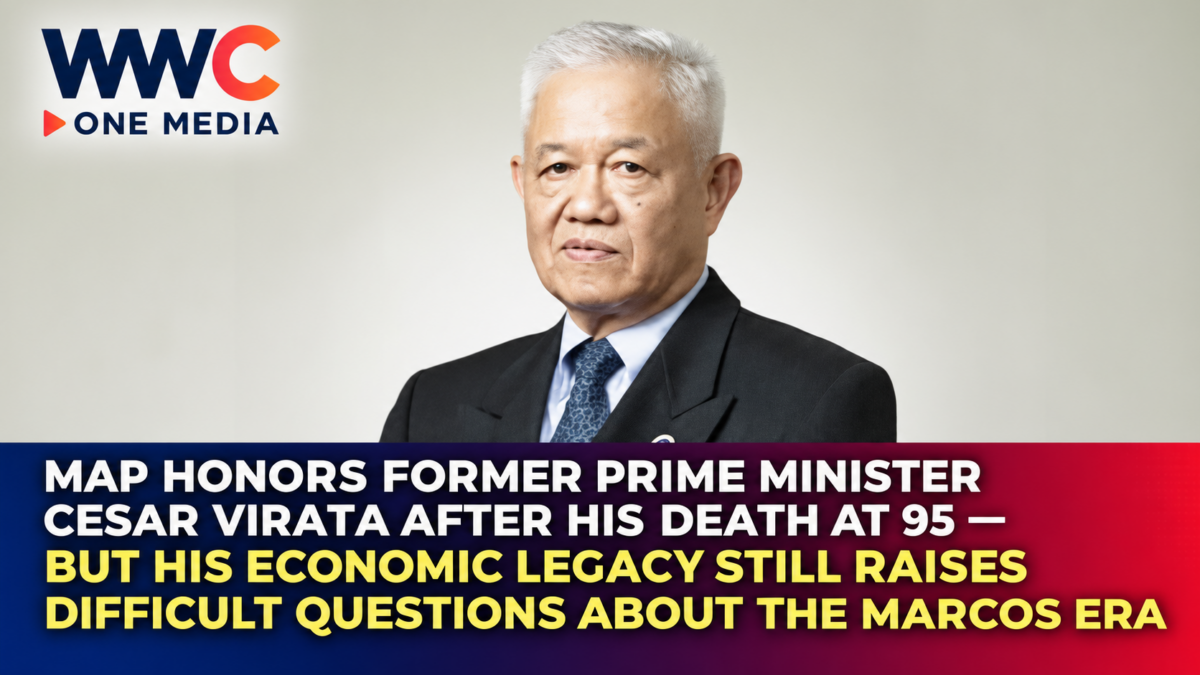
MANILA, Philippines — October 10, 2026 — The Management Association of the Philippines (MAP) has paid tribute to former Prime Minister and Finance Minister Cesar E. A. Virata, remembering the late economic technocrat as a leading figure in Philippine public administration and corporate management.
Virata, who died on October 2 at the age of 95, served as the country’s finance chief for approximately 16 years and as prime minister during the final five years of the administration of former President Ferdinand Marcos Sr.
In its tribute, MAP praised his commitment to professional management, financial leadership and public service, recalling why the association selected him as its Management Person of the Year in 1981.
The recognition reflects the respect Virata earned among business leaders and economic professionals during a career extending from government and education to banking and corporate governance.
But his death has also renewed a more complicated discussion about the legacy of a technocrat who helped manage the Philippine economy under an authoritarian government.
The bigger question is how history should assess a public official praised for managerial competence while also acknowledging the political system and economic crises that defined his years in power.
MAP Calls Cesar Virata a Model of Statesmanship and Management Excellence
In a statement reported by Bilyonaryo on October 2, the Management Association of the Philippines honored Virata’s contributions to the government and private sector.
MAP described him as a respected leader whose professional career reflected management competence and dedication to national development.
The organization emphasized his contributions to economic policy, finance, corporate governance and institution-building.
It also recalled naming him Management Person of the Year in 1981.
That distinction remains part of the association’s official roster of management awardees.
Virata received the honor during a period when he was a central figure in Philippine economic policymaking.
MAP’s statement expressed the belief that his record would continue to influence future Filipino executives and public administrators.
However, the recognition is a tribute to his career, not a newly conferred 2026 Management Person of the Year award.
A 16-Year Career at the Center of Philippine Economic Policy
Virata’s national political career was closely associated with the administration of Ferdinand Marcos Sr.
He became finance secretary in 1970 and continued as finance minister until 1986.
The position placed him at the center of government decisions involving taxation, public spending, borrowing and international financial relations.
His tenure spanned substantial changes in the Philippine economy, including the global oil shocks of the 1970s, inflationary pressures and the debt difficulties of the early 1980s.
Virata also represented the Philippines in international financial institutions, including the World Bank and Asian Development Bank.
These responsibilities gave him a prominent position in negotiations affecting government financing and economic development.
Supporters credited his technical expertise and ability to navigate complicated fiscal issues.
Critics and historians, however, have raised questions about the effectiveness of economic policies pursued during the Marcos administration, particularly as the country entered a severe economic crisis in the early 1980s.
His record therefore remains inseparable from both his professional responsibilities and the broader policies of the government he served.
From Finance Chief to Philippine Prime Minister
Virata became Philippine prime minister in 1981 under the constitutional and political arrangements of the Marcos government.
He held the position until February 1986, when the EDSA People Power Revolution brought the administration to an end.
He simultaneously remained a major figure in economic policymaking.
The premiership placed him among the most senior officials of a government whose rule included martial law, restrictions on political freedoms and extensive allegations of abuses.
His role differed from that of Marcos, who remained the dominant political authority.
Nevertheless, Virata was a senior member of the administration and participated in its economic governance.
This historical context is essential to a balanced assessment.
Professional qualifications and public-service achievements can be acknowledged without treating them as evidence that the political system was democratic or free from wrongdoing.
Similarly, serving in the administration does not establish that Virata personally committed every abuse associated with the period.
Individual responsibility and institutional responsibility require careful distinction.
The Economic Crisis That Complicates Virata’s Legacy
The later years of Virata’s public career coincided with one of the Philippines’ most difficult economic periods.
The country faced mounting external debt, weakened investor confidence and financial instability during the early 1980s.
The 1983 assassination of opposition leader Benigno Aquino Jr. further intensified political and economic uncertainty.
The Philippines subsequently experienced a severe recession, creating hardship for households and businesses.
These developments remain important when evaluating the effectiveness of economic management under Marcos Sr.
Virata’s supporters have portrayed him as a technocrat attempting to maintain fiscal discipline amid difficult conditions.
Other historical assessments emphasize the failures of the wider economic system, including debt dependence, politically connected economic arrangements and weaknesses in governance.
A fair account must consider both.
The economic crisis cannot be explained solely through the actions of one finance minister, but it cannot be excluded from the record of an official who held responsibility for national financial policy for 16 years.
Virata’s Career Continued After the Marcos Administration
Following the 1986 political transition, Virata returned to work in the private sector.
His experience in government administration and international finance remained valuable to corporations and financial institutions.
He became associated with consulting and banking, including a long career at Rizal Commercial Banking Corporation (RCBC).
According to reporting by The Philippine Star, Virata joined the RCBC board in 1995 and became corporate vice chairman in 2000.
He also held senior advisory responsibilities.
RCBC confirmed his death in an October 2 stock-exchange disclosure.
The bank’s acknowledgment reflected his continuing involvement in corporate governance and financial institutions decades after leaving government.
His post-government career helped establish his reputation beyond his years in the Cabinet.
It also provided a platform for advising business leaders and contributing to discussions about Philippine economic development.
SEC Recognizes His Role in Building Philippine Capital Markets
The Securities and Exchange Commission also paid tribute to Virata, emphasizing his contributions to the development of Philippine financial markets.
SEC Chairperson Francis Lim credited him with helping establish institutions and market infrastructure that continue to support investors and companies.
According to the commission’s statement, Virata was among the incorporators of the Philippine Stock Exchange.
He was also a leading proponent of the country’s fixed-income trading platform.
These contributions are relevant because functioning financial markets depend on institutions that allow businesses and governments to raise capital and enable investors to trade financial instruments.
Stock and bond markets can provide companies with alternatives to traditional bank financing.
Their development also requires regulation, transparency and market infrastructure.
The SEC’s tribute focused on Virata’s contribution to these institutional foundations.
However, the effectiveness of the financial system developed over many decades and through the contributions of numerous policymakers, regulators and private-sector participants.
His involvement was significant, but it should not be described as solely responsible for the creation of every modern Philippine financial institution.
The University of the Philippines Also Remembers Virata
Virata’s influence extended into education and management training.
Before and alongside his public-sector career, he was associated with academic and professional work involving engineering, business administration and management.
The University of the Philippines Diliman School of Economics and the Philippine Center for Economic Development issued a memorial recognizing him as a founding board trustee of the latter institution.
The UP Virata School of Business also bears his name.
The academic connection reflects the importance of management education within his broader career.
For universities, the relationship between public administration and professional training remains relevant.
Effective public institutions require expertise in budgeting, economics, management and organizational leadership.
At the same time, higher education also has a responsibility to encourage critical examination of public policy and historical decisions.
Virata’s association with Philippine education therefore forms part of a legacy that includes both professional accomplishments and continuing debate about his time in government.
President Marcos Jr. Pays His Final Respects
President Ferdinand Marcos Jr. also honored Virata following his death.
According to the Presidential Communications Office, the President visited Virata’s wake at Heritage Memorial Park in Taguig City on October 7.
He remembered the former prime minister’s years of public service and his work alongside President Marcos Sr.
The President also expressed condolences to the Virata family.
The visit reflected the historical connection between Virata and the Marcos family.
It was also part of the wider public response to the death of a figure who played an important role in the country’s twentieth-century government.
However, the current administration’s tribute should be distinguished from an independent historical evaluation of the policies implemented during the elder Marcos presidency.
Expressions of respect for a deceased former official do not settle debates about an administration’s economic and political legacy.
Business Leaders Remember a Technocrat With a Reputation for Discipline
Virata’s death has prompted tributes emphasizing his reputation for personal discipline, financial expertise and measured leadership.
In an October 10 column for The Philippine Star, business journalist Tony Lopez recalled covering Virata’s work from the 1970s through his later banking career.
Lopez offered a personal assessment of Virata as a public servant who did not emerge from government with the wealth associated with some political figures.
Such reflections help explain why Virata retained respect among parts of the business community.
But personal assessments of integrity are distinct from independently established conclusions about every decision made during a long public career.
They provide valuable historical perspectives while remaining opinions of the individuals expressing them.
For readers, the key is recognizing both the testimony of those who worked with him and the broader historical record.
Why Some Historians See a More Complicated Legacy
Virata’s role as a technocrat under Marcos Sr. has long generated discussion.
Economic technocrats often present themselves as specialists focused on practical problems rather than political ideology.
Their expertise can help governments design policies, manage budgets and engage with international institutions.
But technical policymaking does not occur outside politics.
A finance minister’s decisions affect the distribution of resources, government borrowing and the priorities of the administration.
In an October 2026 commentary, the Daily Tribune argued that Virata’s professional capabilities could be recognized without excusing the political system in which he served.
Other commentators have similarly examined the relationship between technocratic expertise and authoritarian power.
This debate extends beyond Virata himself.
It concerns how countries evaluate officials who exercise professional responsibilities within governments that later become subjects of major historical criticism.
The question is particularly relevant to the Philippines, where assessments of the Marcos era remain politically and socially significant.
What Today’s Philippine Leaders Can Learn From His Career
Virata’s long career offers several lessons for contemporary managers and policymakers.
First, complex economic decisions require professional knowledge and institutional competence.
Government leaders must understand financial markets, economic risks and the long-term consequences of borrowing and public spending.
Second, strong institutions matter beyond the careers of individual officials.
The development of capital markets, professional education and financial infrastructure requires sustained cooperation across public and private organizations.
Third, economic expertise must be accompanied by accountability.
Technical competence cannot substitute for transparency, effective institutions and respect for the public interest.
Finally, historical legacies require careful evaluation.
Individual achievements should be assessed alongside the economic and political conditions in which they occurred.
For Philippine leaders confronting present-day questions about government spending, financial stability and public trust, these lessons remain relevant.
The Bigger Picture: Remembering a Public Figure Without Erasing History
The Management Association of the Philippines’ tribute reflects the esteem Virata earned among many business and management professionals.
His career crossed government, banking, education and financial market development.
Few Philippine officials have occupied such an extensive range of senior positions over so many decades.
But the significance of his career also lies in the period during which he served.
The Marcos Sr. administration remains one of the most consequential and contested chapters in Philippine history.
Its economic policies, political institutions and human rights record continue to shape national discussions.
Virata’s legacy should therefore be understood within that history rather than separated from it.
Acknowledging his contributions to economic administration and corporate governance does not require ignoring the limitations and failures of the government in which he served.
A balanced assessment makes room for both recognition and scrutiny.
THE BOTTOM LINE
The Management Association of the Philippines has honored former Prime Minister and Finance Minister Cesar E. A. Virata following his death at 95 on October 2, 2026.
MAP praised his professional leadership, economic expertise and decades of work across government and business.
Other institutions, including the Securities and Exchange Commission, have recognized his contributions to the country’s financial markets and corporate governance.
President Ferdinand Marcos Jr. also paid his final respects, reflecting Virata’s long association with the Marcos family.
Yet the former prime minister’s career remains closely tied to the economic challenges and authoritarian political environment of the Marcos Sr. administration.
The biggest question is not whether Cesar Virata made significant contributions to Philippine public administration and financial institutions — but how those achievements should be weighed against the wider historical record of the government he helped manage.
For today’s generation of Filipino leaders, his life presents an enduring lesson: professional competence matters, but genuine public service must also withstand the tests of accountability, transparency and history.