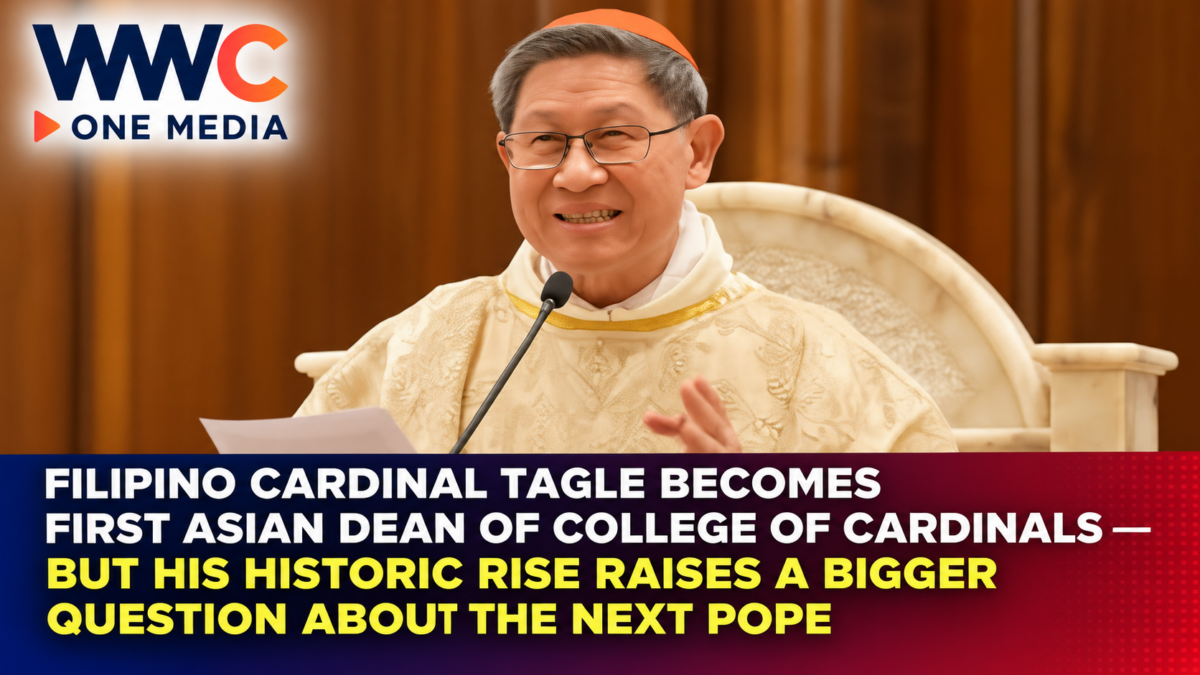
VATICAN CITY — Filipino Cardinal Luis Antonio Gokim Tagle has reached one of the highest positions in the Roman Catholic Church after being elected Dean of the College of Cardinals, becoming the first Asian to lead the influential body responsible for electing a new pope.
The historic appointment, approved by Pope Leo XIV on October 9, 2026, places the former Archbishop of Manila at the center of the Vatican’s leadership structure and gives him a major role in organizing a future papal election.
Tagle, 69, succeeds Italian Cardinal Giovanni Battista Re, 92, who is stepping down after serving as dean since 2020.
The development represents another milestone for a Filipino church leader who was widely discussed as a possible successor to Pope Francis during the 2025 conclave.
But while Tagle’s appointment is being celebrated as a breakthrough for Asian Catholics, it also raises an intriguing question: Could the Filipino cardinal’s historic rise strengthen his standing as a potential future pope, or will his new position prove more important in determining how the Church chooses its next leader?
Pope Leo XIV Approves Tagle’s Historic Election
The Vatican announced on Friday, October 9, that Pope Leo XIV had approved Tagle’s election as Dean of the College of Cardinals.
The cardinal was elected on Thursday, October 8, by members of the Order of Cardinal-Bishops, the highest-ranking order within the College of Cardinals.
Under Church law, the dean is elected by eligible cardinal-bishops, with the election requiring papal approval.
The decision makes Tagle the first Asian cardinal to occupy the position, which has historically been held by European church leaders.
The Vatican also confirmed that Tagle will assume the title of the Suburbicarian Church of Ostia while retaining his existing title of Albano.
The former dean, Cardinal Re, becomes Dean Emeritus and retains his titular church of Sabina-Poggio Mirteto.
For the Philippine Catholic community, the election places one of the country’s most prominent religious figures in a leadership role with worldwide responsibilities.
What Does the Dean of the College of Cardinals Actually Do?
The Dean of the College of Cardinals holds an important coordinating position in the Catholic Church.
The College of Cardinals consists of senior Catholic leaders who advise the pope and perform important duties in the governance and continuity of the Church.
When the papacy becomes vacant following a pope’s death or resignation, eligible cardinals gather to elect a successor.
The dean has a central role in coordinating the college’s activities and managing important procedures connected with a papal transition.
According to Vatican News, the dean is responsible for convening a future conclave and presiding over it, provided he remains in office and is under 80 years old.
Tagle is currently 69, making him eligible to participate in a future conclave under the present age rules.
However, the dean does not possess authority to choose the next pope independently.
Nor does he have additional votes or governing power over the other cardinals.
The Vatican describes the position using the Latin expression primus inter pares, meaning “first among equals.”
In practical terms, Tagle will help guide the procedures surrounding a future papal election, but the pope will still be chosen through the votes of eligible cardinal-electors.
First Asian Dean Marks a Breakthrough for the Philippine Church
Tagle’s appointment is particularly significant because it places an Asian church leader at the head of an institution historically dominated by European cardinals.
The Catholic Church has expanded substantially across Africa, Asia and other regions outside Europe.
As the Church’s membership and leadership become increasingly international, appointments such as Tagle’s reflect its changing geographic character.
For the Philippines, the development carries special importance.
The country is home to one of the world’s largest Catholic populations and remains a major center of Catholic life in Asia.
Filipino Catholics have long contributed to the Church through missionary work, religious education, charitable organizations and international pastoral service.
Tagle’s election adds another landmark to that tradition.
His new responsibilities also provide an opportunity for Asian perspectives and experiences to remain visible within the Church’s senior leadership.
However, his role as dean is universal rather than national.
He will coordinate the College of Cardinals on behalf of the worldwide Catholic Church, not simply represent Filipino interests.
Tagle Was Considered a Strong Contender During the 2025 Papal Election
The historic promotion has renewed attention on Tagle’s reputation as a potential pope.
Before the May 2025 conclave, international news organizations and Vatican observers frequently included him among the cardinals considered papabile — an Italian term used for a possible papal candidate.
His international experience, senior Vatican responsibilities and pastoral reputation made him a prominent figure in discussions about who might succeed Pope Francis.
However, the Vatican does not publish an official list of papal candidates.
Conclave voting is conducted in secrecy, meaning public claims about individual support must be treated cautiously unless independently established.
The 2025 conclave ultimately elected Cardinal Robert Francis Prevost, who became Pope Leo XIV.
Tagle’s latest election as dean does not reverse that outcome or designate him as Leo’s eventual successor.
It does, however, place him in a senior position that could make his leadership more visible during a future papal transition.
Could Cardinal Tagle Become the First Filipino Pope?
Tagle’s appointment is likely to revive public speculation about whether a Filipino could someday lead the Catholic Church.
His election as dean is not itself a step in a formal succession process.
Unlike some political offices, the papacy does not have an appointed heir or predetermined line of succession.
When the papacy becomes vacant, eligible members of the College of Cardinals elect the next pope through a secret ballot.
Tagle would have one vote if he remained an eligible cardinal-elector.
His position as dean would not give him greater voting power.
Historically, serving as dean has not prevented a cardinal from becoming pope.
Cardinal Joseph Ratzinger, who served as Dean of the College of Cardinals, was elected Pope Benedict XVI in 2005.
That precedent shows that a dean can become pope, but it does not indicate that Tagle is certain or even likely to follow the same path.
For now, his elevation should be understood as a confirmed leadership appointment rather than a prediction about the next papal election.
From Archbishop of Manila to Senior Vatican Leader
Tagle’s rise through the Catholic hierarchy reflects decades of pastoral and administrative service.
Born in Manila in 1957, he began his priestly ministry in the Philippines and later pursued advanced theological studies.
He served as Bishop of Imus in Cavite before becoming Archbishop of Manila in 2011.
In November 2012, Pope Benedict XVI elevated him to the College of Cardinals.
His appointment brought him into the group of senior church leaders responsible for participating in papal elections and advising the pope.
During his leadership in Manila, Tagle became known for his accessible communication style and emphasis on pastoral care.
His public ministry often focused on poverty, compassion and the challenges faced by vulnerable communities.
These qualities helped build his international reputation and made him a recognizable figure beyond the Philippines.
Pope Francis Brought Tagle Into the Vatican’s Global Mission Leadership
In 2019, Pope Francis appointed Tagle to lead the Congregation for the Evangelization of Peoples, bringing the Filipino cardinal into a major Vatican leadership role.
He began serving in Rome in 2020.
Following the restructuring of the Roman Curia under Pope Francis, Tagle became Pro-Prefect of the Section for First Evangelization and New Particular Churches within the Dicastery for Evangelization.
The office plays an important role in supporting Catholic missionary activity and newly established local churches around the world.
Its work is particularly relevant to regions where Catholic institutions continue developing.
Tagle’s responsibilities have given him experience dealing with church communities across different countries, cultures and social conditions.
According to the Vatican’s announcement, he will continue performing his responsibilities within the Dicastery for Evangelization while serving as dean.
The combination places him in two influential areas of Church administration.
Cardinal Giovanni Battista Re Steps Down at 92
Tagle replaces one of the Vatican’s most experienced senior officials.
Cardinal Giovanni Battista Re, now 92, served as Dean of the College of Cardinals from 2020.
His tenure included a significant period in modern Church history, particularly the death of Pope Francis and the election of Pope Leo XIV in 2025.
Re presided over Pope Francis’ funeral on April 26, 2025.
He also led the Mass for the Election of the Pope on May 7, before the conclave that elected Leo XIV.
Because Re was over 80, he was not eligible to vote in that conclave or preside over its balloting.
His departure from the dean’s office marks a generational transition, with leadership moving to the younger Tagle.
Re will retain the honorary designation of Dean Emeritus.
Why the Dean Now Serves a Five-Year Term
Tagle’s tenure will be governed by reforms introduced by Pope Francis in 2019.
Previously, the Dean of the College of Cardinals traditionally held the position for life.
Francis changed the arrangement to establish a five-year term, renewable once.
The reform was intended to account for the increasing responsibilities associated with coordinating a growing and more geographically diverse College of Cardinals.
Under the revised rules, a dean may be elected for a second five-year term, subject to the applicable procedures.
The arrangement provides for regular leadership renewal while allowing continuity when appropriate.
For Tagle, the five-year term creates an opportunity to guide the college during a period of continued change within the global Catholic Church.
It also means his appointment is not necessarily permanent.
What Happens If Another Papal Conclave Is Called?
Although Tagle’s new office gives him responsibilities connected with a future papal election, there is no current conclave scheduled.
Pope Leo XIV remains the reigning pontiff.
A conclave takes place only when the papal office becomes vacant.
Under the Church’s rules, the dean has responsibilities during the period between pontificates, including helping coordinate the College of Cardinals and relevant election procedures.
If Tagle remains dean and is under 80 when a future conclave begins, he would normally preside over it.
If he is no longer eligible because of age or other circumstances, the role would pass according to the applicable Church rules.
The precise timing of any future conclave is unknown.
The appointment therefore concerns institutional preparedness rather than an immediate change in the papacy.
Why Tagle’s Appointment Matters Beyond the Philippines
The election carries significance for Catholics across Asia and other regions outside Europe.
For much of its history, senior positions within the Vatican were predominantly occupied by European church leaders.
The growing involvement of cardinals from Asia, Africa and Latin America reflects the increasingly international character of Catholic leadership.
Tagle’s election is another example of that development.
His experience in the Philippines and in international evangelization work has exposed him to the needs of communities in different social and economic environments.
These experiences could inform how he approaches coordination among senior church leaders.
However, his appointment does not by itself announce a change in Catholic doctrine or establish a new policy direction.
The dean’s responsibilities are primarily connected with the College of Cardinals and the continuity of its institutional functions.
The Bigger Picture: A Filipino Cardinal at the Center of Vatican Leadership
Tagle’s election comes just over a year after the conclave that brought Pope Leo XIV to the papacy.
Having previously been discussed as a possible pope, Tagle now moves into a position carrying a different kind of responsibility.
Rather than being merely a name in speculation about future papal candidates, he has received a confirmed senior leadership role.
His appointment also illustrates how Church leadership can involve both administrative responsibilities and symbolic milestones.
For Filipino Catholics, the news is likely to be a source of pride.
For the Vatican, it represents the selection of a cardinal with substantial international experience.
For the wider Catholic world, the significance lies in the responsibilities Tagle will carry when the College of Cardinals meets and, eventually, when another papal transition occurs.
THE BOTTOM LINE
Filipino Cardinal Luis Antonio Tagle has made history as the first Asian elected Dean of the College of Cardinals, following the approval of Pope Leo XIV on October 9, 2026.
The 69-year-old former Archbishop of Manila succeeds Italian Cardinal Giovanni Battista Re and will serve a five-year term that may be renewed once.
As dean, Tagle will coordinate the work of the College of Cardinals and play an important role in a future papal transition, provided he remains in office and meets the applicable age requirements.
His election is particularly notable because he was widely discussed as a possible pope before the 2025 conclave.
However, his new position does not make him the designated successor to Pope Leo XIV or provide him with additional voting power.
For the Philippines, Tagle’s elevation is a historic achievement that places a Filipino church leader in one of the Catholic Church’s most influential offices.
But the bigger story extends beyond national pride: a cardinal once discussed as a potential pope now holds a position that could place him at the center of the process through which the next pontiff is chosen.