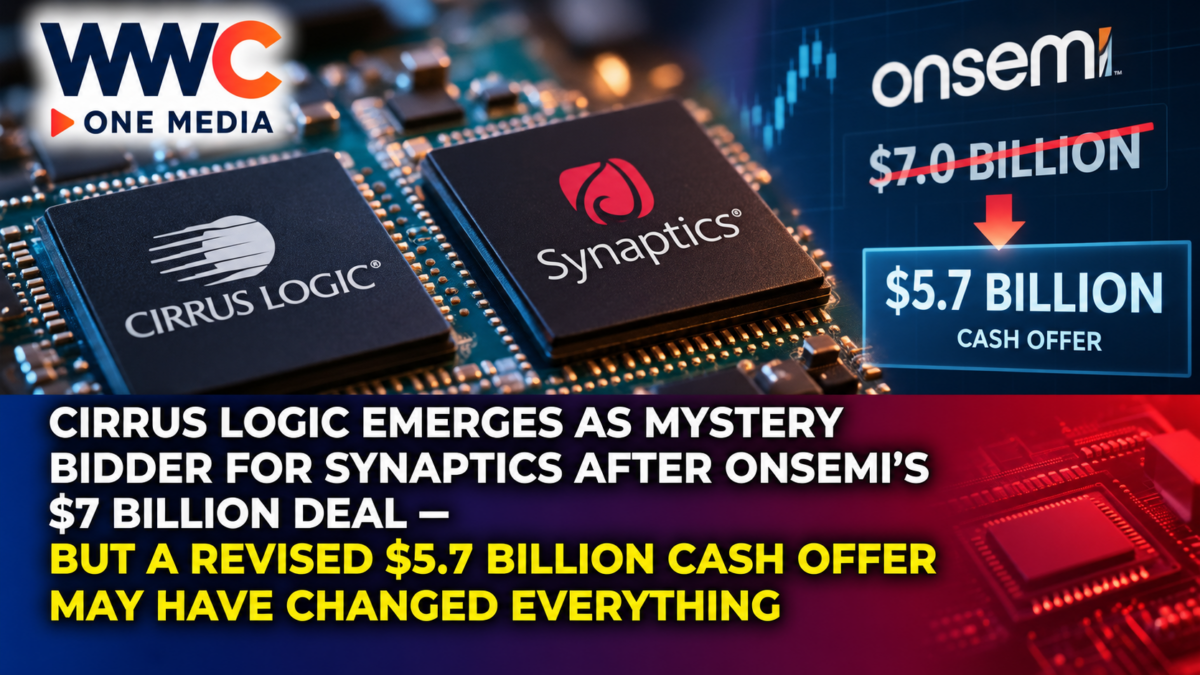
SAN JOSE, California — October 10, 2026 — A behind-the-scenes fight for US semiconductor company Synaptics has come into the spotlight after Cirrus Logic was identified in a media report as the mystery bidder that challenged Onsemi’s multibillion-dollar acquisition agreement.
According to Bloomberg, Cirrus Logic submitted an unsolicited cash-and-stock proposal for Synaptics in September, seeking to disrupt Onsemi’s previously announced purchase of the chipmaker.
The competing approach prompted a review of the transaction and contributed to a dramatic change in Onsemi’s acquisition strategy.
On October 1, Onsemi and Synaptics announced that they had replaced their original approximately $7 billion all-stock agreement with a revised transaction valued at approximately $5.7 billion in cash.
Under the new terms, Synaptics shareholders will receive $123 per share if the transaction closes.
Although the new headline value is lower than that of the original announcement, the revised offer provides fixed cash consideration rather than shares whose market value can fluctuate before closing.
Synaptics’ board unanimously approved the amended agreement after evaluating the competing proposal.
But the bigger question is whether Cirrus Logic’s challenge has ended — or whether the battle for Synaptics reflects a much larger competition for the chips that will power the next generation of artificial intelligence devices.
Cirrus Logic Reportedly Made an Unsolicited Bid for Synaptics
Bloomberg reported on October 9 that Cirrus Logic was behind the competing acquisition proposal submitted to Synaptics.
The report cited people familiar with private negotiations.
Cirrus was described as the unnamed third party referred to in Synaptics’ regulatory filings as Party A.
The filings provide extensive information about the bidding process but do not publicly identify Party A by name.
That distinction matters.
The existence of a competing proposal is confirmed in official corporate disclosures, while the identification of Cirrus Logic as the bidder comes from Bloomberg’s reporting.
The companies have not all independently confirmed that identification in the official merger documents reviewed.
It also remains unclear whether Cirrus Logic intends to pursue another proposal after Synaptics accepted Onsemi’s revised terms.
The Rival Bid Arrived After Onsemi’s Original Deal
On June 25, Onsemi announced an agreement to acquire Synaptics through an all-stock transaction valued at approximately $7 billion.
The original proposal would have given Synaptics investors 1.35 Onsemi shares for each Synaptics share.
The agreement was part of Onsemi’s strategy to expand beyond its established semiconductor businesses into connected computing, intelligent devices and physical AI applications.
But while that deal was progressing, a competing bidder continued evaluating Synaptics.
According to the merger history disclosed to US regulators, Party A submitted an unsolicited acquisition proposal on September 2.
The approach created an important decision for Synaptics’ board.
Directors were required to consider whether the new proposal could deliver greater value to shareholders than the existing Onsemi agreement.
They also needed to assess the risks of accepting an alternative transaction, including financing, execution and regulatory approval.
SEC Filings Reveal the Competing Offer
Synaptics’ merger proxy provides specific details about the September 2 proposal.
Party A initially offered $55 in cash per Synaptics share plus a fixed number of shares in its own company.
Based on the relevant market price, the proposal represented an implied total value of approximately $118.15 per Synaptics share.
Because the offer included stock, its effective value could change as the bidder’s share price moved.
The proposal was also nonbinding.
That meant it did not constitute a completed acquisition agreement.
Synaptics and its advisers subsequently engaged with the rival bidder to discuss valuation, financing and transaction terms.
The negotiations continued through September as the board considered alternatives to the original Onsemi agreement.
Rival Negotiations Became More Competitive
The regulatory documents show that Party A later improved the structure of its proposal.
During discussions on September 17, the rival bidder indicated a revised consideration package containing $57.50 in cash per Synaptics share, plus stock.
Based on the relevant share price at that time, the combination represented an implied value of approximately $124.91 per Synaptics share.
That was higher than the implied value of the bidder’s September 2 proposal.
However, the offer remained exposed to stock-price fluctuations.
Synaptics and its financial advisers considered the cash component, the bidder’s market value and the certainty of completing the proposed transaction.
The negotiations also involved corporate governance, financing commitments, legal terms and potential termination payments.
The sequence illustrates why takeover competitions cannot be evaluated through a headline price alone.
The highest indicative number does not always represent the most attractive completed transaction.
Shareholders and directors must assess how much consideration they will actually receive and the probability that the transaction will close.
Onsemi Changes Strategy With a $5.7 Billion Cash Offer
On October 1, Onsemi and Synaptics announced a revised merger agreement.
The biggest change was the payment structure.
Instead of issuing 1.35 Onsemi shares for every Synaptics share, Onsemi agreed to pay $123 in cash for each eligible Synaptics share.
The aggregate transaction value was approximately $5.7 billion.
That was lower than the approximately $7 billion valuation attached to the original agreement in June.
But the two figures should not be compared without considering their different structures.
The first deal involved Onsemi shares whose value depended on market prices.
The revised agreement provides a fixed cash amount, subject to completion of the transaction.
For Synaptics investors, that removes exposure to changes in Onsemi’s stock price between the announcement and closing.
For Onsemi, it changes the acquisition’s financing requirements and potential financial effects.
Why a Smaller Deal Can Still Be More Attractive
At first glance, reducing an acquisition’s stated value from $7 billion to $5.7 billion might seem like a weaker offer.
But stock-based merger values can fluctuate dramatically.
A fixed exchange ratio means shareholders receive a predetermined number of acquiring-company shares.
If the buyer’s stock price declines, the market value of the consideration also falls.
That dynamic affected the attractiveness of the original Onsemi proposal.
The revised cash deal offers a clearer amount for Synaptics shareholders to evaluate.
The company’s board concluded that the amended Onsemi transaction was preferable after reviewing the competing proposal with its financial and legal advisers.
This decision does not establish that Cirrus Logic submitted an inferior offer in every respect.
Rather, it reflects the board’s assessment of value, risk and closing certainty under the available alternatives.
Why Onsemi Wants Synaptics
The acquisition fits Onsemi’s effort to strengthen its position in semiconductor technologies used in intelligent electronic systems.
Synaptics develops chips and related technologies used in connectivity, sensing, computing and human-machine interfaces.
These capabilities can support applications involving consumer electronics, connected devices and industrial systems.
Onsemi is known for technologies serving automotive, industrial, power-management and sensing markets.
Combining the businesses could broaden its product portfolio.
The company has identified physical AI as an important long-term opportunity.
Physical AI generally refers to artificial intelligence integrated with physical machines and devices, allowing them to sense, interpret and respond to their environments.
Possible applications include robotics, factory automation, intelligent vehicles and other connected systems.
However, the acquisition will not automatically make Onsemi a leader in every segment of that market.
The strategic benefits depend on successfully integrating technologies, customers and operations.
Cirrus Logic’s Reported Interest Also Has Strategic Logic
Cirrus Logic specializes in semiconductor technologies used in audio, mixed-signal processing and other electronic functions.
Synaptics has capabilities in connectivity and human-interface technologies.
A combination could potentially broaden the range of components offered to device manufacturers.
That strategic overlap helps explain why Synaptics might attract interest from more than one semiconductor company.
However, the precise financial and operational advantages Cirrus expected from a transaction have not been independently established.
Those details cannot be inferred solely from the fact that a proposal was submitted.
The reported bid demonstrates competitive interest in Synaptics’ assets.
It does not prove that a Cirrus-Synaptics merger would have been more profitable or technologically successful than the revised Onsemi transaction.
Onsemi Secures Financing for the Cash Acquisition
The revised agreement creates a more substantial cash-funding requirement for Onsemi.
The company says it plans to finance the transaction using existing cash and committed debt financing.
It has obtained financing commitments from Morgan Stanley.
Separate reporting identifies a senior secured term loan commitment of up to approximately $2.45 billion.
Onsemi also stated that the amended merger agreement does not contain a closing condition tied to its financing.
This is important for deal certainty because the buyer cannot simply treat the absence of financing as a routine reason to walk away without regard to the agreement’s terms.
Nevertheless, debt financing adds obligations that Onsemi must manage after the acquisition.
Interest costs, leverage and cash-flow requirements can affect the combined company’s financial flexibility.
Investors will therefore watch whether anticipated earnings benefits and operating efficiencies justify the acquisition’s financing costs.
Onsemi Expects Faster Earnings Benefits
Onsemi has argued that the revised transaction is more attractive for its own shareholders.
The company expects the deal to contribute positively to adjusted earnings per share immediately after closing.
That is an improvement over the expectations associated with the original transaction.
Onsemi also expects opportunities to generate additional revenue and manufacturing efficiencies.
Earlier company materials identified approximately $200 million in expected annual synergies, with potential additional benefits over time.
However, synergy estimates are forecasts rather than confirmed future profits.
Achieving them will require coordination across engineering, manufacturing, sales and corporate operations.
Integration costs could also affect the financial outcome.
The revised agreement may improve the transaction’s financial structure, but it does not eliminate the operational risks associated with combining two semiconductor businesses.
Synaptics Shareholders Still Need to Approve the Transaction
The takeover is not yet complete.
Onsemi and Synaptics have said they expect the transaction to close by the middle of 2027.
Completion remains subject to approval by Synaptics shareholders and satisfaction of applicable regulatory and other conditions.
The companies have stated that the US Federal Trade Commission has approved the transaction.
Other regulatory reviews remain relevant.
Until the deal closes, Synaptics continues operating as a separate listed company.
The agreed price of $123 per share is the consideration payable upon completion under the merger terms, not proof that every shareholder has already received cash.
Any further competing offer, unexpected regulatory complication or material change in circumstances could influence the process.
However, no new binding agreement with Cirrus Logic has been confirmed in the reports reviewed.
The Takeover Reflects Competition for AI-Enabled Devices
The wider significance of the bidding contest lies in the market for semiconductors used in increasingly intelligent machines.
Much of the public attention surrounding AI has focused on expensive data-center processors and high-performance computing.
But AI also depends on smaller chips installed directly in physical devices.
Robots need sensors, controllers and connectivity.
Smart industrial equipment requires reliable data processing and communications.
Consumer devices rely on chips that connect people with software and hardware.
Companies that supply these components may benefit as more AI applications move beyond data centers.
The potential opportunity explains why established semiconductor manufacturers are seeking broader capabilities through acquisitions.
However, demand growth is not guaranteed.
Product cycles, competition, customer spending and technological shifts can affect the size and profitability of these markets.
What the Deal Means for Technology Investors
The takeover provides an example of several important factors in merger investing.
First, a competing bid can force a buyer to reconsider its original terms.
Second, an all-cash agreement and an all-stock agreement expose shareholders to different risks.
Third, a bidder’s reported interest does not guarantee that a bidding war will continue.
Fourth, announced merger consideration does not remove the possibility that a transaction could fail to close.
For Synaptics shareholders, the principal questions concern approval, timing and the likelihood of receiving the agreed cash consideration.
For Onsemi investors, attention will focus on debt financing, earnings performance and the expected strategic benefits.
For Cirrus Logic investors, the key uncertainty is whether the company will pursue other opportunities or reconsider its reported interest in Synaptics.
These considerations require analysis beyond the headline acquisition price.
Why the Story Matters for Asian Semiconductor Supply Chains
Semiconductor mergers in the United States can have implications for companies and production networks across Asia.
The industry relies on global relationships involving chip design, fabrication, packaging, testing and electronics manufacturing.
Countries including Taiwan, Japan, South Korea, Malaysia, Singapore and the Philippines participate in different parts of these supply chains.
Changes in product portfolios and manufacturing strategies can influence relationships with suppliers and customers.
For the Philippines, which has an established semiconductor assembly and testing industry, consolidation among international chip companies is worth monitoring.
However, the Onsemi-Synaptics agreement does not automatically imply new Philippine investments, factory closures or employment changes.
Any regional consequences will depend on the companies’ eventual integration plans.
Those details have not been established by the acquisition announcement.
The Bigger Picture: The Fight for Future AI Hardware Is Expanding
The Cirrus Logic report highlights how competition for artificial intelligence opportunities is extending beyond the largest computing-chip manufacturers.
Companies are also competing for technologies used in connectivity, sensing and the interaction between people and machines.
Synaptics occupies a position in these markets that has attracted strategic interest from multiple potential acquirers.
Onsemi’s revised agreement indicates how seriously it values those capabilities.
The reported Cirrus Logic proposal shows that competing buyers may have different views about how the same assets could fit into their businesses.
But the existence of multiple interested companies does not guarantee that the winning buyer will create more value.
That outcome depends on price, financing, integration and the future performance of the acquired business.
THE BOTTOM LINE
Bloomberg reports that Cirrus Logic submitted an unsolicited bid for Synaptics, challenging the semiconductor company’s previously announced acquisition by Onsemi.
US securities filings independently confirm that an unnamed Party A submitted a competing cash-and-stock proposal and participated in negotiations with Synaptics.
On October 1, Onsemi revised its original approximately $7 billion all-stock deal into an agreement to acquire Synaptics for $123 per share in cash, valuing the transaction at approximately $5.7 billion.
Synaptics’ board unanimously approved the revised terms.
The acquisition is still expected to close by mid-2027, subject to shareholder and other remaining approvals.
The biggest question is whether the reported Cirrus Logic challenge is truly over — or whether the competition for Synaptics reveals how strategically valuable connectivity and sensing chips have become in the race toward physical AI.
Onsemi appears to have strengthened its position with a revised cash offer. But the real test will come after the merger closes, when the company must prove that its multibillion-dollar bet can deliver lasting growth.