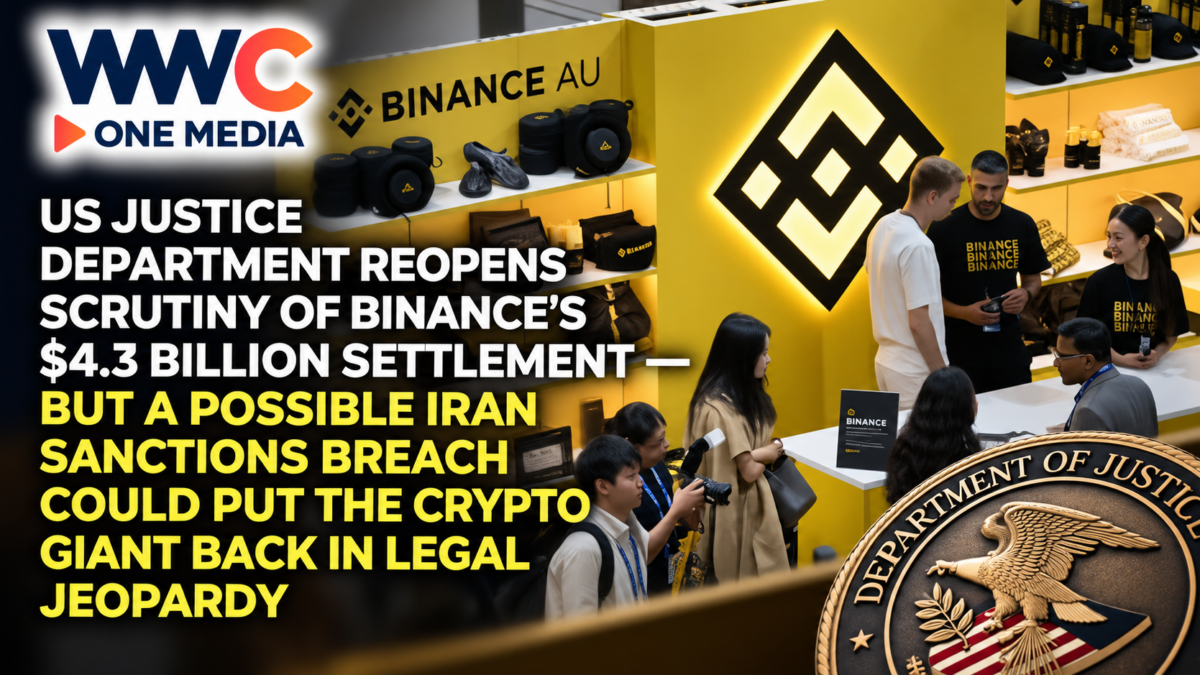
WASHINGTON, United States — October 10, 2026 — Binance is once again under scrutiny from American prosecutors, raising fresh questions about whether the world’s largest cryptocurrency exchange has fulfilled the sweeping compliance promises it made after agreeing to pay approximately $4.3 billion to resolve criminal violations in 2023.
The US Department of Justice is examining Binance’s compliance with that landmark settlement while investigating possible sanctions violations involving transactions connected to Iran.
In an interview reported by Bloomberg on October 9, Tysen Duva, head of the Justice Department’s Criminal Division, confirmed that officials were reviewing the company’s obligations under the agreement.
The review comes amid a separate federal investigation into cryptocurrency transactions allegedly connected to sanctioned Iranian oil sales.
Last month, prosecutors in Manhattan filed a civil action seeking the forfeiture of approximately $61 million in cryptocurrency that authorities allege was generated through illegal Iranian petroleum trading.
The developments have revived concerns about the ability of major cryptocurrency platforms to identify suspicious transactions, enforce economic sanctions and prevent their services from being used to move illicit funds.
However, the Justice Department has not announced that Binance breached its 2023 settlement.
The company has also maintained that it is strengthening its controls and cooperating with law enforcement.
The bigger question is whether the current investigation will end without charges — or expose Binance to renewed prosecution and potentially substantial additional financial penalties.
DOJ Confirms Review of Binance’s 2023 Settlement
The latest development marks an important escalation in regulatory attention surrounding Binance.
According to Bloomberg, Duva confirmed that officials were examining whether Binance had complied with the commitments it made when settling its previous criminal case.
Those obligations were designed to address serious weaknesses in the exchange’s anti-money-laundering and sanctions-control systems.
Duva did not disclose the precise evidence under review.
He also did not say that Binance had violated its agreement.
That distinction is essential because a compliance review does not automatically mean prosecutors have established wrongdoing.
Authorities may examine a company’s conduct and determine that no further action is warranted.
They may also identify deficiencies that require remediation or conclude that the terms of an earlier agreement have been breached.
The outcome remains uncertain.
The $4.3 Billion Settlement That Changed Binance
To understand why the current review matters, it is necessary to revisit November 21, 2023.
That day, Binance pleaded guilty to criminal charges involving US banking and sanctions laws.
The company admitted violations associated with the Bank Secrecy Act, failure to register as a money-transmitting business and the International Emergency Economic Powers Act.
Binance agreed to pay approximately $4.3 billion in criminal penalties and forfeiture.
The settlement was one of the largest corporate criminal resolutions in the cryptocurrency industry’s history.
According to the Justice Department, Binance had prioritized growth and market share while failing to implement controls required under US law.
Federal authorities said those failures allowed customers in sanctioned jurisdictions to access financial services that should have been restricted.
The company agreed to extensive compliance improvements and independent monitoring.
For Binance, the settlement was intended to mark a transition toward a more tightly regulated operating model.
The renewed DOJ review raises the question of whether those improvements have been sufficient.
Why Iran Is Back at the Center of the Investigation
Iran has become a central focus of the latest scrutiny.
US authorities have long imposed restrictions on transactions involving designated Iranian individuals, organizations and businesses.
These sanctions are intended to limit access to financial resources for sanctioned entities and activities.
Cryptocurrency creates a particular challenge because digital assets can move rapidly across borders and through multiple wallets.
Transfers may involve intermediaries, trading firms and services operating in different jurisdictions.
Investigators must determine who controls the funds, where they originated and whether regulated businesses knew or should have recognized the relevant risks.
The current Binance investigation concerns allegations of transactions connected to Iran despite restrictions intended to prevent such activity.
However, authorities have not publicly established that Binance knowingly facilitated illegal transactions in the matters now under review.
That remains a question for investigators.
Prosecutors Seek $61 Million Linked to Iranian Oil Sales
A major development occurred on September 14, when the US Attorney’s Office for the Southern District of New York announced a civil forfeiture complaint involving approximately $61 million in cryptocurrency.
Prosecutors alleged that the digital assets represented proceeds from black-market sales of Iranian crude oil and petroleum products.
They also alleged that the transactions were intended to benefit the Iranian government and military organizations, including the Islamic Revolutionary Guard Corps.
The government is seeking to recover the assets through a civil forfeiture proceeding.
The case illustrates how illicit financing investigations increasingly involve cryptocurrency infrastructure.
However, filing a forfeiture complaint does not mean a court has accepted every allegation.
The Justice Department itself emphasizes that allegations in a civil forfeiture complaint are not proven until the government obtains the necessary judgment.
The $61 million figure represents assets targeted in the proceeding, not a new fine already imposed on Binance.
Bloomberg Reports a Wider Federal Investigation
In September, Bloomberg reported that federal prosecutors were examining possible Iran sanctions violations involving Binance.
The investigation is being led by the US Attorney’s Office in Manhattan, with involvement from the Justice Department’s Criminal Division in Washington.
Investigators are examining whether the exchange allowed transactions that should have been restricted.
A central question is the adequacy of Binance’s compliance controls.
For example, investigators may assess whether suspicious accounts were identified, whether transactions were appropriately reviewed and whether the company met its obligations to cooperate with authorities.
The existence of a federal investigation is significant.
But it does not establish the company’s legal responsibility for every transaction involving a questionable counterparty.
An exchange’s potential liability depends on the applicable laws, the evidence and the conduct of the people or entities involved.
Wall Street Journal Reports Alleged Iranian Financial Network
Additional scrutiny has come from an investigation published by The Wall Street Journal.
The newspaper reported that accounts associated with Iranian financier Babak Zanjani and connected intermediaries were involved in substantial cryptocurrency activity through Binance.
Its reporting described approximately $850 million in transactions across 21 accounts linked to the network.
The investigation also discussed alleged connections involving entities associated with Iran’s Islamic Revolutionary Guard Corps.
These findings have increased public attention on the ability of cryptocurrency exchanges to detect complex sanctions-evasion networks.
However, the amounts reported by The Wall Street Journal should not be described as money that prosecutors have conclusively proven Binance illegally processed in a new criminal case.
The reporting concerns suspected activity, financial relationships and evidence examined by investigators.
The legal consequences remain unresolved.
Binance disputes allegations that its compliance efforts were inadequate and says it has taken action against suspicious accounts.
Binance Denies Claims That Its Compliance Program Failed
Binance has pushed back against reports questioning its sanctions controls.
In an earlier formal response to a US congressional inquiry, the company argued that allegations involving certain transactions and accounts had been misrepresented.
It said its internal investigations resulted in the removal of entities identified as Hexa Whale and Blessed Trust.
Binance also said it provided information to law enforcement and continued investigating suspicious activity after receiving official requests.
The company maintains that it prohibits users located in Iran from using its platform.
It has also emphasized investment in identity verification, transaction monitoring and sanctions screening.
In response to Bloomberg’s latest reporting, Binance said it continues improving controls and cooperating with authorities.
These are the company’s positions, rather than findings that independently settle the disputed allegations.
Whether its actions satisfied the requirements of the 2023 agreement is the issue now facing prosecutors.
What Did Binance Promise Under the Original Agreement?
The 2023 settlement imposed obligations extending beyond the payment of financial penalties.
Binance agreed to strengthen its anti-money-laundering and sanctions-compliance programs.
It was required to retain an independent compliance monitor for three years.
The monitor’s role includes assessing policies, internal systems and controls intended to reduce the risk of future violations.
The company also agreed to reporting obligations involving evidence or allegations of relevant misconduct.
These requirements were designed to make compliance an ongoing responsibility rather than a one-time settlement exercise.
For prosecutors, the current review may involve determining whether the company followed those commitments in practice.
The distinction matters because regulators do not evaluate compliance solely by whether a company has written policies.
They also examine whether controls function effectively when suspicious activity occurs.
Could Binance Face Another Multibillion-Dollar Penalty?
One of the most serious potential consequences is that prosecutors could conclude Binance breached its settlement agreement.
Bloomberg reported that a violation could expose the exchange to renewed prosecution over criminal activity originally resolved by the agreement.
Additional financial penalties could also be possible, depending on the governing settlement terms and any subsequent proceedings.
That possibility explains why the review is commercially significant.
However, it would be inaccurate to claim that Binance is already facing a new $4.3 billion fine.
No such additional penalty has been announced in the current matter.
Likewise, the Justice Department has not publicly confirmed that the settlement was breached.
The potential legal consequences remain contingent on the investigation’s findings.
Investors should therefore distinguish between confirmed regulatory scrutiny and hypothetical enforcement outcomes.
The Original Binance Case Involved Iran Transactions
The current allegations also carry historical significance.
In its 2023 criminal resolution, the Justice Department said Binance had failed to prevent transactions involving US users and people located in sanctioned jurisdictions.
Federal officials specifically identified Iran.
According to the DOJ, Binance’s controls allowed more than $898 million in trading between US users and users ordinarily resident in Iran between January 2018 and May 2022.
That finding was part of the historical misconduct addressed in the original settlement.
It is separate from the transactions being investigated in 2026.
The distinction is important.
The 2023 activity was resolved through the company’s guilty plea and settlement.
The current review concerns whether the exchange subsequently complied with its obligations and whether additional transactions may have violated US law.
Changpeng Zhao’s Legal History Remains Part of the Story
Binance founder Changpeng Zhao, widely known as CZ, also faced criminal consequences in 2023.
He pleaded guilty to failing to maintain an effective anti-money-laundering program at the company.
He resigned as chief executive and subsequently served a four-month prison sentence.
Zhao was later pardoned by President Donald Trump.
That pardon has attracted attention because of the broader political debate surrounding cryptocurrency regulation.
However, Zhao’s personal legal history and Binance’s corporate settlement are separate matters.
A presidential pardon granted to an individual does not automatically cancel a company’s independent contractual or regulatory obligations.
The latest investigation therefore focuses on Binance’s compliance responsibilities rather than assuming that Zhao’s pardon resolved all remaining issues.
Binance Says It Has Expanded Its Compliance Operations
Since the settlement, Binance has emphasized improvements in its compliance infrastructure.
The company has said more than 1,500 employees, representing roughly one-quarter of its global workforce, were involved in compliance-related functions.
It has also described investment in technology for monitoring transactions, identifying suspicious activity and cooperating with authorities.
The claims reflect the scale of the exchange’s stated compliance efforts.
However, staffing levels and spending do not, by themselves, demonstrate that every control is effective.
A large compliance department can still encounter difficulties identifying sophisticated financial networks.
Conversely, suspicious activity on a platform does not automatically establish that management approved it or failed to respond appropriately.
The DOJ review is important because it may provide further evidence about the effectiveness of the company’s systems.
DOJ Also Praises Cooperation With Cryptocurrency Companies
Despite the renewed investigation, the Justice Department is not presenting every cryptocurrency exchange as an adversary.
Duva has emphasized the value of cooperation between technology companies and law enforcement.
In the same Bloomberg interview, he praised digital-asset businesses for assisting investigations involving cybercrime, financial scams and transnational criminal organizations.
He also encouraged companies to voluntarily disclose suspected wrongdoing.
The DOJ’s broader approach includes supporting settlements and remediation when companies cooperate appropriately.
This creates a dual message for the cryptocurrency industry.
Authorities want exchanges to identify and report suspicious activity.
But they are also prepared to examine whether companies fulfill commitments made in earlier enforcement cases.
The policy recognizes that cryptocurrency firms can be important partners in stopping financial crime while remaining subject to legal accountability.
Why Crypto Sanctions Enforcement Is Difficult
Unlike traditional bank transfers, cryptocurrency transactions can involve publicly accessible blockchains and a large number of intermediary wallets.
Transfers may pass through decentralized protocols or services operating outside conventional banking systems.
That does not make transactions invisible.
Blockchain analysis can help investigators identify patterns and trace movement between wallets.
But determining who ultimately controls particular assets can be complicated.
The existence of a transaction involving a suspicious wallet may not reveal whether an exchange knew about the risk at the time.
Compliance teams therefore use multiple sources of information, including customer verification, transaction screening, law enforcement alerts and internal investigations.
The current Binance case underscores the difficulty of enforcing national sanctions in a financial system that operates across borders.
What the Investigation Means for Crypto Investors
The renewed scrutiny creates regulatory uncertainty around one of the cryptocurrency industry’s biggest trading platforms.
Investors and institutional clients may monitor whether the investigation affects Binance’s operations, banking relationships or ability to serve particular markets.
However, the announcement does not establish that customer funds are missing or that the exchange has become insolvent.
Those would be separate claims requiring specific evidence.
Regulatory investigations can create risks without proving a platform is financially distressed.
For users, the important considerations include the exchange’s legal status in their jurisdiction, custody arrangements, withdrawal procedures and available consumer protections.
The outcome of the DOJ investigation may influence how regulators and institutional counterparties evaluate Binance’s compliance record.
But it is too early to quantify any final commercial impact.
Why the Philippines and Southeast Asia Should Pay Attention
The Binance investigation is relevant to cryptocurrency users and regulators throughout Asia.
Digital assets are used across regional markets for trading, transfers and other financial activities.
At the same time, governments are seeking to reduce risks involving fraud, money laundering and sanctions evasion.
The Philippines has its own regulatory framework governing virtual-asset service providers and related financial activities.
An investigation in the United States does not automatically determine whether an exchange is authorized to operate in another jurisdiction.
Nonetheless, international enforcement actions can influence how local regulators assess risk.
For Philippine investors, the broader lesson is to evaluate whether a digital-asset platform is appropriately authorized and subject to effective oversight.
The importance of compliance grows as cryptocurrency trading becomes more integrated with mainstream finance.
The Bigger Picture: Crypto’s Compliance Promises Are Being Tested
The central issue in the Binance case extends beyond one exchange.
Cryptocurrency companies increasingly argue that their services can operate within the same financial-crime safeguards expected of traditional institutions.
The industry has invested in transaction surveillance and customer-identification technology.
But regulators continue examining whether those systems work when confronted with complex financial networks.
The Binance settlement was intended to demonstrate that a major exchange could address past misconduct and operate under stronger controls.
The renewed DOJ review tests that proposition.
If prosecutors determine that Binance complied with its commitments, the investigation may ultimately close without new charges.
If they find serious violations, the consequences could be significant for the company and the broader industry.
Either outcome could influence future enforcement expectations.
THE BOTTOM LINE
The US Justice Department is reviewing whether Binance complied with its 2023 criminal settlement, which required the cryptocurrency exchange to pay approximately $4.3 billion and strengthen its anti-money-laundering and sanctions controls.
The review comes as federal prosecutors investigate possible Iran-related transactions on the platform.
In September, authorities also sought the forfeiture of approximately $61 million in cryptocurrency allegedly linked to illicit Iranian oil sales.
Binance maintains that it cooperates with law enforcement and has strengthened its compliance systems.
The Justice Department has not announced that the company breached its earlier agreement, and the investigation may end without new charges.
The biggest question is whether Binance can demonstrate that the reforms promised after its historic settlement were effective — or whether US prosecutors will conclude that the exchange failed to meet obligations central to its previous criminal resolution.
Binance paid billions to move beyond its past regulatory failures. Now, a renewed US investigation could determine whether that chapter is truly closed.