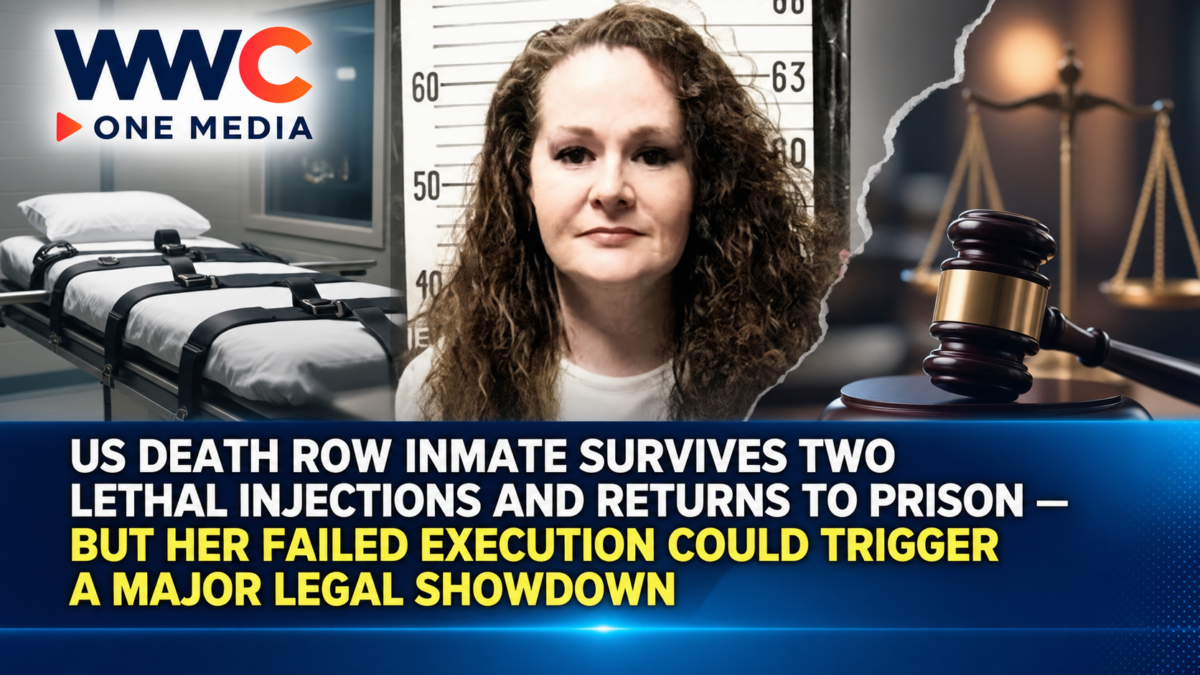
NASHVILLE, TENNESSEE — A 50-year-old American woman who survived an attempted execution involving two doses of a lethal drug has been discharged from hospital and returned to prison, reigniting a fierce national debate over the death penalty. Christa Pike, convicted of the 1995 murder of teenager Colleen Slemmer, survived Tennessee’s September 30 execution attempt despite receiving pentobarbital, a drug intended to cause death. Now, with the state suspending further executions and launching an independent investigation, her case could become a major test of constitutional protections against cruel and unusual punishment.
A death row inmate who survived an execution attempt in Tennessee has returned to prison after an extraordinary medical recovery, raising urgent questions about the safety, legality and future of lethal injection in the United States.
Christa Pike, 50, was discharged from a Nashville-area hospital on October 10, 2026, after spending approximately 10 days receiving treatment following a failed execution.
According to Channel NewsAsia, citing Agence France-Presse, Pike has returned to the Deborah K. Johnson Rehabilitation Center, where she had been incarcerated for approximately three decades.
Her attorneys confirmed that she continues receiving medical attention while recovering from the physical and psychological consequences of the procedure.
Pike’s survival is particularly unusual because lethal injection is specifically designed to end a prisoner’s life.
The Death Penalty Information Center has identified her as the first known person to survive an execution attempt after lethal-injection drugs were actually administered.
Previous attempted executions have been abandoned because officials struggled to establish intravenous access, but Pike’s case involved the administration of the execution drug.
For Tennessee authorities, the incident has created a major crisis of confidence in the state’s capital punishment system.
For Pike’s attorneys, it has strengthened their argument that another execution attempt would subject her to unconstitutional suffering.
How Christa Pike Survived Two Doses of a Lethal Drug
Pike was scheduled to be executed on September 30 at Riverbend Maximum Security Institution in Nashville.
The state planned to use pentobarbital, a powerful barbiturate employed in some American lethal-injection protocols.
According to reporting by Reuters, Associated Press and CNA, the execution team administered two doses of the drug.
However, the procedure failed to cause her death.
During the execution attempt, Pike experienced severe complications and ultimately required emergency medical treatment.
She was transferred to hospital in critical condition and spent part of her recovery on a ventilator.
Medical experts have raised the possibility that the intravenous drugs did not enter her bloodstream as intended.
If medication leaks into surrounding tissue rather than circulating properly, the expected effects can be altered and local tissue damage can occur.
However, this explanation remains a medical hypothesis.
Tennessee authorities have not publicly established the definitive cause of the failed execution.
The investigation must determine what happened during the drug administration and whether procedures were followed appropriately.
Lawyers Say Pike Woke Up Confused After Doctors Feared the Worst
Pike’s condition initially appeared extremely serious.
Her attorneys reported that she suffered significant medical complications, including impaired movement in one arm and concerns about her neurological condition.
At one stage, her legal team feared that she might not regain meaningful consciousness.
But she subsequently awakened and began speaking.
Reuters reported on October 6 that Pike had become conscious and was able to communicate with people around her.
Her lawyers described her as confused and struggling to understand what had happened.
Additional reporting indicated that she experienced memory and concentration difficulties while recovering.
Her attorney, Randy Spivey, said she woke up asking where she was and who was speaking to her.
The remarkable recovery did not mean she had escaped serious injury.
Pike still required continued medical observation following her discharge.
Her long-term recovery and any lasting neurological or physical effects had not been fully established as of October 11.
Pike Returns to Prison After 10 Days in Hospital
On October 10, Pike’s legal team confirmed that she had been discharged from hospital.
The attorneys said she was transferred back to the Deborah K. Johnson Rehabilitation Center in Tennessee.
She had previously been held at the facility for approximately 30 years.
In their statement, her lawyers expressed appreciation for the medical personnel and emergency responders who treated her.
They also confirmed that she would continue receiving medical care in prison.
The transfer marked an important development after days of uncertainty about whether she would survive the failed execution.
However, returning to prison does not mean her death sentence has been cancelled.
Her attorneys are continuing to pursue legal remedies and a possible commutation of her sentence.
The question of whether Tennessee could lawfully attempt to execute her again remains unresolved.
Who Is Christa Pike, and Why Was She Sentenced to Death?
The extraordinary circumstances of Pike’s survival have brought renewed attention to the violent crime that placed her on death row.
In 1995, when Pike was 18, she participated in the killing of 19-year-old Colleen Slemmer in Knoxville, Tennessee.
The victim was a fellow participant in a job-training program.
According to court records and reporting summarized by Associated Press, Pike and accomplices attacked Slemmer in a secluded area.
The crime involved severe violence and resulted in Slemmer’s death.
Pike was convicted and sentenced to death in 1996.
Her boyfriend, Tadaryl Shipp, who was a minor at the time, received a life sentence.
The case remains deeply painful for Slemmer’s family.
Any examination of the failed execution must recognize both the seriousness of the original murder and the constitutional limits governing the punishment imposed by the state.
Pike’s conviction has not been overturned by her survival.
The current legal controversy concerns the execution procedure, her medical condition and whether another attempt would violate her constitutional rights.
Tennessee Governor Suspends Executions After Failed Procedure
The attempted execution triggered immediate action from Tennessee Governor Bill Lee.
Lee ordered a suspension of executions for the remainder of 2026 and called for an independent review of the state’s execution procedures.
The review is intended to examine the circumstances surrounding Pike’s failed execution and identify possible operational or medical failures.
The incident was particularly serious because Tennessee had already experienced another unsuccessful execution attempt earlier in the year.
In May, the state failed to complete the scheduled execution of inmate Tony Carruthers.
That earlier incident raised concerns about the reliability of execution procedures.
The two failures have intensified scrutiny of Tennessee’s ability to carry out the death penalty under its existing protocols.
The suspension does not automatically abolish capital punishment in Tennessee.
It temporarily halts further executions while officials investigate the problems.
Whether the state resumes executions, changes its procedures or adopts other measures will depend on the review and future legal decisions.
Tennessee Corrections Chief Resigns Amid Execution Crisis
The fallout has also reached the leadership of Tennessee’s correctional system.
Corrections Commissioner Frank Strada resigned after the failed execution.
His departure came as the state faced increasing criticism over the handling of lethal-injection procedures.
The resignation has added pressure on officials to explain how an execution involving two drug doses could fail so dramatically.
However, the timing of a resignation does not by itself establish personal legal wrongdoing or responsibility for every aspect of the incident.
The independent investigation will need to examine the role of medical personnel, execution-team procedures, intravenous access, equipment and oversight arrangements.
For state officials, restoring confidence will require more than replacing senior personnel.
It will require a credible explanation of the failure and evidence that future procedures can comply with constitutional requirements.
Court Orders Tennessee to Preserve Evidence
Pike’s lawyers have also secured an important court order.
According to Reuters and The Washington Post, a Tennessee judge directed state authorities to preserve evidence connected with the attempted execution.
Potentially relevant evidence could include medical documentation, records of the procedure and other materials needed to investigate what happened.
The preservation order is significant because the legal dispute may turn on whether the execution team followed proper procedures and whether Pike suffered avoidable injuries.
Her attorneys have accused the state of insufficient transparency.
They have also sought adequate access to their client while she receives medical treatment.
The court’s action protects the availability of evidence for future proceedings.
It does not establish that prison officials committed constitutional violations.
Those questions remain subject to litigation and investigation.
Lawyers Demand Life Without Parole Instead of Another Execution
Pike’s legal team is urging Governor Lee to commute her death sentence to life imprisonment without the possibility of parole.
Their argument is that the state should not subject her to another potentially traumatic or dangerous execution attempt after the failed September 30 procedure.
Her attorneys also previously raised concerns about her medical condition and the difficulties associated with intravenous access.
They warned that existing procedures could cause unnecessary suffering.
The case may involve the Eighth Amendment to the US Constitution, which prohibits cruel and unusual punishments.
American courts have previously examined challenges to lethal-injection methods and the circumstances under which particular execution procedures may be unconstitutional.
However, surviving a failed execution does not automatically establish a legal right to commutation.
The outcome would depend on judicial rulings, executive clemency decisions and the facts established during the investigation.
Pike remains under a death sentence unless a court or authorized executive action changes that status.
Why the Failed Execution Is Historically Unusual
The United States has experienced multiple failed or aborted execution attempts involving difficulties establishing intravenous access.
However, Pike’s experience is distinct.
According to the Death Penalty Information Center, she is the first known prisoner to survive a lethal-injection execution attempt after lethal drugs had actually been administered.
That distinction has intensified public attention because it raises questions about both the effectiveness of the execution procedure and the suffering associated with unsuccessful attempts.
Lethal injection has frequently been presented as a more controlled method of execution than older methods.
But critics argue that inadequate medical transparency, difficulty obtaining appropriate drugs and procedural failures can create serious risks.
Supporters of capital punishment contend that the state has a legitimate interest in carrying out lawful sentences imposed after criminal convictions.
The disagreement is therefore not limited to the specific drug used.
It concerns the state’s ability to administer the death penalty consistently, lawfully and without unconstitutional suffering.
Associated Press: Death Penalty Debate Intensifies Nationwide
Associated Press reporting has placed Pike’s case within a broader debate over capital punishment in the United States.
Some states continue to use lethal injection, while others have authorized alternative methods.
Critics argue that failed executions demonstrate fundamental problems with capital punishment.
They point to medical complications, prolonged suffering, secrecy surrounding execution procedures and the possibility of irreversible miscarriages of justice.
Supporters argue that capital punishment remains appropriate for certain especially serious crimes and that procedural failures should lead to reforms rather than abolition.
The legal debate is complicated because constitutional rules governing execution methods differ from broader moral arguments about whether the death penalty should exist.
Pike’s case has brought these questions together.
Her survival has created a rare situation in which courts may be asked to consider the physical consequences of an execution that was carried out but did not cause death.
Trump’s Administration Faces a Wider Capital Punishment Debate
The controversy comes as President Donald Trump’s administration maintains support for capital punishment at the federal level.
The federal government previously operated under an execution moratorium during President Joe Biden’s administration.
Trump’s administration moved to reverse that approach after returning to office in 2025.
Meanwhile, a separate controversy has emerged over plans for a US military execution by firing squad.
According to CNA and AFP, former Army psychiatrist Nidal Hasan is scheduled to be executed on December 3, 2026, in connection with the 2009 Fort Hood shooting that killed 13 people.
A proposal to livestream the military execution has sparked criticism, including from individuals who otherwise support the death penalty.
Trump has indicated that he will ultimately decide whether the broadcast proceeds.
These developments are separate from Pike’s case, but together they demonstrate how execution methods and public accountability have become prominent national issues.
Pope Leo Criticizes Capital Punishment
The broader controversy has also drawn comment from Pope Leo.
The pontiff reiterated the Catholic Church’s opposition to the death penalty, describing it as incompatible with respect for human dignity.
His comments came amid criticism of the proposed public broadcast of a military execution.
The Catholic Church’s position is based on its teaching that human dignity should be respected even when a person has committed a serious crime.
Other religious and ethical perspectives differ on the circumstances under which capital punishment may be justified.
Pike’s case has renewed this debate because the state attempted to carry out an execution, but the prisoner survived with serious medical consequences.
For opponents of the death penalty, the incident underscores the potential for suffering during state-administered executions.
For supporters, it raises questions about whether procedural reforms could prevent similar failures.
Death Penalty Remains Legal in Many US States
Capital punishment remains part of the American criminal justice system, although its use varies significantly by jurisdiction.
As of October 2026, 23 US states have abolished the death penalty.
California, Oregon and Pennsylvania maintain execution moratoriums.
Other states continue to authorize capital punishment, subject to state and federal legal requirements.
Tennessee remains among the states that permit the death penalty.
However, Governor Lee’s suspension means further executions are temporarily halted during the review.
The situation illustrates the fragmented nature of capital punishment policy across the United States.
Different states have adopted different approaches to execution methods, clemency, sentencing and oversight.
Pike’s legal proceedings could influence future arguments over execution protocols, although no nationwide precedent has yet been established.
Could Tennessee Attempt to Execute Christa Pike Again?
The most important unresolved question is what happens next.
Pike remains under a valid death sentence, but her lawyers are seeking commutation and other legal protections.
Tennessee authorities are investigating the execution failure.
A judge has ordered preservation of evidence, potentially allowing courts to examine whether the attempted execution violated constitutional standards.
The state could face significant legal challenges before any future attempt.
However, the final outcome remains uncertain.
A new execution date has not been confirmed in the reporting available as of October 11.
Nor has a court established that a second execution attempt would necessarily be unconstitutional.
For Pike’s attorneys, the immediate priority is ensuring access to medical care, documenting her injuries and preventing a renewed execution without a full examination of the first attempt.
For the state, the challenge is explaining the failure while fulfilling its legal and constitutional responsibilities.
What the Case Means for Global Human Rights Discussions
Although the incident occurred in Tennessee, it has attracted international attention.
Countries differ considerably in their treatment of capital punishment.
Some have abolished it entirely, while others retain the death penalty for particular crimes.
The Philippines abolished the death penalty under Republic Act No. 9346 in 2006.
Debates over reinstatement have periodically resurfaced, but capital punishment has not been restored under Philippine law.
The Tennessee incident offers a reminder of the legal, medical and ethical questions associated with execution procedures.
It also demonstrates the importance of independent oversight when governments exercise their most severe powers.
However, the American case does not directly change Philippine criminal law.
Its relevance lies primarily in the broader international discussion about justice, punishment and human rights.
The Bigger Picture: A Failed Execution Becomes a Test of American Justice
Christa Pike’s survival has left Tennessee facing a crisis few states have encountered.
The government attempted to carry out a death sentence using lethal injection.
Two doses of pentobarbital were administered.
The prisoner survived, suffered serious complications and required prolonged hospital treatment before returning to prison.
The incident prompted the suspension of executions, the resignation of a senior corrections official and an independent review.
It has also created potentially significant litigation concerning execution methods and constitutional protections.
For the family of Colleen Slemmer, the case remains inseparable from the violent murder that led to Pike’s conviction.
For Pike’s attorneys, the failed procedure raises a separate question about the limits of state punishment.
Both aspects are essential to an accurate understanding of the controversy.
Christa Pike has survived an execution attempt that was intended to end her life, becoming the first known American prisoner to survive after lethal-injection drugs were administered.
But her return to prison has not resolved the crisis. Instead, it has opened a far-reaching legal and ethical debate over whether Tennessee can attempt to execute her again after a procedure that caused serious injury and failed to achieve its intended result.
The next major decision may determine not only Pike’s future but also how American courts evaluate the constitutional consequences of a failed execution.