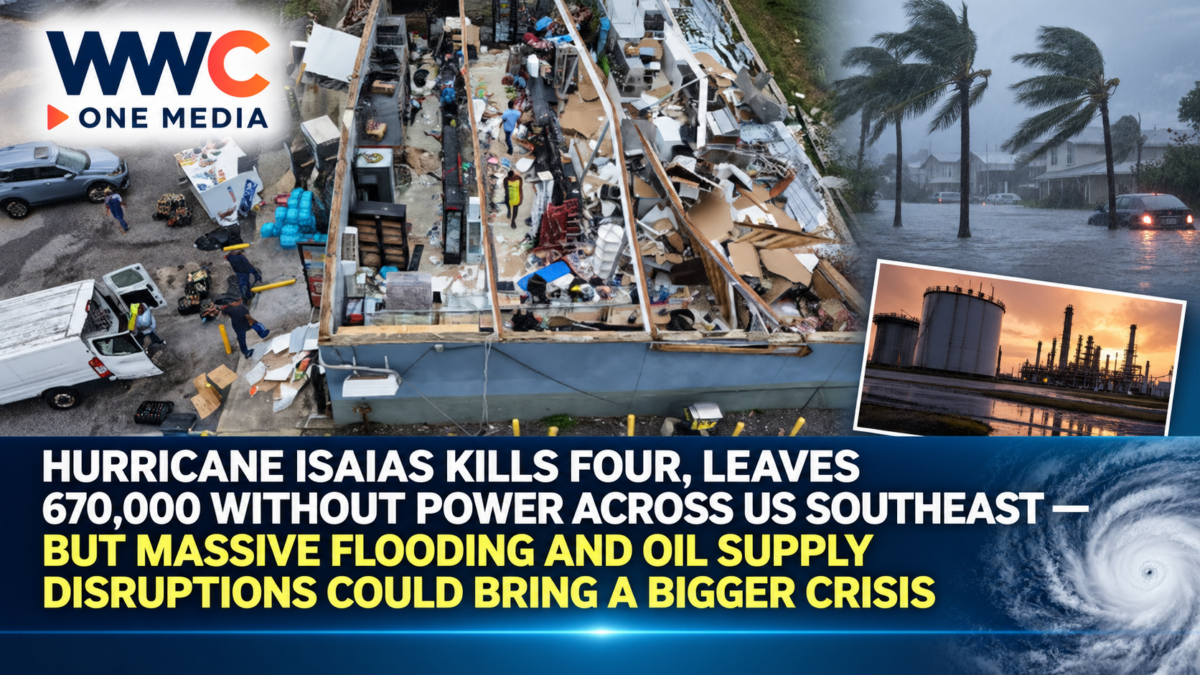
FLORIDA, UNITED STATES — Hurricane Isaias has killed at least four people and left approximately 670,000 electricity customers without power across the southeastern United States after striking Florida’s Gulf Coast as a powerful Category 2 storm. Although Isaias has weakened into a post-tropical cyclone, authorities warn that flash floods, tornadoes and dangerous conditions could continue threatening communities. Meanwhile, severe disruptions to offshore oil and natural gas production are raising new concerns about America’s energy supply.
The southeastern United States is confronting widespread destruction after Hurricane Isaias slammed into Florida’s Panhandle, bringing destructive winds, heavy rainfall and coastal flooding before pushing inland.
The storm made landfall near Destin, Florida, late on October 9, with sustained winds of approximately 105 miles per hour, equivalent to 169 kilometers per hour.
By Saturday, October 10, authorities had confirmed at least four fatalities, while hundreds of thousands of households and businesses remained without electricity.
According to Reuters, in reporting carried by Channel NewsAsia, approximately 670,000 electricity customers were without power across Florida, Alabama, Georgia and Mississippi as of midday Saturday.
The storm also uprooted trees, damaged buildings, blocked roads and disrupted airport operations.
But the immediate impact may be only part of the danger.
Even after the hurricane weakened, forecasters warned that heavy rainfall could trigger additional flash flooding, while unstable weather conditions could produce tornadoes across parts of the Southeast.
At the same time, offshore energy producers were struggling to restart operations after shutting down significant portions of US Gulf of Mexico oil and natural gas production.
Hurricane Isaias Kills Four as Deadly Storm Sweeps Across Southeastern States
The death toll reached four as emergency teams assessed damage across the affected states.
According to Reuters, two people died after trees fell onto homes.
Additional reporting by the Associated Press and The Guardian linked other fatalities to storm-related incidents, including carbon monoxide poisoning associated with generator use.
The fatalities underscore the dangers that hurricanes can create even after their strongest winds have passed.
Fallen trees, damaged buildings, flooding and disrupted electricity supplies can continue threatening residents during recovery.
Emergency officials have urged people to avoid unsafe roads, damaged structures and downed power lines.
They also warn that portable generators must never be operated inside homes, garages or other enclosed spaces because their exhaust can produce lethal carbon monoxide.
As recovery operations continue, authorities may update casualty assessments and damage figures.
The four fatalities represent the toll reported in the coverage available by October 11, rather than a guarantee that no additional storm-related deaths will be identified.
Florida Suffers the Largest Share of Power Outages
Florida was the hardest-hit state in the outage snapshot reported by Reuters.
PowerOutage.us recorded approximately 420,000 customers without electricity in Florida, followed by 190,000 in Alabama, 43,000 in Georgia and 17,000 in Mississippi.
The combined total was approximately 670,000.
These figures refer to electricity customers rather than individual residents, meaning the number of people affected could be substantially larger.
Other news organizations reported that the total number of customers who lost power at some point during the storm approached or exceeded 800,000.
Those higher figures describe a different period or measure of storm impact, and should not be confused with the midday October 10 outage count.
Restoring electricity has become a major priority for local authorities.
Florida Governor Ron DeSantis said approximately 16,000 utility line workers had been prepared to respond to the storm.
Crews were assessing damaged distribution systems, clearing debris and working to restore service where conditions permitted.
However, repairs could be complicated by flooding, fallen trees and unsafe road access.
Pensacola Hit by Destructive Winds, Flooding and Infrastructure Damage
Communities along Florida’s Gulf Coast experienced some of the storm’s most visible damage.
In Pensacola and nearby areas, strong winds overturned vehicles and trailers, uprooted trees and left roads covered with debris.
Coastal flooding also affected parking areas and low-lying roads.
The Associated Press reported damage to Pensacola International Airport and other infrastructure.
Some airports, highways and bridges began reopening as conditions improved.
However, transportation recovery depended on damage inspections and the removal of hazards.
Local authorities cautioned residents against unnecessary travel while recovery crews were still working.
The damage demonstrates that infrastructure disruption can continue long after a hurricane has weakened.
Even where major buildings remain standing, fallen power lines, blocked roads and flooded facilities can prevent communities from returning immediately to normal activities.
Alabama Closes Roads as Dangerous Flooding Threat Continues
Alabama also experienced serious disruptions.
Emergency officials in Houston County announced the closure of all county roads because of fallen trees, damaged electrical lines and dangerous travel conditions.
Flash flood warnings added to concerns about driving through affected areas.
Floodwater can conceal damaged road surfaces, debris and dangerous currents.
Authorities advised residents to avoid travel until emergency crews could assess and reopen roads safely.
As the storm’s remnants moved inland, forecasters continued monitoring rainfall and possible tornado development.
The threat extended beyond areas directly struck by the hurricane at landfall.
This is an important characteristic of tropical cyclones: they can produce dangerous weather far from the coast, even after their sustained winds weaken below hurricane strength.
Isaias Weakens, but Flood and Tornado Warnings Remain
The US National Hurricane Center reported that Isaias had weakened into a post-tropical cyclone by October 10.
The change in classification indicated that the system no longer retained the same tropical structure it had possessed over the Gulf of Mexico.
However, becoming post-tropical does not automatically make a storm harmless.
The remaining circulation can still generate strong winds, heavy rainfall and dangerous flooding.
The National Weather Service warned of possible flash floods affecting portions of Georgia, the Carolinas, Tennessee Valley and other southeastern areas.
The Guardian reported that rainfall totals could reach approximately 15 inches in some locations.
Actual impacts would depend on where the heaviest precipitation occurred and how quickly local rivers, drainage systems and waterways responded.
Communities in flood-prone locations were urged to remain alert despite the storm’s weakening status.
Trump Approves Emergency Federal Assistance
President Donald Trump approved emergency declarations to support affected states.
According to the Associated Press, federal assistance was authorized for Florida, Alabama and Georgia.
The declarations allowed federal resources to support emergency operations and help state and local authorities respond to the storm.
The Federal Emergency Management Agency, or FEMA, plays an important coordinating role in such situations.
Federal assistance can support emergency protective measures, logistical operations and other eligible response activities.
However, an emergency declaration does not automatically mean every damaged property or individual household qualifies for direct financial assistance.
The scope of aid depends on the specific declaration, eligibility rules and subsequent federal decisions.
For affected communities, the immediate priority remains protecting lives and restoring essential services.
Gulf of Mexico Oil Production Faces Major Shutdowns
Beyond the humanitarian and infrastructure damage, Isaias has disrupted one of America’s most important energy-producing regions.
According to Reuters, approximately 69% of offshore oil production and 57% of natural gas output in the US Gulf of Mexico remained shut down as of Saturday.
Some 113 production platforms, representing approximately 30% of the total monitored facilities, were still evacuated.
The closures were precautionary measures intended to protect workers and equipment from dangerous offshore conditions.
But the scale of disruption highlights the importance of the Gulf region to American energy production.
Even temporary shutdowns can affect the timing of crude oil and gas deliveries.
The extent of the economic impact depends on how quickly production resumes and whether platforms, pipelines or refineries suffered lasting damage.
The reported shutdown percentages represent the offshore output affected at that point in time.
They do not mean that 69% of total US oil production or 57% of all US natural gas production had stopped.
Shell and Chevron Begin Restarting Offshore Operations
Major energy companies have begun taking steps to restore production.
Reuters reported that Shell started redeploying personnel to its Mars, Olympus, Ursa, Vito and Appomattox offshore assets.
Chevron also began preparations to return workers to its platforms.
The company indicated that crew remobilization would continue through Sunday, October 11.
Restoring offshore production requires inspections of platforms, safety systems, transportation arrangements and supporting infrastructure.
The process can take longer if facilities experienced storm damage or if offshore weather conditions remain unsafe.
The return of workers is an encouraging sign for the energy sector.
However, redeploying personnel does not necessarily mean every platform has resumed full production.
Energy markets will continue watching how quickly operators can restore their output.
US Releases Emergency Oil Supplies to Ease Energy Disruptions
The US Energy Department has also taken precautionary steps to manage potential supply disruptions.
Reuters and Associated Press reported that the department authorized access to as much as four million barrels of crude oil from the Strategic Petroleum Reserve.
The measure was intended to help address refinery supply problems associated with the hurricane.
The Strategic Petroleum Reserve is an emergency government stockpile designed to provide additional supply during significant disruptions.
Authorizing barrels for emergency use does not necessarily mean that the entire approved volume has already been physically delivered to refiners.
Actual use depends on the terms of the arrangements and operational needs.
The move reflects the government’s concern that hurricane-related disruptions could affect more than offshore production.
Refineries, ports, pipelines and transportation networks can also experience operational problems following severe storms.
Financial Times: Hurricane Disrupts Nearly 70% of Offshore Oil Output
The Financial Times separately reported that Hurricane Isaias caused extensive shutdowns in the Gulf of Mexico energy sector.
Approximately 70% of offshore oil output was halted as companies evacuated workers and secured facilities.
The publication noted that oil prices might not respond dramatically if production recovered quickly.
However, prolonged interruptions or damage to refineries could create greater pressure.
This distinction is important.
A large percentage of offshore production being temporarily shut does not automatically translate into an equivalent reduction in available fuel for consumers.
Inventories, alternative production, imports and refinery operations all influence market supply.
Nevertheless, investors are monitoring restoration efforts because the Gulf of Mexico remains a strategically important source of US crude oil and natural gas.
Could the Hurricane Push Global Oil Prices Higher?
The interruption raises concerns about possible effects on international energy markets.
If production platforms restart quickly and infrastructure damage is limited, market effects may be temporary.
However, prolonged shutdowns could tighten supply under certain conditions.
Refinery damage or extended transportation disruptions could also affect regional gasoline and diesel availability.
For international oil markets, the consequences depend on global inventories, demand, alternative supplies and the duration of operational interruptions.
Higher prices are a possibility, not a confirmed consequence of the hurricane.
For oil-importing countries such as the Philippines, global crude and fuel prices matter because changes can influence transportation, electricity generation and business costs.
However, no direct increase in Philippine pump prices can be attributed to Isaias without evidence from global market movements and local pricing conditions.
The Guardian: Isaias Becomes an Unusual Late-Season Hurricane
Hurricane Isaias is also drawing attention because of its timing.
The Guardian reported that it was among the latest-forming first Atlantic hurricanes of a season on record, with comparisons to an event in 1905.
The storm developed during a season in which forecasters had expected relatively subdued activity because of El Niño conditions.
El Niño can increase upper-level wind shear across portions of the Atlantic, potentially making hurricane development more difficult.
However, seasonal forecasts do not eliminate the possibility of dangerous storms.
Even a relatively quiet hurricane season can produce a highly destructive landfall.
Climate scientists also distinguish between long-term changes in hurricane behavior and the weather conditions responsible for any single event.
Warmer ocean temperatures can influence storm intensity and rainfall potential, but attributing one particular hurricane to climate change requires dedicated scientific analysis.
Another Storm Threatens Mexico and California
While the US Southeast was dealing with Isaias, the eastern Pacific was experiencing additional tropical cyclone activity.
Tropical Storm Rachel approached the northern Baja California region, bringing strong winds, rough seas and elevated tides.
Reuters reported approximately 7,000 electricity customers without power in California in connection with the storm’s effects.
Meanwhile, Associated Press reported that Hurricane Simon intensified to Category 4 strength as it approached Mexico’s Pacific coast.
Authorities warned of potentially severe rainfall, flooding, storm surge and landslides in vulnerable coastal and mountainous areas.
These are separate storm systems from Isaias.
Their simultaneous occurrence does not mean they are part of one connected weather system.
Nevertheless, they illustrate the multiple emergencies that authorities across North America were managing during the same period.
Why the Disaster Matters for the Philippines and Asia
Although Hurricane Isaias struck the United States, its impact has international relevance.
The Philippines is highly exposed to typhoons, flooding, storm surges and other weather-related hazards.
The disaster illustrates challenges also faced by Philippine emergency agencies, including evacuation planning, electricity restoration, flood management and the protection of critical infrastructure.
The American response also demonstrates the importance of deploying trained repair crews and coordinating assistance across different jurisdictions.
For Asian energy importers, the Gulf of Mexico production interruptions provide another reminder that extreme weather can affect international fuel supply chains.
However, Isaias is not a Philippine tropical cyclone, and its weather hazards do not directly threaten the Philippine archipelago.
Any impact on Philippine fuel prices or economic conditions would depend on international market transmission rather than the storm itself.
The Bigger Picture: Hurricane Isaias Leaves a Dangerous Recovery Ahead
Hurricane Isaias has left four people dead, hundreds of thousands without power and extensive damage across the southeastern United States.
Its landfall near Destin, Florida, brought destructive winds and coastal flooding, while its movement inland created additional threats of flash flooding and tornadoes.
Emergency declarations and thousands of utility workers have supported the response.
Yet restoring electricity, reopening damaged infrastructure and ensuring safe conditions for displaced or affected residents remain major challenges.
The storm has also disrupted Gulf of Mexico energy production at a time when global markets are sensitive to supply changes.
As Shell, Chevron and other operators work toward resuming production, officials will continue assessing the scale of the damage.
The immediate crisis may ease as weather conditions improve.
But the economic and human consequences could persist well beyond the storm’s departure.
Hurricane Isaias has already killed four people and left approximately 670,000 electricity customers without power in the US Southeast, according to an October 10 outage snapshot.
But the bigger concern is that flooding, damaged infrastructure and widespread energy production shutdowns could prolong the recovery even after the hurricane has weakened.
For affected communities, the next major test is not simply surviving the storm — it is restoring essential services, rebuilding damaged properties and preventing additional deaths during the recovery.