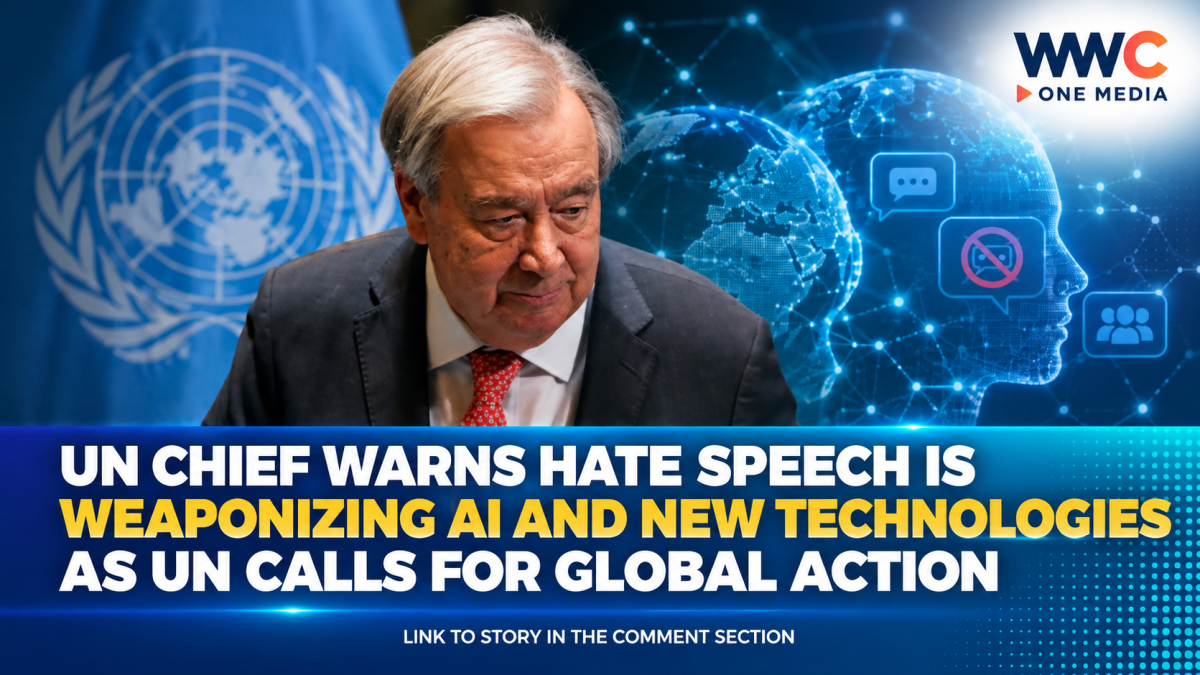
UNITED NATIONS — United Nations Secretary-General António Guterres is warning that hate speech is rapidly adapting to the digital age, with artificial intelligence, algorithms and online platforms giving hateful narratives new ways to spread across borders and reach millions.
Speaking at a global conference on interreligious and intercultural dialogue and countering hate speech on Sept. 17, Guterres called for governments, technology companies, civil society and communities to work together to confront the growing problem.
He said hate speech is “taking on new forms” and “finding new pathways,” including through digital platforms, algorithms and AI.
AI and Algorithms Are Changing How Hate Spreads
The UN chief said the rapid development of digital technology has given hate speech unprecedented speed and reach.
Online systems can rapidly amplify inflammatory material, allowing messages that once remained confined to small communities to circulate across countries and cultures.
Guterres warned that the expanding reach of hate speech can erode trust, divide communities and contribute to the dehumanization of entire groups.
The UN has previously warned that artificial intelligence and algorithm-driven platforms can intensify the spread of harmful content when systems reward outrage and divisive engagement.
Hate Speech Can Go Beyond Words
Guterres emphasized that hate speech can have consequences beyond offensive language.
In its most serious forms, the UN says hate speech can contribute to discrimination, violence, conflict and atrocity crimes.
The Secretary-General pointed to racism, misogyny and xenophobia, as well as antisemitism, anti-Muslim hatred and discrimination against religious and ethnic minorities, as examples of forms of hatred that can become normalized in society.
UN General Assembly President Khalilur Rahman similarly warned that hateful narratives can grow from fear and a lack of understanding before being exploited by people seeking to target particular groups.
He argued that dialogue and tolerance can help address those underlying causes.
UN Calls for a Whole-of-Society Response
Rather than placing responsibility solely on governments, Guterres called for a broad international response involving governments, technology companies, regional and multilateral organizations, civil society, faith communities, academia and the media.
He urged countries to address not only the consequences of hate speech but also its underlying drivers.
The UN’s existing Strategy and Plan of Action on Hate Speech provides a framework for governments and other stakeholders to address the issue, while the organization has also promoted initiatives aimed at protecting religious sites and strengthening information integrity.
Fighting Hate Without Silencing Free Expression
One of the central challenges highlighted by Guterres is how to combat harmful speech without undermining legitimate freedom of expression.
The Secretary-General stressed that efforts to rein in hate speech should not amount to eliminating free expression.
At the same time, he argued that freedom of expression should not be used as a justification for content that causes or compounds serious harm.
That tension is becoming increasingly important as AI-generated and algorithmically amplified content becomes more widespread.
Technology Can Also Be Part of the Solution
The UN’s position is not that technology itself is inherently responsible for hate speech.
In his remarks, Guterres called for responsible action using the tools available today, while the General Assembly president noted that properly designed and governed emerging technologies can also help identify risks, improve access to accurate information and strengthen resilience against hateful narratives.
That means the debate is increasingly shifting toward how AI platforms and digital systems are designed, governed and used, rather than simply whether the technology exists.
A Growing Global Challenge
The UN’s latest warning comes as artificial intelligence becomes increasingly integrated into social media, search, content creation and communication.
That expansion creates new opportunities for information sharing but also raises questions about how quickly harmful narratives can be produced, translated, personalized and distributed.
For the United Nations, the response must therefore involve more than removing individual pieces of content.
Guterres called for stronger dialogue among cultures and religions, better cooperation between governments and technology companies, and greater public awareness of the forces that can turn prejudice into organized hostility.
The message from the UN is increasingly clear: as technology makes communication faster and more powerful, societies must also find ways to prevent that power from being used to deepen hatred and division.