
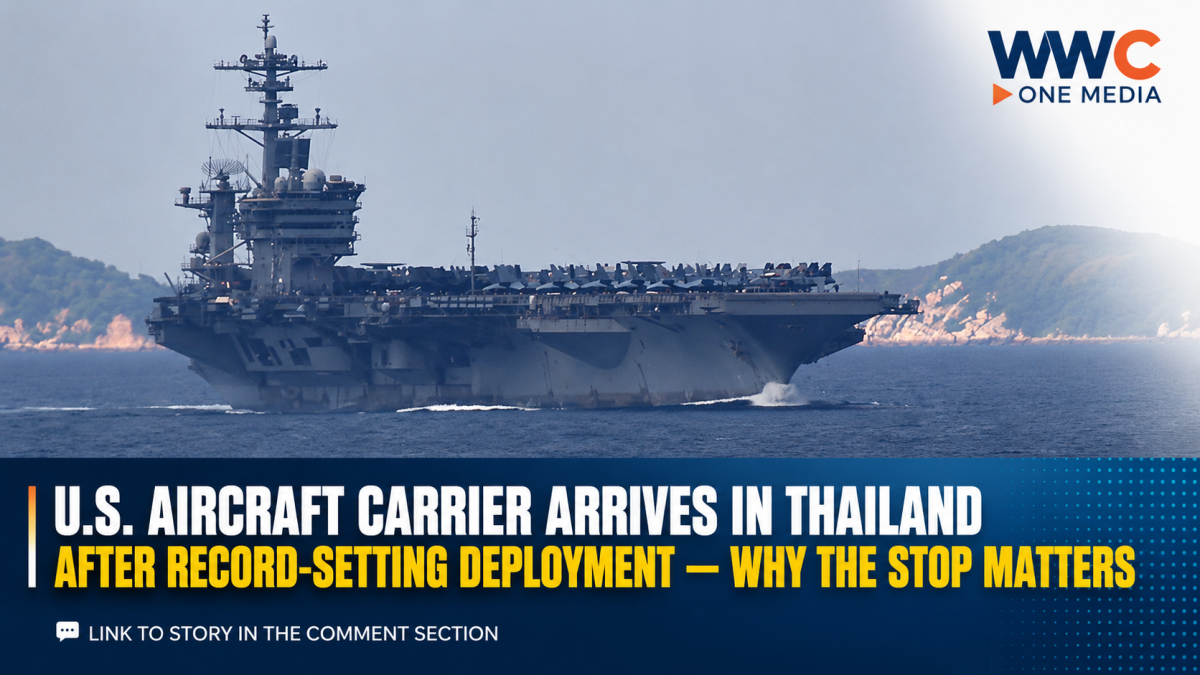
LAEM CHABANG, Thailand — The USS Abraham Lincoln has arrived in Thailand after an unusually long deployment, bringing roughly 5,000 U.S. sailors and Marines to the country’s eastern seaboard for a rare period of rest and recovery.
The Nimitz-class nuclear-powered aircraft carrier entered Laem Chabang on Sept. 2, 2026, following an extended deployment that included operations in the Middle East. Thai officials said the port visit is intended for rest, recuperation and logistical support, rather than a joint military exercise.
The arrival comes after months of sustained operations and growing attention over the strain placed on the carrier’s crew.
More than 200 days at sea
The Lincoln’s deployment has attracted international attention because of its extraordinary length.
Reuters reported that the carrier had spent more than 200 consecutive days at sea, with Democratic lawmakers describing it as a modern-day record. Other military and international outlets have reported figures exceeding 250 days, depending on how the deployment and port-call periods are counted.
The carrier departed its home port in San Diego in November 2025 and was subsequently redirected toward the Middle East as the United States expanded military operations involving Iran.
The unusually long deployment is significant because U.S. Navy aircraft-carrier deployments typically involve regular port visits for crew rest, maintenance and replenishment. Stars and Stripes reported that carriers generally visit port roughly every 30 to 45 days, although operational circumstances can dramatically alter that schedule.
Why Thailand?
Thailand’s eastern seaboard is providing the crew with an opportunity to step away from the intense operational tempo.
The U.S. and Thailand have a longstanding military relationship, and Thailand is the only U.S. treaty ally in mainland Southeast Asia. The current visit is being described as a routine port call rather than a new military exercise.
The Abraham Lincoln Carrier Strike Group includes the aircraft carrier along with other naval vessels. U.S. Navy information confirms that elements of the strike group arrived in Thailand, including the USS Frank E. Petersen Jr. and the USS Robert Smalls, which made separate port visits.
The scheduled visit is expected to run through the first part of September.
Pattaya is preparing for thousands of U.S. personnel
The arrival is also a major event for the local economy.
Nearby Pattaya is expecting thousands of sailors and Marines to spend time ashore during their leave. Local officials have arranged transportation between Laem Chabang and Pattaya, with Reuters reporting that around 40 buses will be used to move personnel in staggered groups.
Thai officials and local businesses see the visit as a potential short-term boost for restaurants, transportation, hotels and entertainment businesses.
Khaosod English reported that local officials estimated spending by visiting personnel could potentially reach 5 million to 15 million baht, depending on how many personnel go ashore and how long they remain in the area.
But authorities are also preparing for the challenges that come with such a large influx of foreign military personnel.
Security measures tightened in Pattaya
Thai authorities have increased security and issued restrictions for visiting military personnel.
According to Reuters, personnel have been prohibited from participating in certain high-risk activities, including jet skiing, bungee jumping, wrestling and boxing.
Police are also increasing patrols around Pattaya’s beachfront and nightlife areas.
That comes after recent raids resulted in dozens of people being detained over suspected prostitution, according to local officials cited by Reuters. Prostitution is illegal in Thailand, although the sex industry remains visible in major tourist destinations such as Pattaya.
The human cost of the deployment
The celebratory tone surrounding the port visit is tempered by concerns about conditions aboard the carrier.
Military-focused publications, including Stars and Stripes and Navy Times, have reported concerns about crew morale, mental health and quality-of-life conditions during the extended deployment. Reports have included allegations involving food and water shortages, mail disruptions and suicide-related incidents.
U.S. Defense Secretary Pete Hegseth has disputed some of the reporting, saying accounts of conditions aboard the carrier were significantly misrepresented. U.S. military officials have also publicly praised the crew’s resilience and leadership.
That disagreement makes the Thailand stop more than simply a diplomatic port call: it offers the crew a chance to rest after one of the most demanding deployments in the carrier’s recent history.
A powerful symbol for U.S.-Thailand ties
The arrival of the Abraham Lincoln also carries a broader geopolitical message.
Thailand remains an important U.S. security partner in Southeast Asia, while Washington continues to maintain a significant military presence across the wider Indo-Pacific.
For the sailors aboard the Lincoln, however, the immediate priority is considerably simpler: getting off the ship, seeing land again and recovering after months of sustained operations.
The carrier’s Thailand visit could therefore serve two purposes at once — reinforcing a longstanding U.S.-Thai alliance while giving thousands of exhausted service members a badly needed break.
And after spending months at sea, the next question is where the Abraham Lincoln goes after Thailand — and whether its extraordinary deployment is finally coming to an end.
WWC ONE MEDIA J.M.D




Leave a Reply