
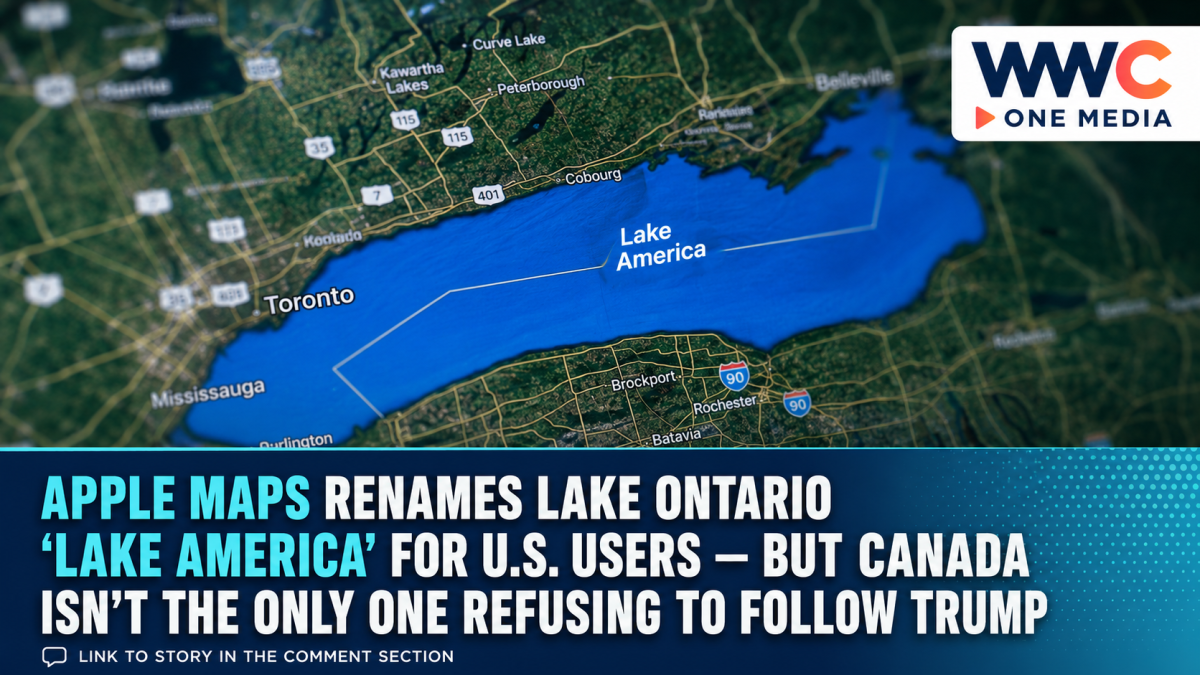
Apple has officially joined Google in displaying “Lake America” instead of Lake Ontario to users in the United States, turning President Donald Trump’s controversial geographic-name change into a fresh political, technological and cross-border dispute.
The change began appearing on Apple Maps after Trump signed an executive order on August 27 directing the U.S. federal government to rename Lake Ontario as “Lake America.”
Apple confirmed that users in the United States will see the new designation after the name was updated in the U.S. Geographic Names Information System, or GNIS. Canadian users, however, will continue to see Lake Ontario, while people elsewhere in the world are expected to see both names.
That distinction is crucial.
Trump’s executive order changes how the lake is identified by the U.S. federal government. It does not force Canada, international organizations, state governments or private companies to adopt the new name.
And that is where what looks like a simple map update becomes a much bigger story.
Google Moved First. Apple Has Now Followed.
Alphabet’s Google Maps began showing “Lake America” to U.S. users over the weekend after the federal geographic database was updated.
Google said Canadian users would continue seeing Lake Ontario, while users outside the United States and Canada would generally see both names.
Apple initially appeared slower to make the switch.
By September 1, however, Apple Maps had begun implementing essentially the same geographic approach: “Lake America” in the United States, Lake Ontario in Canada and both names for much of the rest of the world.
The result is an unusual situation in which two people looking at essentially the same body of water may see different names depending on where their mapping service believes they are located.
And those competing labels reflect something larger than cartography.
They reflect a political dispute between Washington and Ottawa that has spilled directly onto some of the world’s most widely used technology platforms.
What Trump’s Executive Order Actually Says
Trump’s August 27 executive order directs the U.S. Secretary of the Interior, working with the Board on Geographic Names, to update federal records and replace references to Lake Ontario with Lake America.
The White House justified the decision by emphasizing the lake’s economic importance to the United States and America’s role in Great Lakes security and navigation.
The order specifically points to the U.S. Coast Guard operating nine of the 11 icebreaking vessels serving the Great Lakes, arguing that American investment and security have helped keep the freshwater system available for shipping and recreation.
But presidential authority over American federal naming practices is not the same thing as international authority over a lake shared with another sovereign country.
Lake Ontario sits between New York and the Canadian province of Ontario. Reuters reports that roughly 52% of its surface area lies in Canada, with the remainder on the U.S. side.
Canada therefore has no obligation to adopt Washington’s preferred name.
Canadian officials have made clear that they do not intend to do so.
Canada Pushes Back: It’s Still Lake Ontario
Canadian Prime Minister Mark Carney rejected the renaming shortly after Trump announced it, while New York Governor Kathy Hochul also said her state would continue referring to the body of water as Lake Ontario.
Ontario Premier Doug Ford went even further, unveiling signage declaring:
“Lake Ontario, Now and Always.”
The dispute has also drawn objections from Indigenous leaders.
The Seneca Nation called for Trump to reverse the order, arguing that the Lake Ontario name has deep Indigenous cultural and historical roots.
Associated Press reported that Seneca Nation President J. Conrad Seneca cited the Huron-derived “oniatarí,” commonly associated with the meaning “lake of shining waters,” while pointing to the region’s centuries of Indigenous history.
The Lake Ontario name itself predates both the modern United States and Canada by centuries.
Reuters notes that it has been used for more than 400 years.
Most Americans Don’t Support the Rename Either
Perhaps the most politically significant twist is that resistance is not limited to Canada.
A Reuters/Ipsos poll conducted after Trump’s announcement found overwhelming opposition among Americans to changing Lake Ontario’s name.
Only 14% supported the Lake America designation, while 63% opposed it. The remainder were unsure or did not answer.
The nationwide online survey included 1,023 U.S. adults and had a margin of error of about four percentage points.
The lake controversy has unfolded alongside worsening U.S.-Canada trade tensions.
The same Reuters/Ipsos survey found that only 20% of respondents supported higher tariffs on Canadian goods, while 57% opposed them.
That broader economic fight matters because Trump’s decision to rename the lake arrived as relations between the longtime allies were becoming increasingly confrontational.
Then MapQuest Did the Opposite — And Something Unexpected Happened
While Apple and Google adapted their maps to the federal designation, one much older mapping company chose another path.
MapQuest refused.
The company publicly announced that it would continue displaying Lake Ontario.
The response quickly went viral.
TechCrunch reported that MapQuest surged to the No. 1 navigation app in the U.S. Apple App Store, with downloads rising sharply after its announcement.
Sensor Tower data cited by TechCrunch estimated that MapQuest recorded about 184,000 global downloads during the week beginning August 24, including roughly 162,000 in the United States — increases of more than tenfold from the previous week.
Forbes subsequently reported an even more striking single-day figure.
MapQuest was estimated to have surpassed 100,000 downloads on Sunday alone across the United States and Canada, its best performance in roughly a decade.
The company’s general manager also said usage had climbed to around 50 times normal levels following the controversy.
For a mapping brand that was synonymous with printing driving directions in the early days of the commercial internet, the political argument unexpectedly became a massive marketing opportunity.
This Isn’t Trump’s First Map Battle
The Lake Ontario dispute closely resembles another geographic-name controversy from the beginning of Trump’s second term.
In January 2025, Trump ordered the U.S. federal government to rename the Gulf of Mexico as the Gulf of America.
Google and Apple eventually modified their mapping services for American users following that federal change as well.
The companies’ approach illustrates an increasingly complicated challenge for global technology platforms.
A map is supposed to tell users where something is.
But what happens when governments disagree over what that thing should be called?
Apple and Google have effectively answered that question by localizing geographic labels according to the user’s country.
What Americans see can therefore differ from what Canadians see — even when both are looking at exactly the same lake.
Why the Apple Maps Change Matters Beyond One Lake
The larger issue isn’t simply whether the words “Lake America” appear on an iPhone.
Digital maps have become an invisible layer of modern infrastructure.
Navigation apps feed information into websites, businesses, delivery platforms, government services and countless third-party applications.
That means a naming decision made inside one database can rapidly spread far beyond a government document.
Google discovered that complication almost immediately. Some Ontario websites using embedded Google mapping technology temporarily displayed the American label because of how their regional map settings had been configured. Google explained that developers could specify Canada as their region to ensure Lake Ontario was displayed.
In other words, political geography is increasingly becoming software logic.
The border is no longer merely drawn on the map.
It can determine what the map itself says.
WWC ONE MEDIA MJE




Leave a Reply