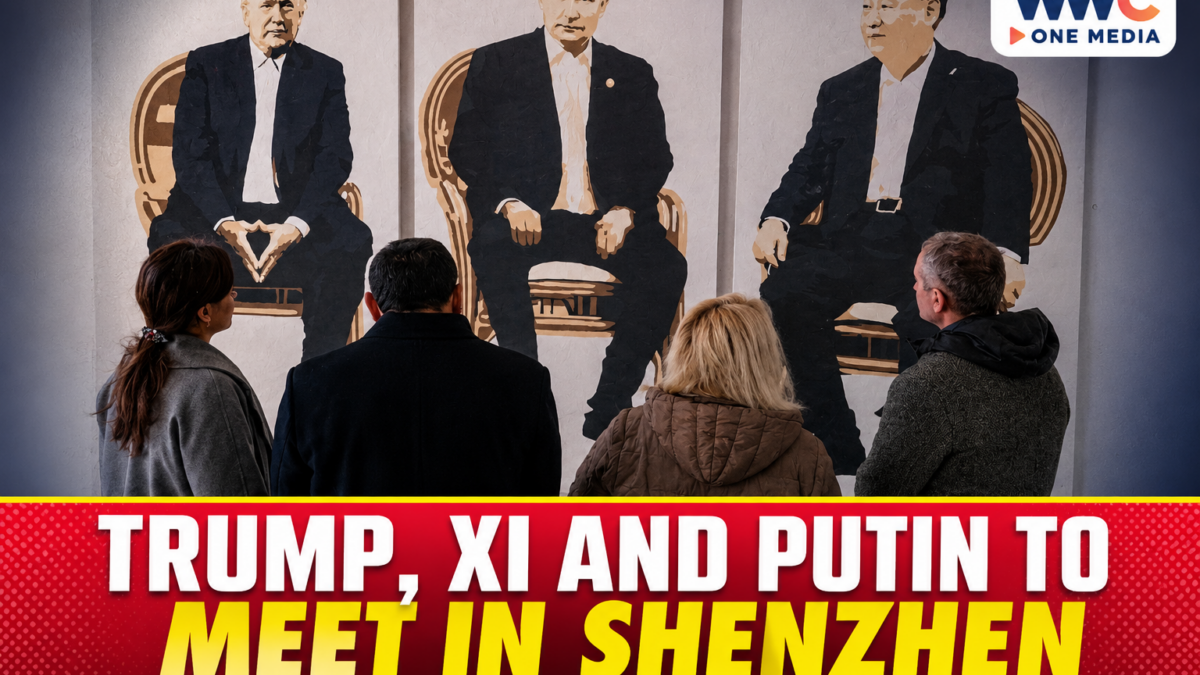
The planned meeting of US President Donald Trump, Chinese President Xi Jinping and Russian President Vladimir Putin in Shenzhen on Nov. 19 will put three major powers in the same room for a discussion that could carry consequences well beyond the summit venue.
China’s Foreign Ministry confirmed the gathering on Nov. 16, describing it as the first face-to-face meeting involving the heads of state of China, Russia and the United States. The announcement gives the meeting an unusual diplomatic profile, but it does not establish that the three governments have already reached common positions on the conflicts and strategic disagreements confronting them. China Foreign Affairs+1
The timing adds another layer of significance. The meeting is scheduled alongside the 33rd Asia-Pacific Economic Cooperation (APEC) Economic Leaders’ Meeting, also taking place in Shenzhen on Nov. 18–19. That places a major-power diplomatic encounter within a wider gathering focused on regional economic cooperation. China Foreign Affairs+1
A historic meeting, but not yet a negotiated breakthrough
The Chinese announcement identifies the three participants and confirms the date and location. At a Nov. 16 press conference, Foreign Ministry spokesperson Mao Ning said the leaders would exchange views on safeguarding world peace and promoting strategic stability in relations among major countries.
That is a broad diplomatic objective rather than a detailed list of agreed negotiating points. The distinction is important: a summit announcement confirms that leaders intend to meet, but it does not prove that they have settled difficult questions or agreed on a joint policy.
The three governments also approach international security from different positions. A meeting could provide an opportunity to communicate directly, clarify priorities and reduce the risk of misunderstanding. Whether that produces concrete commitments will depend on what the leaders are prepared to discuss and what their governments are willing to implement afterwards.
For now, the public announcement establishes the meeting itself and its stated diplomatic purpose. It does not provide evidence of a completed agreement. China Foreign Affairs+1
APEC gives the Shenzhen meeting a wider economic setting
The leaders are gathering as Shenzhen hosts a major regional economic event.
The 33rd APEC Economic Leaders’ Meeting is scheduled for Nov. 18–19 under the theme “Building an Asia-Pacific Community to Prosper Together.” Xi is set to chair the meeting and deliver remarks.
The APEC CEO Summit runs from Nov. 17–18 under the theme “To Prosper and Win the Future Together.” The Chinese announcement also said Xi would attend its opening ceremony and deliver a keynote speech, while holding bilateral meetings with foreign leaders on the sidelines of the economic leaders’ gathering. China Foreign Affairs
APEC’s agenda provides a separate but relevant backdrop. Its official work covers trade integration, connectivity and artificial intelligence, among other areas of regional cooperation. Senior officials meeting in Shenzhen ahead of the leaders’ gathering have been advancing work on those subjects. APEC+1
The overlap does not mean the trilateral summit is an APEC meeting or that all APEC economies will participate in it. Rather, the two events bring different diplomatic and economic discussions to the same city during the same week.
Why the three governments have reasons to keep talking
The United States, China and Russia each hold permanent seats on the United Nations Security Council. Their decisions and disagreements can affect international responses to security crises, arms control and other issues requiring cooperation among major powers.
China’s Foreign Ministry invoked that shared Security Council status when explaining the importance of communication among the three countries. It also said the leaders should manage differences and maintain stable relations. China Foreign Affairs
That objective is significant because dialogue does not require the participants to agree on every issue. Governments can maintain communication while continuing to disagree over security priorities, international conflicts and the rules governing relations between states.
A direct meeting may therefore be useful even if it produces no sweeping declaration. The more meaningful measure will be whether it creates follow-up discussions, practical arrangements or a clearer understanding of where cooperation remains possible.
The Philippines has an interest in what major powers decide
For the Philippines and other Asia-Pacific economies, the relationship among Washington, Beijing and Moscow matters because international tensions can affect trade, investment confidence, supply chains and regional security.
The APEC gathering also gives the region a platform to discuss economic issues that affect businesses and workers across member economies. Trade integration, digital development and connectivity are not simply diplomatic themes; they influence how companies move goods, adopt technology and reach markets. APEC+1
However, the trilateral meeting should not be treated as a substitute for regional institutions or as evidence that the three powers will determine the future of the Asia-Pacific on their own.
For Manila, the practical concern is whether major-power communication helps create a more predictable environment for regional cooperation. A stable relationship among major economies can support confidence, but unresolved disagreements can continue to create uncertainty.
What happens next
The next key date is Nov. 19, when the three presidents are scheduled to meet in Shenzhen. The public record available ahead of the gathering confirms the plan and China’s stated expectations, but does not yet establish the final agenda or the outcome.
The important questions will be whether the leaders issue a joint statement, announce follow-up mechanisms or identify specific areas where their governments can work together. Any assessment of success should be based on those concrete results rather than the symbolism of the meeting alone.
The summit’s historic character may attract attention, but its lasting importance will depend on what happens after the leaders leave the room.