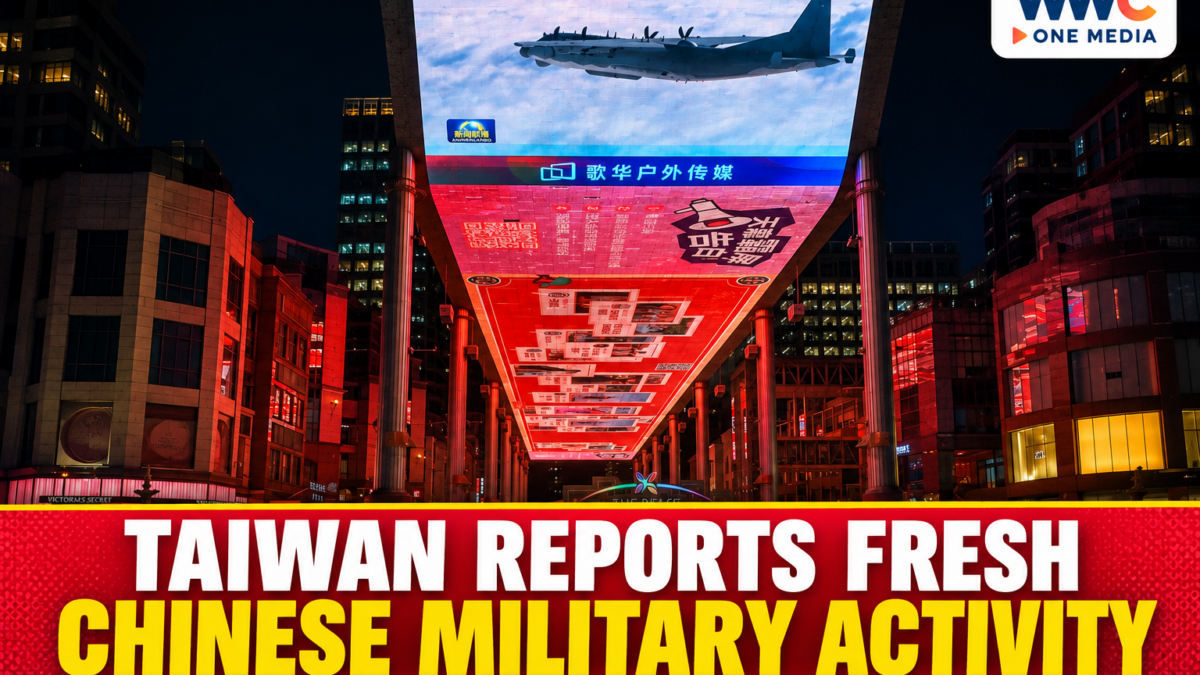
Taiwan’s defence ministry reported renewed Chinese military activity around the island in November, including aircraft operations across the Taiwan Strait and the presence of Chinese naval and government vessels. The latest public records provide a clearer picture of the pressure facing Taipei, but they do not independently confirm every detail of the much larger regional deployment described by unnamed Taiwanese security officials.
In a Nov. 12 release, Taiwan’s Ministry of National Defense said it detected 29 sorties involving Chinese military aircraft and unmanned aerial vehicles, including J-10, J-16, JH-7, KJ-500 and Y-20U aircraft. The ministry reported that 22 sorties crossed the median line of the Taiwan Strait, including its extension, and entered areas north, central, southwest and east of Taiwan. mnd.gov.tw+1
The report adds an important official record to the debate over China’s military activity. It also illustrates why individual daily reports should be distinguished from claims about the total number of vessels operating across the wider western Pacific.
Taiwan’s military reports show activity across several areas
Taiwan’s daily monitoring reports provide specific figures for aircraft and vessels detected around the island.
For the 24-hour period ending at 6 a.m. on Nov. 12, the ministry reported seven sorties of Chinese military aircraft, seven Chinese navy ships and two official vessels. Three of the seven aircraft sorties entered Taiwan’s southwestern and eastern air defence identification zone, or ADIZ. mnd.gov.tw+1
The following day’s report recorded 30 aircraft sorties, eight Chinese navy ships and three official vessels during the reporting period ending at 6 a.m. on Nov. 13. Taiwan said 23 of the 30 sorties crossed the median line or its extension and entered the island’s northern, central, southwestern and eastern ADIZ. mnd.gov.tw
These figures describe activity detected during specific reporting windows. They should not be added together as though they represent separate vessels or a single continuous deployment.
The distinction matters because aircraft sorties, naval ships and government vessels are different categories of activity. A daily count also does not establish how many vessels operated throughout the entire western Pacific.
The November 12 release recorded a larger wave of aircraft activity
Taiwan’s Nov. 12 announcement also documented a separate development later that day.
Beginning at 9:38 a.m., the ministry said it detected 29 sorties involving Chinese combat and auxiliary aircraft and unmanned aerial vehicles. Of those, 22 crossed the median line or its extension and entered several areas around Taiwan.
Taiwan said its armed forces monitored the activity and responded by dispatching aircraft and naval vessels and deploying shore-based missile systems. mnd.gov.tw
The release used the term “joint combat readiness patrol” to describe the activity as characterised by Taiwan’s authorities. That wording should be understood as Taipei’s description, not as an independently established explanation of Beijing’s operational intentions.
Beijing describes its carrier operations as routine training
China has publicly defended the activities of its aircraft carrier Liaoning in the western Pacific.
In an Oct. 29, 2026, press conference, China’s Ministry of National Defense spokesperson Zhang Xiaogang described the carrier task group’s training as part of the military’s annual plan. He said the exercises were intended to test and improve the group’s capabilities in distant waters and were not directed against a specific country or objective. Ministry of National Defense+1
That explanation differs from Taiwan’s assessment of the security implications of Chinese military activity.
The two positions should be reported separately. Taiwan regards the operations as part of a wider security challenge, while Beijing presents its carrier training as routine military activity.
The available official statements do not settle the disagreement over the strategic purpose of the operations.
What the public record does not establish
Claims about more than 100 Chinese naval and coast guard vessels operating across the wider western Pacific in early November have attracted considerable attention. However, the publicly available daily Taiwanese defence ministry reports cited here do not provide a comprehensive regional vessel count confirming that figure.
Nor do the cited records independently establish that the exercises included simulated attacks on specific cities, a submarine-launched intercontinental ballistic missile or a coordinated blockade rehearsal during the reported early-November deployment.
Those details should not be presented as confirmed findings of the official records reviewed for this update.
This distinction does not mean the broader claims are necessarily false. It means they require additional publicly verifiable evidence before they can be stated as established fact.
Why the developments matter to the Philippines
The Taiwan Strait and the surrounding western Pacific are strategically important to the Philippines because of their proximity to northern Philippine territory and their role in regional maritime movement.
Batanes, located near the Bashi Channel and Luzon Strait, gives the Philippines a direct geographical connection to developments around Taiwan.
A serious escalation could affect commercial shipping, aviation, regional security coordination and the movement of people. It could also create pressure on the Philippine government to prepare for possible humanitarian and economic consequences.
For Manila, the key issue is not simply how many aircraft or ships appear in a particular daily report. It is whether military activity becomes more frequent, moves into more sensitive areas or creates conditions that increase the possibility of an accident or miscalculation.
What happens next
Taiwan’s defence ministry continues to publish daily reports of aircraft and vessel activity around the island. Those updates will be important for determining whether the November pattern represents a temporary increase or a sustained change in military activity.
The next developments to watch include further crossings of the Taiwan Strait median line, movements of Chinese carrier groups and any official announcements concerning larger military exercises.
Beijing’s public explanation of its operations will also remain important in assessing the competing positions.
For now, the official record confirms continued Chinese military activity around Taiwan and repeated responses by Taiwan’s armed forces. It does not, by itself, prove that an invasion or blockade is imminent.
The distinction between documented military movements and assessments of their strategic purpose remains essential to understanding the situation without overstating the evidence.