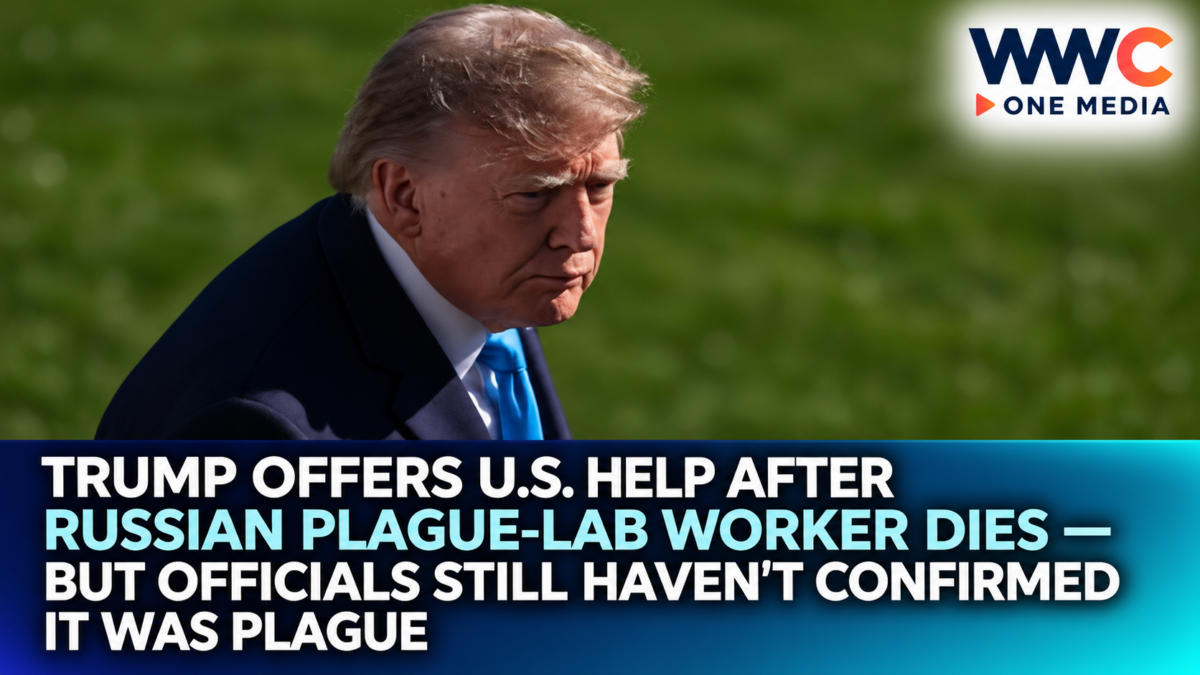
MOSCOW/WASHINGTON — President Donald Trump has offered U.S. assistance to Russia after the unexplained death of a laboratory worker at a Siberian institute specializing in dangerous infectious diseases triggered quarantines, international monitoring and fears that she may have contracted pneumonic plague.
But despite the alarming headlines, one crucial fact remains unresolved:
Russian authorities have not confirmed that plague killed her.
The employee of the Irkutsk Anti-Plague Research Institute of Siberia and the Far East died after developing severe pneumonia, prompting Russian authorities to quarantine part of a hospital, trace her contacts and launch emergency anti-epidemic measures.
Russia’s public-health watchdog, Rospotrebnadzor, says extensive testing has so far found no microorganisms associated with the woman’s professional laboratory work.
Officials continue to describe her illness as “pneumonia of unknown etiology.”
That makes the story far more complicated than reports claiming Russia has suffered a confirmed plague outbreak.
There is a suspected case.
There is a death.
There are quarantines.
But there is not yet a publicly confirmed plague diagnosis.
Trump says the United States will help Russia
Trump addressed the case on October 5 while speaking to reporters at the White House.
Asked about the situation, he said the United States was prepared to assist Russia.
“We’ll help,” Trump said, according to Reuters.
His offer was broad, and the White House did not immediately announce a specific package of medical personnel, laboratory assistance or supplies.
But the statement was notable because U.S.-Russia relations remain deeply strained over Moscow’s war in Ukraine.
Trump’s response suggests Washington views infectious-disease monitoring as an area where cooperation could still occur despite the wider geopolitical confrontation.
Secretary of State Marco Rubio was more cautious.
Rubio said the U.S. was monitoring the situation closely but did not believe the case currently represented a reason for public alarm.
He described it instead as something that required attention and continued observation.
Nearly 200 people have reportedly been monitored
Russian authorities moved quickly after the worker became seriously ill.
Local and international reports indicate that roughly 200 people have been placed under medical observation, although the number actually kept in isolation appears smaller and different reports have used different figures.
The hospital in Shelekhov, a city outside Irkutsk where the woman was treated, was placed under quarantine.
Officials temporarily stopped admitting or discharging patients from parts of the facility and restricted routine laboratory operations.
Everyone identified as having had relevant contact with the worker has been placed under surveillance, according to regional authorities.
That does not mean nearly 200 people are infected.
So far, Russian authorities have reported no confirmed secondary plague cases.
Among people tested after contact with the woman, two reportedly tested positive for a virus associated with the common cold and two others for COVID-19.
Other tests were negative.
Who was the worker?
Local media identified the woman as 28-year-old Darya Shipilova, a laboratory employee at the Irkutsk anti-plague institute.
Her precise cause of death remains under investigation.
Unconfirmed reports circulating in Russian and international media claimed she may have been exposed to Yersinia pestis, the bacterium that causes plague, during a laboratory accident.
Some reports specifically alleged that a container holding live plague bacteria was damaged.
Russian authorities have not confirmed those accounts.
Rospotrebnadzor says its investigation found no incidents at the institute involving pathogenic microorganisms that could be linked to the worker’s illness.
That distinction is essential.
A reported laboratory accident is not the same thing as a confirmed one.
Conflicting statements helped fuel the fear
Public anxiety increased partly because early official comments were inconsistent.
Alexei Tsydenov, governor of the neighboring Buryatia region, initially said the woman had died “maybe of the plague,” according to media reports.
Irkutsk regional officials later emphasized that the formal diagnosis remained pneumonia of undetermined origin.
Russia’s health watchdog subsequently issued statements saying no laboratory-related organism had been identified in the woman’s samples.
Kremlin spokesman Dmitry Peskov urged people to rely on Rospotrebnadzor’s official information rather than rumors and speculation.
But by that point, claims of a plague laboratory accident were already spreading widely on social media.
Russia sent its top health official to Siberia
The response nevertheless shows that authorities are treating the incident seriously.
Anna Popova, head of Rospotrebnadzor, traveled personally to the Irkutsk region to meet regional officials and oversee the response.
Officials implemented what they described as a full range of anti-epidemic measures.
The Irkutsk Aluminum Plant in nearby Shelekhov also instructed employees to wear masks as a precaution.
Its management stressed that the measure was preventive rather than evidence of confirmed transmission.
The unusual level of precaution contributed to public concern.
But aggressive containment measures are exactly what public-health authorities are expected to deploy when dealing with a potentially dangerous but unidentified infection.
What exactly is pneumonic plague?
Plague is caused by the bacterium Yersinia pestis.
The microorganism typically circulates among wild rodents and fleas.
Humans can become infected through flea bites, contact with infected tissues or, in the case of pneumonic plague, inhalation of infectious respiratory particles.
There are three major clinical forms:
bubonic plague, which commonly causes swollen and painful lymph nodes;
septicaemic plague, in which bacteria spread through the bloodstream;
and pneumonic plague, which infects the lungs.
Pneumonic plague is the form that creates the greatest concern about person-to-person spread.
It can be transmitted through respiratory droplets during close contact with an infected individual.
Untreated pneumonic plague can be deadly
The word “plague” understandably evokes the medieval Black Death.
Modern medicine, however, has dramatically changed the risk.
The World Health Organization says plague can still be extremely severe and that pneumonic and septicaemic forms are effectively fatal if not treated early.
But antibiotics are effective against Yersinia pestis, meaning early diagnosis and prompt treatment can save lives.
People who have been closely exposed to pneumonic plague can also receive preventive antibiotics.
This is why identifying and monitoring contacts is so important.
If the Siberian worker’s illness is eventually confirmed as plague, rapid contact tracing would be one of the primary tools used to prevent additional cases.
Pneumonic plague does not spread like measles or COVID
Another important point has been lost in some of the more alarming coverage.
Pneumonic plague can spread between people, but it generally requires close exposure to respiratory droplets from a sick patient.
It does not normally spread efficiently over long distances through the air in the way highly contagious respiratory viruses can.
That greatly limits its pandemic potential when cases are quickly identified and treated.
Public-health specialists quoted in international coverage have therefore urged caution without panic.
The case is serious enough to investigate aggressively.
It is not currently evidence of a global plague emergency.
WHO says the current risk is low
The World Health Organization has assessed the wider public-health risk from the Siberian incident as low, according to reports citing the agency, while Russian and international authorities continue investigating.
That assessment is consistent with what is currently known:
there is one unexplained fatal illness;
no publicly confirmed plague diagnosis;
no confirmed secondary plague infections;
and active contact monitoring is underway.
Those conditions could change if new laboratory results emerge.
For now, however, there is no evidence of widespread transmission.
Plague still exists in the modern world
Another misconception is that plague disappeared centuries ago.
It did not.
Yersinia pestis continues to circulate naturally in animal populations in several parts of the world.
WHO says most human cases reported globally between 2019 and 2025 occurred in the Democratic Republic of Congo and Madagascar.
Siberia also contains natural plague reservoirs among wild animals and fleas.
That means isolated human infections are biologically possible even without a laboratory accident.
What remains unanswered in the Irkutsk case is whether plague was involved at all—and, if so, whether infection occurred naturally or through occupational exposure.
The institute itself specializes in dangerous infections
The Irkutsk Anti-Plague Research Institute is part of Russia’s network of facilities devoted to monitoring and researching dangerous infectious diseases.
Such institutions historically emerged in regions where plague and other zoonotic diseases occur naturally.
Workers can handle dangerous biological materials under controlled conditions, which is why any unexplained fatal infection involving an employee receives unusual scrutiny.
But working at a plague institute does not automatically mean a worker who develops pneumonia contracted plague from the laboratory.
That is precisely what investigators are trying to determine.
No evidence of a confirmed lab leak
This deserves particular emphasis because social-media reports have already used the phrase “lab leak.”
There is currently no publicly confirmed evidence that Yersinia pestis escaped from the institute.
Rospotrebnadzor says its investigation found no workplace incident involving pathogenic organisms and no laboratory-related microorganism in samples taken from the woman.
Those are Russian government findings and will inevitably face scrutiny because independent verification remains limited.
But absence of independent access is not evidence that the opposite claim is true.
Until additional laboratory results or independent evidence emerge, describing the case as a confirmed plague laboratory accident would be inaccurate.
International authorities are watching anyway
The United States is not the only outside government paying attention.
The European Centre for Disease Prevention and Control has reportedly been monitoring the incident, and other governments in the region have increased surveillance.
Kyrgyzstan introduced additional quarantine controls at border crossings as a precaution, according to health reporting.
Those measures reflect uncertainty rather than proof of international spread.
Public-health agencies often respond conservatively when the pathogen involved could potentially be dangerous.
It is much easier to relax precautions later than to re-establish control after transmission has already occurred.
Trump’s offer is politically notable
The health issue is unfolding against the backdrop of one of the most strained U.S.-Russian relationships in decades.
Washington and Moscow remain deeply divided over Ukraine.
The United States continues engaging Russia diplomatically while simultaneously supporting Kyiv and pressuring Moscow economically.
Trump nevertheless said the U.S. would assist if Russia needed help confronting the potential health threat.
That reflects a longstanding principle in global health:
infectious diseases do not respect political alliances.
Helping another government contain a dangerous pathogen can also protect the country offering assistance.
A disease successfully contained in Siberia is far less likely to become an international problem.
But Washington is not sounding an emergency alarm
Rubio’s comments are equally important.
He said the administration sees no current cause for alarm, even while acknowledging that officials are monitoring developments carefully.
That is a considerably more measured message than the most dramatic social-media posts surrounding the case.
The United States has not announced travel restrictions against Russia because of the incident.
Nor has WHO declared an international health emergency.
The current posture is monitoring, information gathering and preparedness.
The biggest problem right now may be uncertainty
Infectious-disease scares are particularly vulnerable to misinformation when official information arrives slowly.
That appears to be part of what happened in Siberia.
A researcher at an anti-plague facility died unexpectedly.
Hospitals were quarantined.
Russia’s top health official traveled to the region.
Officials used phrases such as “particularly dangerous infection.”
And social-media accounts filled in the missing information with claims about broken plague samples and laboratory accidents.
Some of those claims could eventually prove accurate.
But they have not been publicly established.
That is why precise wording matters.
What we know — and what we still do not
The confirmed picture is much narrower than many headlines suggest.
A worker at the Irkutsk anti-plague institute became seriously ill and died.
Russian officials say she developed pneumonia of unknown origin.
Authorities quarantined part of a hospital and placed contacts under observation.
Rospotrebnadzor says it has found no evidence connecting her illness to pathogens handled professionally.
No secondary plague cases have been confirmed.
The United States and European authorities are monitoring the situation.
Trump has offered American assistance.
WHO considers the wider risk low.
What remains unknown is the most important question:
What actually killed the laboratory worker?
That answer will determine whether this remains a contained scare or becomes a much bigger story
If further testing confirms ordinary pneumonia or another unrelated infection, the plague fears could quickly subside.
If Yersinia pestis is identified, investigators will need to determine how she became infected and whether anyone else was exposed.
And if evidence emerges of a laboratory accident, scrutiny will expand dramatically—not only over the health response, but over biosafety practices at Russia’s high-risk research facilities.
For now, none of those outcomes has been established.
That makes caution essential.
Trump has offered U.S. help, Russia has quarantined contacts and international health agencies are paying close attention.
But despite the frightening word attached to the institute where the woman worked, there is still no official confirmation that plague caused her death.
And until that diagnosis is established, the biggest story in Siberia is not a confirmed plague outbreak.
It is the uncertainty surrounding a mysterious death inside one of Russia’s most sensitive disease laboratories.