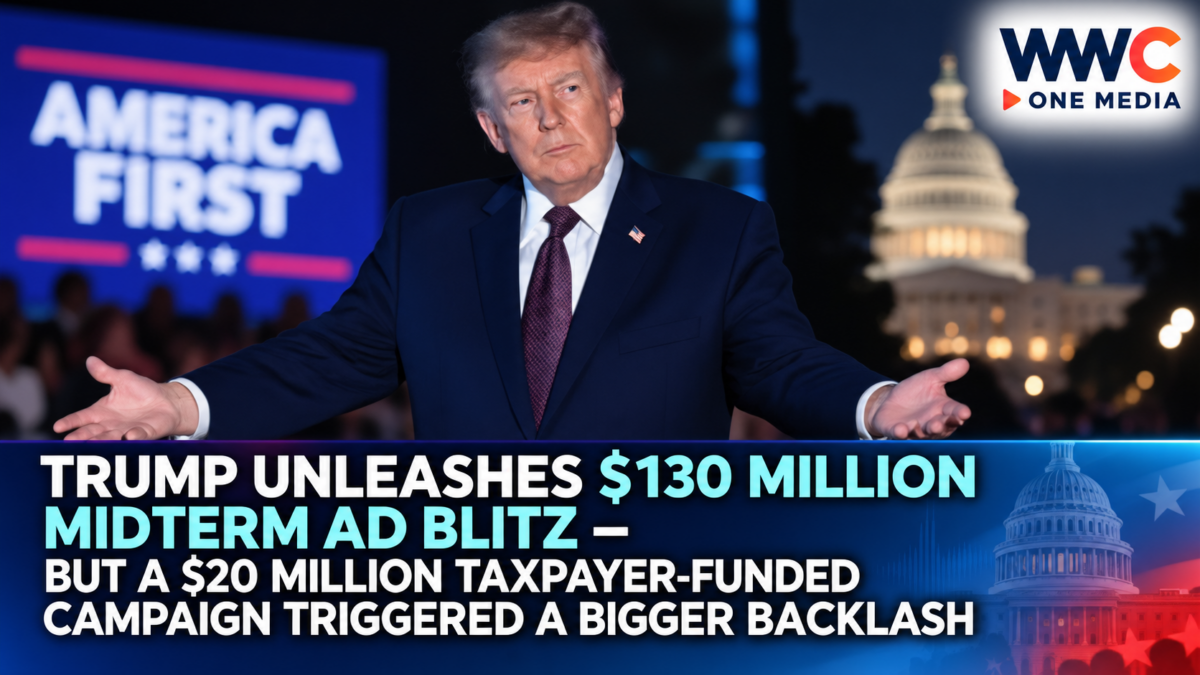
WASHINGTON — President Donald Trump’s political operation is flooding the final weeks of the 2026 midterm elections with more than $130 million in advertising to protect Republican control of Congress, but a completely separate television campaign paid for with federal money has created an even more explosive fight over where government messaging ends and political propaganda begins.
Trump-aligned super PACs have reserved more than $130 million in advertising across competitive House and Senate contests as Republicans confront an increasingly difficult political environment ahead of the November 3 elections.
At the same time, the Trump administration redirected approximately $20 million in Homeland Security funding toward a national television campaign featuring Trump and messages praising his presidency. Those advertisements were officially labeled government-funded public-service announcements, but Democrats, watchdog organizations and several Republicans questioned whether taxpayers were effectively financing political promotion just weeks before voters choose the next Congress.
The controversy eventually became intense enough that Trump reversed course.
On October 5, he said taxpayers would no longer finance the ads and that he would instead pay for future spots personally or through MAGA Inc., his heavily funded political committee.
That reversal may stop new federal spending on the campaign.
It does not answer what happens to the taxpayer money already spent.
Trump’s political machine is spending heavily to save Republicans
The legitimate political advertising campaign is massive.
Trump-connected groups have reserved roughly $138 million in ads and other campaign communications across about 50 races.
The biggest player is No Going Back PAC, which booked more than $95 million in advertising and has concentrated much of its spending on Senate contests.
Another Trump-linked organization, Safety and Affordability PAC, booked about $27 million and is focusing more heavily on House races.
MAGA Inc. itself reserved additional spending, including millions for the Texas Senate contest.
Together, the organizations effectively divided the battlefield.
No Going Back has emphasized Senate races.
Safety and Affordability has concentrated on vulnerable House Republicans.
And MAGA Inc. retains an enormous reserve that could fund even more advertising before Election Day.
MAGA Inc. still has hundreds of millions available
Trump enters the final month with an extraordinary financial advantage.
MAGA Inc. had roughly $400 million to $415 million in reserves heading into the fall campaign, according to current reporting.
That war chest gives Trump unusual power inside the Republican Party.
Candidates in difficult races increasingly depend on outside organizations connected to him for television, streaming and digital advertising.
Republicans had spent months urging Trump’s political operation to deploy more of that money as the electoral environment deteriorated.
Now it has.
But the late timing comes at a cost.
Late political advertising is more expensive
Super PACs do not receive the same legally guaranteed television rates as candidate campaigns.
During the final 60 days before an election, candidate committees generally receive broadcasters’ lowest available rates.
Outside political groups must often pay market prices.
And those prices rise as airtime becomes scarce.
That means $130 million spent late in September and October buys fewer television spots than the same amount would have purchased months earlier.
Trump’s network therefore has enormous money—but is paying heavily for waiting.
Republicans now dominate congressional advertising
The spending surge has helped Republicans seize a major advertising advantage.
AdImpact says more than $1 billion in congressional political advertising aired during September alone, the biggest September total of the past three election cycles.
Republican advertisers accounted for roughly 60% of that spending, about $200 million more than Democrats.
The Senate picture is similar.
Through September 30, Republicans had outspent Democrats by about $188 million in competitive Senate races, giving the GOP 60% of aired spending across the key battlegrounds tracked by AdImpact.
That represents a major reversal from the previous three election cycles, when Democrats held the early advertising advantage.
The entire 2026 election could become the most expensive ever
The scale of this election is historic.
AdImpact forecasts $11.6 billion in total political advertising spending during the 2026 cycle.
If that estimate holds, the midterms will surpass:
the $8.9 billion spent during the 2022 midterms;
and even the roughly $11.2 billion spent during the 2024 presidential election cycle.
That is remarkable because there is no presidential race on the ballot this year.
Broadcast television remains the largest advertising category, but connected television and streaming are rapidly increasing their share.
Politics is becoming one of the largest advertising businesses in America.
Why Trump is spending so aggressively
The answer is simple:
Republicans are in danger of losing Congress.
Trump’s approval ratings remain weak nationally, and voters continue to express frustration over the cost of living, fuel prices and the economy.
Reuters reported that Democrats are now competitive in a number of states Trump comfortably carried in 2024, forcing Republicans to spend money defending territory they once expected to hold easily.
Republicans still hold important structural advantages.
They have money.
They have favorable districts in several states.
And Trump retains an intensely loyal political base.
But a Democratic wave could cost them control of the House and potentially threaten their Senate majority.
That would dramatically change the final two years of Trump’s presidency.
Losing the House would give Democrats subpoena power
For Trump, the House is not merely another legislative chamber.
Democratic control would hand congressional committees the power to investigate his administration.
That could mean hearings involving:
government spending;
immigration enforcement;
foreign policy;
federal contracts;
White House officials;
and potentially the controversial taxpayer-funded ads themselves.
Democrats could subpoena administration officials and documents.
They could also block major portions of Trump’s legislative agenda.
That makes maintaining Republican control strategically important to the White House.
Trump is campaigning as though he is personally on the ballot
Trump has launched an aggressive pre-election campaign schedule, traveling around the country in the final weeks.
AP reported that his 32-day political blitz includes stops designed to reassure Republican voters worried about the economy and help vulnerable GOP candidates.
His message is deliberately presidential.
He is telling Republicans to treat the midterms as a referendum on his administration.
That strategy cuts both ways.
Trump remains extraordinarily effective at motivating his political base.
But Democrats also use him to motivate theirs.
In many districts, the 2026 midterms increasingly look less like individual congressional contests and more like another national referendum on Trump.
Then came the taxpayer-funded ads
The political PAC spending is legal campaign activity.
The government advertising controversy is fundamentally different.
The Office of Management and Budget shifted $20 million into the Department of Homeland Security for a national media campaign.
The resulting television spots featured Trump, patriotic imagery and claims praising the state of the country under his presidency.
Some echoed themes associated with his political campaigns.
They ended with a disclosure saying they were:
“Paid for by the U.S. Government.”
That wording made the controversy impossible to ignore.
Critics said the government was financing political propaganda
Democratic lawmakers immediately argued that the advertisements crossed the line between legitimate government communication and partisan political promotion.
Some legal experts and watchdog organizations raised questions about federal prohibitions on unauthorized propaganda and the use of public resources for political purposes.
Public Citizen filed complaints seeking scrutiny of the advertisements.
California Attorney General Rob Bonta also sought investigations into whether government money had been improperly used.
But an important accuracy distinction remains:
No court or federal watchdog has issued a final ruling that the advertisements were illegal.
Critics allege they violated federal restrictions.
The administration disputes that interpretation.
The legal issue remains unresolved.
Republicans also objected
The backlash was not exclusively Democratic.
Republican lawmakers including Sens. Thom Tillis and John Kennedy publicly questioned why taxpayer money should be used for advertisements so closely associated with Trump’s political messaging.
That bipartisan criticism made the issue politically more dangerous.
The dispute was no longer simply Trump versus Democrats.
It became a broader question of whether any administration should use federal funds for messaging that resembles an election campaign.
The White House called them public-service announcements
The administration defended the campaign.
Officials said the advertisements were intended to promote patriotism, highlight government accomplishments and communicate with Americans.
The White House argued that previous administrations had also used federal money to promote government policies.
That general principle is true.
Governments routinely advertise:
military recruitment;
public health;
tax information;
disaster preparedness;
immigration rules;
anti-drug campaigns;
and other federal programs.
The dispute is not whether the government can advertise.
It is whether these particular ads were genuinely governmental communication—or whether they were effectively election-season political advertisements.
Trump eventually decided the fight was not worth it
On October 5, Trump announced that future ads would no longer be financed by taxpayers.
Instead, he said he would use his own money or funds from MAGA Inc.
That was a significant reversal.
Trump continued defending the advertisements themselves, describing them as positive messages promoting the United States.
But he effectively conceded the funding issue had become politically damaging enough to change course.
The decision eliminates the biggest controversy going forward:
the use of public money.
But what happens to the money already spent?
That remains unresolved.
Reuters reported the overall federal campaign involved approximately $20 million in Homeland Security funding.
AP reported that millions had already been committed or spent before Trump announced his reversal.
It remains unclear whether:
MAGA Inc. will reimburse the government;
Trump will personally reimburse it;
the already-aired advertisements will remain federally funded;
or government watchdogs will determine that no reimbursement is required.
That issue could continue well beyond Election Day.
The political optics are especially difficult because MAGA Inc. has plenty of money
One reason the controversy became so politically damaging is that Trump did not appear to need taxpayer financing.
His political operation already controls hundreds of millions of dollars.
MAGA Inc. has a war chest of roughly $400 million or more.
That raises an obvious question:
Why use public money for advertisements praising Trump when his political organization can easily afford them?
Trump’s reversal effectively answers that concern going forward.
Political ads will be paid for politically.
The broader election advertising war is still accelerating
Even after the taxpayer issue fades, the genuine campaign-ad battle will continue.
Republicans are flooding competitive races with television and streaming spots.
Democrats are responding.
Crypto groups are spending heavily.
Billionaire-backed PACs are active.
Labor groups are involved.
Gun-control and abortion-rights organizations are buying airtime.
AdImpact’s $11.6-billion forecast suggests Americans will see more political advertising in 2026 than during any previous election cycle.
The final weeks could become even more expensive as campaigns compete for increasingly scarce airtime.
Republicans’ financial edge does not guarantee victory
This is the biggest strategic uncertainty.
Money matters enormously in elections.
It allows campaigns to:
define opponents;
increase name recognition;
mobilize voters;
and dominate television markets.
But money cannot guarantee an election result.
Democrats currently see opportunities in Republican-held areas because voters remain concerned about affordability and Trump’s political standing.
That means Republicans could win the advertising war and still lose important seats.
Trump is effectively betting that saturation can change the environment
The strategy behind the $130-million-plus blitz is straightforward.
If Republican candidates are struggling, overwhelm the airwaves.
Use Trump’s financial resources to define Democratic challengers.
Increase Republican turnout.
Remind conservative voters what losing Congress would mean for Trump’s agenda.
And make the midterm election feel as important as a presidential contest.
It is an expensive strategy.
But with control of Congress at stake, Trump’s allies clearly believe it is worth the cost.
The irony is that the taxpayer ad controversy distracted from a much bigger political machine
The $20 million government-ad controversy attracted enormous attention because taxpayer money was involved.
But Trump’s genuine political operation is spending many times more than that through legal campaign organizations.
More than $130 million in Trump-aligned advertising has already been reserved.
MAGA Inc. still possesses hundreds of millions more.
Republicans hold a major congressional advertising advantage.
And total political ad spending could reach a record $11.6 billion.
That is the much larger story.
Trump is turning the final month of the midterms into a massive financial intervention designed to preserve Republican power in Washington.
But the controversy exposed an important boundary
Political organizations exist to promote politicians.
Government agencies exist to serve the public.
The fight over Trump’s federal advertisements became explosive because critics believed that distinction was being blurred.
Trump’s decision to move future spending to MAGA Inc. restores that boundary more clearly.
It does not settle whether the earlier spending complied with federal law.
And if Democrats win control of the House, those advertisements could become one of many subjects of congressional investigation.
November 3 will determine whether the spending worked
Republicans have the financial advantage.
Trump has an enormous political war chest.
Outside groups are pouring money into vulnerable districts.
And the president is campaigning aggressively.
Yet none of that guarantees the outcome.
The economy remains a major problem for Republicans.
Democrats have expanded the electoral map.
And many races remain extremely close.
Trump and his allies can buy more than $130 million worth of political advertising.
What they cannot buy is certainty.
And after a separate $20 million taxpayer-funded campaign created enough controversy to force Trump to change how the ads are financed, the 2026 midterms have produced an unusual question:
Will Trump’s massive political war chest be enough to save Republican control of Congress—or has the backlash around his presidency already become too expensive to advertise away?