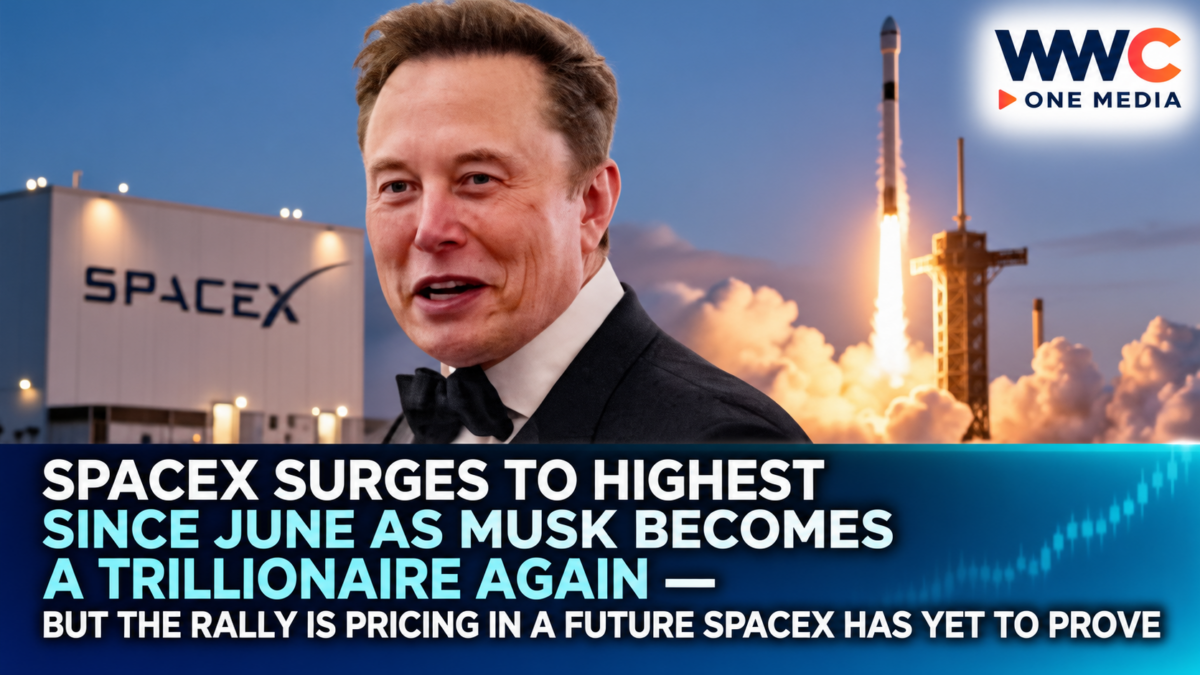
NEW YORK — Elon Musk has returned to trillionaire status after SpaceX shares surged to their highest level since June, but the extraordinary wealth milestone says as much about Wall Street’s expectations for Starship, Starlink and artificial intelligence as it does about SpaceX’s business today.
SpaceX shares jumped 7.6% on Monday, October 5, closing at $171.09, roughly 27% above the company’s $135 IPO price and near the stock’s strongest level since its blockbuster June market debut.
Forbes estimated Musk’s net worth rose back above the $1 trillion threshold, making him once again the world’s only trillionaire by its calculations.
Business Insider, also citing Forbes, put his fortune at roughly $1.046 trillion after Monday’s move.
But that number needs an important qualification.
Musk does not have $1 trillion sitting in a bank account.
Most of his fortune is tied to equity stakes in companies such as SpaceX and Tesla.
If those shares rise, his estimated net worth can increase by tens of billions of dollars in a single day.
If they fall, the opposite can happen just as quickly.
Musk had already crossed $1 trillion once before
Musk first reached the unprecedented milestone after SpaceX’s June IPO.
SpaceX raised approximately $75 billion at $135 per share, valuing the company at about $1.77 trillion before its first day of public trading.
The shares quickly climbed after their debut, pushing SpaceX’s market value beyond $2 trillion and lifting Musk’s estimated wealth above $1 trillion for the first time.
That status did not last.
SpaceX and Tesla shares later declined, pulling his estimated fortune back below the threshold.
Fortune reported that Musk remained a trillionaire for only about 12 days following the initial SpaceX surge.
That history illustrates how sensitive the figure is to public-market prices.
The latest trillionaire milestone is therefore better understood as a valuation snapshot than a permanent financial status.
Morgan Stanley helped reignite the rally
One major catalyst behind Monday’s SpaceX move was a bullish report from Morgan Stanley analyst Adam Jonas.
Morgan Stanley reiterated an Overweight rating and $300 price target, implying substantial upside from current levels.
Jonas argued SpaceX could actually be relatively inexpensive when its valuation is adjusted for expected growth.
Although the company trades at roughly 30 times projected 2028 operating profit—well above the large-cap technology median—Morgan Stanley argues its growth-adjusted valuation is more attractive.
That is an aggressive argument.
Calling a company worth roughly $2 trillion “cheap” sounds almost absurd in absolute terms.
But Morgan Stanley is not comparing SpaceX with ordinary industrial companies.
It is valuing SpaceX as a high-growth technology platform spanning:
rocket launches;
satellite broadband;
artificial intelligence;
government contracts;
and potentially orbital computing.
That is why the stock can simultaneously look extremely expensive by conventional metrics and inexpensive by growth-adjusted ones.
Wall Street increasingly sees SpaceX as more than a rocket company
The most important change in the SpaceX investment story is that analysts are no longer valuing the company simply as an aerospace business.
Its economic engine increasingly has several layers.
Falcon rockets generate launch revenue.
Starlink provides recurring broadband subscriptions.
Starship could dramatically increase payload capacity and lower future launch costs.
And SpaceX’s expanding AI operation creates the possibility of an entirely new technology business.
That combination is what allows analysts to imagine valuations normally associated with the world’s biggest technology companies rather than traditional aerospace firms.
Reuters described SpaceX’s IPO as essentially a giant bet on Musk’s “rockets-to-AI” vision, with the company’s valuation increasingly dependent on businesses that extend well beyond conventional launch services.
Starlink remains the strongest commercial foundation
Despite all the excitement around Starship and AI, SpaceX’s most mature growth engine is still Starlink.
Reuters reported that Starlink represented roughly 60% of SpaceX’s 2025 revenue and had about 10.3 million users around the time of the IPO.
That recurring-revenue model transformed SpaceX.
Rocket launches generate large payments, but they occur mission by mission.
Starlink allows SpaceX to collect monthly fees from:
households;
businesses;
airlines;
ships;
governments;
and military users.
That makes the business far more predictable.
It also gives SpaceX a massive internal customer for its own rockets.
Every Starlink satellite SpaceX launches strengthens a network that generates recurring revenue.
This vertical integration is one of the company’s biggest structural advantages.
But the company is still losing billions of dollars
The valuation looks much more demanding when measured against current profits.
SpaceX generated about $18.67 billion in revenue in 2025, up from $14.02 billion the previous year.
But it also reported a $4.94 billion net loss, compared with a $791 million profit a year earlier, partly because of enormous spending on AI and next-generation rocket development.
At its IPO valuation, Reuters estimated SpaceX traded at roughly 94 times trailing sales.
That is an extremely high valuation.
It means investors are not paying for the SpaceX that exists today.
They are paying for the company they believe SpaceX could become several years from now.
That distinction is central to understanding both the rally and Musk’s trillionaire status.
Starship is one of the biggest reasons investors accept the valuation
Starship is designed to change the economics of spaceflight.
Falcon 9 already proved that reusable rockets can reduce launch costs.
Starship aims to go much further by making both stages of the system reusable.
The rocket is designed to carry more than 100 metric tons to low-Earth orbit, far more than Falcon 9.
If SpaceX can launch Starship frequently, recover the hardware and fly it again with limited refurbishment, it could dramatically reduce the cost of putting satellites and other payloads into orbit.
That would benefit:
Starlink;
NASA missions;
national-security launches;
commercial satellites;
future space stations;
and Musk’s longer-term AI ambitions.
But the key word is if.
Starship’s latest test was promising—but not perfect
SpaceX’s 14th Starship test flight delivered one of the program’s biggest recent breakthroughs.
The vehicle reached orbit and deployed commercial Starlink satellites, proving that Starship is moving closer to becoming an operational launch platform.
But the flight also experienced a Raptor engine malfunction that shortened the mission and remains under investigation.
That makes the recent stock rally understandable—but also speculative.
Investors saw major progress.
They also saw proof that significant engineering problems remain.
The next flights therefore carry enormous importance for the stock.
Morgan Stanley sees Flight 15 as a potential catalyst
Morgan Stanley specifically highlighted the upcoming Starship Flight 15 as one of the events that could significantly change investor sentiment.
Analysts believe successful progress toward recovering the Starship upper stage could demonstrate that SpaceX is moving closer to true full-system reusability.
That matters economically.
Launching an expensive rocket once is fundamentally different from launching it repeatedly.
Aircraft economics work because planes fly again and again.
Musk wants Starship to eventually operate according to something closer to that model.
If SpaceX can prove it, the economics of the entire space industry could change.
If it cannot, many of today’s most optimistic valuation models would need to be reconsidered.
SpaceX’s launch dominance is already extraordinary
Even before Starship becomes fully operational, SpaceX dominates global orbital launch activity.
Reuters reported that the company’s rockets carried more than four-fifths of the mass launched into orbit globally over the three years preceding its IPO.
That dominance comes largely from Falcon 9.
The rocket’s reusable first stage has allowed SpaceX to launch far more frequently than traditional competitors.
This existing launch infrastructure gives SpaceX an advantage that many startups lack.
Starship is being developed inside a company that already understands high-frequency rocket operations.
That significantly reduces some execution risk.
It does not eliminate it.
AI is becoming the next giant valuation story
The part of the SpaceX bull case becoming increasingly controversial is artificial intelligence.
Musk has increasingly combined his space and AI ambitions, including through SpaceX’s acquisition and integration of xAI.
Morgan Stanley argues the market may still be undervaluing SpaceX’s potential AI operations.
The theory is that SpaceX could eventually become a major provider of AI computing infrastructure both on Earth and potentially in orbit.
Space-based computing sounds futuristic, but the economics are theoretically attractive.
Satellites can receive abundant solar energy.
Orbit eliminates some land constraints.
Starlink provides a global communications network.
And Starship could potentially launch enormous quantities of computing equipment.
But this remains one of the most speculative pieces of the valuation.
The near-term AI story is still mostly on Earth
Reuters reported that analysts see SpaceX’s more immediate AI opportunity as terrestrial computing infrastructure, not orbital data centers.
SpaceX’s Earth-based AI facilities are already consuming billions of dollars of investment.
The company spent heavily on AI infrastructure in 2025 and has discussed expanding computing capacity dramatically over the rest of the decade.
Those facilities could produce substantial enterprise revenue.
That is a real commercial opportunity.
But it also requires enormous capital.
And the AI market is intensely competitive.
OpenAI, Anthropic, Google, Microsoft, Amazon and Meta are all spending at extraordinary levels.
SpaceX is entering a fight against some of the richest companies in history.
Musk thinks SpaceX could generate $1 trillion in annual revenue
Perhaps the most extraordinary claim came from Musk himself.
After the IPO, he said SpaceX could potentially generate $1 trillion in annual revenue by around 2030 or 2031.
That would represent astonishing growth from $18.67 billion in 2025.
Wall Street analysts are more conservative.
Reuters reported that Goldman Sachs projected more than $470 billion in 2030 revenue, while Morgan Stanley estimated roughly $330 billion.
Those figures are still enormous.
And they show just how much future growth investors are already assuming.
The difference between $300 billion, $500 billion and $1 trillion in annual revenue can mean trillions of dollars in valuation.
That is why tiny changes in long-term assumptions can move SpaceX stock dramatically.
Musk’s fortune is unusually sensitive to SpaceX
SpaceX is now one of the biggest components of Musk’s personal wealth.
That means every significant move in the stock creates huge changes in his estimated net worth.
If a person owns hundreds of billions of dollars of equity and the stock rises 8%, their paper wealth can increase by tens of billions almost instantly.
That is essentially what happened Monday.
Forbes estimated Musk gained more than $30 billion from Friday’s close, pushing him back over $1 trillion.
This is why billionaire rankings can appear to swing dramatically from day to day.
They are largely marking public securities to market.
They do not measure cash balances.
Tesla also helped
SpaceX was not the only contributor.
Tesla stock also gained on Monday, adding to Musk’s estimated wealth.
Tesla had already helped boost Musk’s fortune late the previous week after stronger-than-expected vehicle-delivery data helped lift shares.
Musk’s fortune therefore remains unusually concentrated in highly volatile growth assets.
That creates enormous upside during rallies.
It also means his wealth can decline rapidly during market corrections.
SpaceX has already fallen sharply once since the IPO
Investors received a reminder of that risk over the summer.
After the IPO surge, SpaceX shares fell toward roughly $105 at one point, erasing a substantial portion of their gains before recovering.
That decline pushed Musk below the trillionaire threshold.
Monday’s move merely reversed part of that earlier drop.
So while the stock is back near its strongest level since June, it has already demonstrated that even one of the market’s most celebrated IPOs can experience severe volatility.
Wall Street is becoming increasingly bullish again
Morgan Stanley is not alone in its optimism.
Since the IPO, multiple major brokerages have issued bullish ratings on SpaceX.
Reuters reported that Wall Street firms including Goldman Sachs, Morgan Stanley and JPMorgan turned positive as the company entered the Nasdaq-100 soon after its listing.
Bullish analysts cite:
Starlink subscriber growth;
Starship reusability;
government demand;
AI infrastructure;
and future space-based businesses.
Bearish or cautious analysts generally focus on:
valuation;
execution risk;
capital spending;
and the enormous gap between current profits and future expectations.
That divide is exactly what makes SpaceX such a volatile stock.
The company’s $2 trillion valuation already requires extraordinary success
SpaceX does not need to fail for investors to lose money.
It only needs to perform less spectacularly than expected.
That is a critical distinction.
A company can:
remain the world’s leading launch provider;
grow Starlink significantly;
win major government contracts;
and still disappoint shareholders if the stock already assumes something even bigger.
Public markets price expectations, not absolute quality.
The better the company is believed to be, the higher the hurdle becomes.
SpaceX now faces one of the highest hurdles in the market.
Starship failures could have an outsized effect on the stock
Before SpaceX became public, Starship explosions were largely engineering events.
Investors in the private company could tolerate long development cycles.
Now every major test can become a stock-market catalyst.
A successful launch can strengthen confidence.
A serious failure can reduce estimates for:
Starlink capacity;
NASA schedules;
launch economics;
and future revenue.
Reuters recently warned that Starship’s engine problem could affect NASA lunar-mission objectives if it indicates deeper technical issues.
That makes the development program financially relevant in a way it was not before.
NASA is another important stakeholder
NASA depends on SpaceX for major parts of its Artemis lunar program.
Starship is intended to serve as a lunar landing system for future astronaut missions.
That creates another source of credibility and revenue.
But it also creates schedule pressure.
SpaceX needs to demonstrate technologies including:
orbital refueling;
long-duration operations;
rendezvous;
lunar landing;
and reliable propulsion.
The complexity means Starship still has a long way to go before investors can treat the lunar business as routine.
SpaceX is investing in infrastructure for far more launches
The company is simultaneously expanding physical infrastructure around Cape Canaveral and other launch sites.
That includes fuel systems, launchpads and supporting infrastructure designed for much higher Starship launch frequency.
Those investments reinforce the long-term vision:
SpaceX does not want Starship to fly occasionally.
It wants the system eventually operating at industrial scale.
That is why investors are willing to assign trillions of dollars of potential future value.
But it is also why capital requirements remain enormous.
Rising interest rates make the valuation harder to defend
Another risk has nothing to do with rockets.
The U.S. 10-year Treasury yield is around 5.3%, near multiyear highs.
High interest rates generally make high-growth stocks less attractive.
Investors can earn substantial returns in relatively safe government securities without taking the execution risks attached to companies such as SpaceX.
SpaceX’s valuation therefore depends on expected growth being strong enough to overwhelm the higher discount rate.
Monday’s rally suggests investors currently believe it is.
That confidence could change if yields rise further.
SpaceX is now tied to the broader AI market
Monday also happened during a strong session for AI-related shares.
Nvidia climbed 2.1% to another record valuation, Microsoft and Meta advanced, and the Nasdaq reached a new all-time high.
That matters because SpaceX is increasingly treated like an AI growth stock as much as an aerospace stock.
If AI sentiment remains strong, SpaceX may benefit.
If AI valuations undergo a broad correction, SpaceX could be pulled down even if its rocket business continues performing well.
That is the cost of being valued partly as a technology platform.
“Trillionaire” is a dramatic headline—but SpaceX is the real story
Musk’s return above $1 trillion is historically remarkable.
No other individual has accumulated a fortune of that estimated scale.
But for investors, the bigger story is what had to happen to create that number.
SpaceX went from a private rocket company to one of the world’s most valuable public corporations.
Starlink became a global telecommunications network.
Wall Street began valuing Starship as a potential transformation of launch economics.
And investors started assigning real financial value to SpaceX’s ambitions in AI and orbital computing.
That combination pushed Musk’s equity holdings into unprecedented territory.
The next trillion dollars will be harder
Going from a $100 billion company to a $1 trillion company requires enormous success.
Going from $2 trillion to $4 trillion requires creating another $2 trillion of market value.
That is a much higher hurdle.
SpaceX will need growth across multiple businesses simultaneously.
Starlink must keep expanding.
Starship must become reliable.
AI must generate significant commercial revenue.
Government demand must remain strong.
And the company must eventually prove it can turn huge spending into sustainable profits.
The market already believes much of that will happen.
Musk is a trillionaire again—but only as long as the market believes the story
Monday’s rally pushed SpaceX back toward its post-IPO highs.
Morgan Stanley sees another 75% upside.
Wall Street is becoming more optimistic about Starship.
Starlink continues expanding.
And Musk is once again worth more than $1 trillion on paper.
But none of those numbers are permanent.
Musk’s trillionaire status is ultimately tied to what investors believe SpaceX will become—not simply what it earns today.
And at more than $170 per share, the market is making an extraordinary assumption:
that SpaceX can evolve from the world’s dominant rocket company into something far larger.
The next Starship flights may determine whether that assumption keeps getting more expensive—or begins coming back to Earth.