
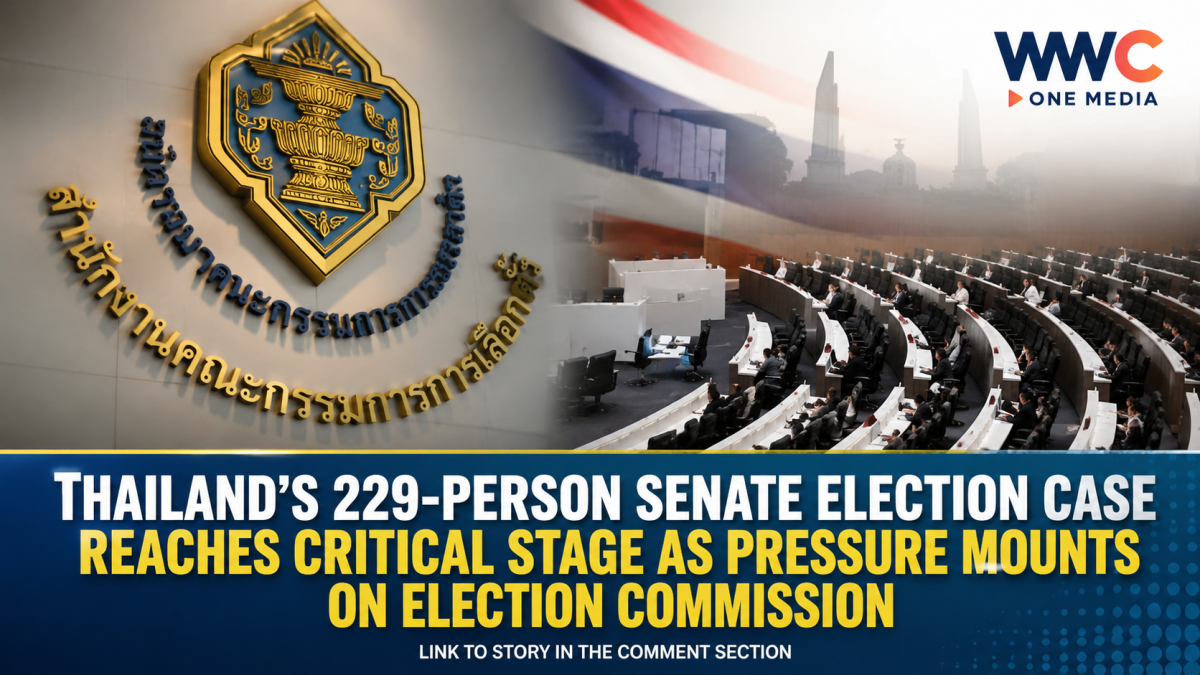
BANGKOK — Pressure is intensifying on Thailand’s Election Commission (EC) as political groups, reserve senators, civic activists and opposition figures demand action over allegations of collusion in the 2024 Senate election.
The controversy centres on a long-running case involving 229 people, including 138 sitting senators and 91 politicians, party figures and associates, who were previously accused of involvement in an alleged scheme to manipulate the Senate selection process.
The case has now become one of the most closely watched political and legal disputes in Thailand, with competing investigative findings creating further questions about what the Election Commission will ultimately decide.
Conflicting investigations fuel the controversy
The original investigation, conducted by the EC’s 26th investigative subcommittee together with the Department of Special Investigation, concluded that there was sufficient evidence to recommend legal action against 229 people.
That finding was announced in 2025 and included 138 senators as well as 91 political figures and people linked to political networks. The investigators cited alleged violations of Thailand’s laws governing the selection of senators.
But the case later took a dramatic turn.
A separate EC subcommittee, known as Subcommittee 36, voted 5-2 in March 2026 to reject the earlier findings and conclude that the 229 accused individuals had no case to answer. The recommendation was then sent to the full seven-member Election Commission for consideration.
That conflicting evidence has become the heart of the political storm.
Supporters of the original investigation argue that the first inquiry uncovered substantial evidence that should be tested in court. Critics, meanwhile, question whether the EC should proceed against people when a later panel reached the opposite conclusion.
Pressure grows for the case to reach the Supreme Court
The latest pressure campaign is being driven by several groups, including reserve senators and civic networks, who want the Election Commission to forward the case to the Supreme Court’s election cases division rather than allow the dispute to remain unresolved.
Bangkok Post reporting said critics have complained that the case has dragged on for roughly two years, while reserve senators and other groups have called for the allegations to be placed before the courts.
Other Thai media have reported similar demands, with campaigners arguing that the evidence should be subjected to judicial scrutiny rather than effectively settled inside the election regulator.
The EC insists it is acting independently
The Election Commission has pushed back against suggestions that political pressure is determining its decision.
In an official statement issued on Aug. 26, the EC said it was carefully reviewing the Senate case using the facts and evidence contained in the case files.
The commission stressed that it is not an investigative body at this stage, but is responsible for considering the evidence already gathered and exercising its authority independently and impartially. It also said that no individual or group should interfere with or pressure commissioners in carrying out their duties.
The statement came after growing speculation about when the EC would finally vote.
The commission also rejected reports that it would vote on the case on Aug. 28, saying the claim was inaccurate and that the case remained under consideration.
Why the 229-person case matters
The dispute is bigger than the fate of individual senators.
Thailand’s Senate has significant constitutional powers, including a role in selecting members of important independent institutions. That makes allegations surrounding the 2024 Senate selection politically sensitive because any proven coordinated manipulation could raise broader questions about the legitimacy and independence of institutions chosen through the Senate.
Opposition figures have therefore argued that the case should not simply be treated as a technical election-law dispute.
People’s Party leader Natthaphong Ruengpanyawut has warned that alleged irregularities surrounding the Senate election could represent a broader attempt to consolidate political power. Recent opposition discussions have also focused on the independence of Thailand’s institutions and the role of senators in choosing members of those bodies.
New evidence keeps the controversy alive
The political pressure has also been intensified by allegations surrounding financial links, voting coordination and political networks.
Recent reporting has highlighted claims involving financial trails and alleged organised voting arrangements. These remain allegations and have not been established as criminal wrongdoing by a court.
iLaw has also published a recent analysis of the evidence and recommendations contained in the EC case files. Its Aug. 28 report said an EC deputy secretary-general had recommended that the commission petition the Supreme Court to strip the electoral rights of 136 senators, while recommending that complaints against Prime Minister Anutin Charnvirakul and certain party executives be dismissed.
That recommendation illustrates just how divided the case has become: the possible outcome may not be a simple decision involving all 229 accused people.
What happens next?
The Election Commission now faces a crucial credibility test.
One possible outcome is that the EC could send some or all of the cases to the Supreme Court for further proceedings. Another is that it could reject some or all of the allegations after reviewing the competing investigative findings.
What is important is that no final finding of guilt has been established against the 229 people merely because they were investigated or accused.
The EC itself says its decision must be based on evidence and the law, while critics insist that transparency is essential if the public is to accept whatever outcome eventually emerges.
For Thailand, the stakes extend well beyond 229 names.
The final decision could affect public confidence in the Election Commission, the credibility of the 2024 Senate selection process and the political balance surrounding Thailand’s powerful Senate.
The question now is no longer simply who was investigated — it is whether Thailand’s election watchdog can produce a decision that both sides of the political divide will accept as credible.

Leave a Reply