
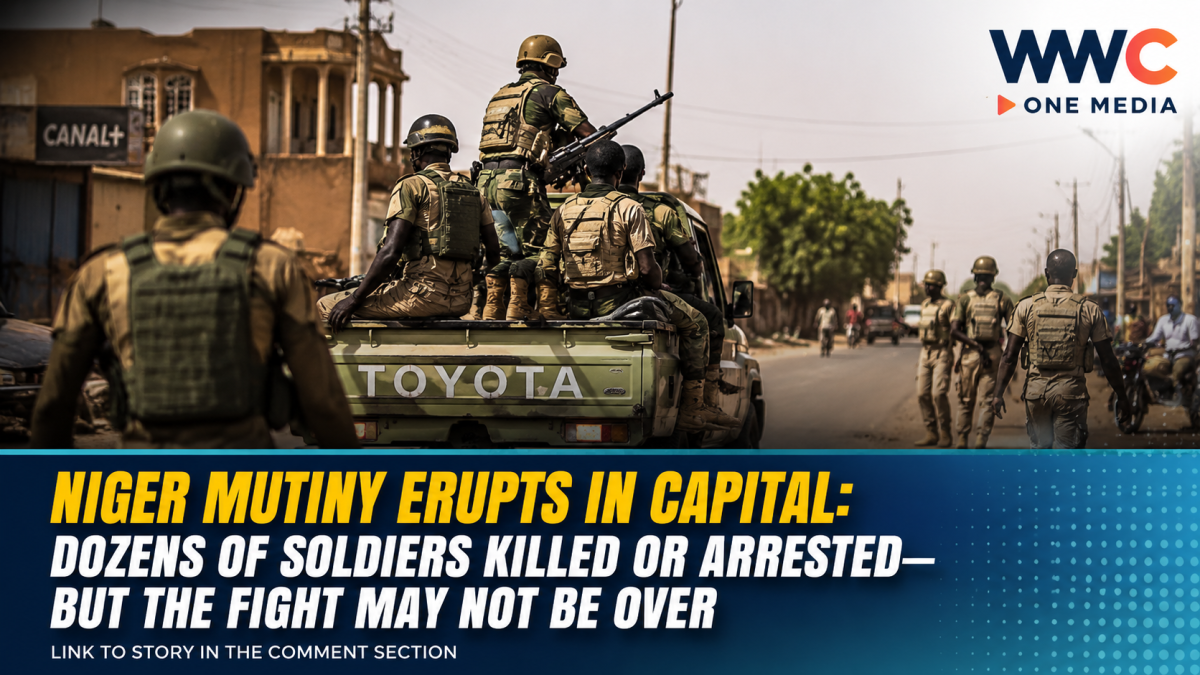
NIAMEY, Niger — Niger’s military government is facing one of its most serious internal challenges since taking power in 2023 after a group of soldiers launched an apparent mutiny in the capital, Niamey, triggering hours of gunfire and explosions around key military and government sites.
According to Niger’s state broadcaster RTN, dozens of soldiers were killed or arrested after security forces moved against the mutineers. The broadcaster also aired footage showing dozens of mostly young soldiers being paraded following the clashes.
However, the exact number of people killed or wounded has not been independently confirmed, and the Associated Press said it could not independently verify all of the government’s claims or determine whether authorities had fully restored control.
Gunfire and explosions shake Niger’s capital
The unrest began around Niamey’s main airport, where a major military installation known as Base 101 is located. The airport complex is strategically important and also hosts military forces from Niger and its regional allies.
Heavy gunfire and explosions were reported overnight into Saturday, while fighting was also heard around the district containing the presidential palace.
Reuters reported that mutinous soldiers attacked several sensitive installations, while Nigerien authorities said the troops had attempted to enter the presidential palace. Loyalist forces reportedly pushed them back.
The national television signal was also briefly disrupted during the fighting, adding to concerns that the unrest had reached strategically important parts of the capital. Al Jazeera reported that the broadcast interruption lasted for more than an hour before services resumed.
What happened inside the military?
Niger’s Defence Minister, General Salifou Mody, said soldiers had taken some troops hostage at a barracks and opened fire at sensitive locations in Niamey.
Authorities described the situation as an attempted uprising and said security forces responded quickly.
By Saturday, the military government said it was “gradually” regaining control of the affected locations and urged residents to remain calm.
But reports from the ground initially suggested that the situation remained fluid, with security sources saying some mutineers were still holding positions around military facilities.
Why are Niger’s soldiers turning against the junta?
The mutiny comes against the backdrop of a much larger security crisis.
Niger has been ruled by a military junta headed by General Abdourahamane Tchiani, who seized power in the July 2023 coup that removed President Mohamed Bazoum.
The junta justified its takeover in large part by pointing to the government’s failure to stop jihadist violence.
Yet militant attacks have continued despite the change in leadership. Analysts cited by AP said the apparent mutiny may reflect frustration among young soldiers over worsening insecurity and battlefield losses.
Al Jazeera also reported that the soldiers involved were believed to have links to areas such as Ouallam, Téra and Dosso, where Niger’s military has faced persistent security challenges.
That makes the latest uprising particularly significant: the same security crisis that helped bring Niger’s military government to power is now contributing to tensions within its own armed forces.
Russia’s role adds another layer
The confrontation also highlights Niger’s increasingly close relationship with Russia.
Several diplomats and analysts told AP that Russia’s Africa Corps provided aerial and ground support to Nigerien forces during the effort to suppress the rebellion.
Niger has moved away from its former military relationship with Western powers, particularly France, since the 2023 coup. It has instead strengthened ties with Russia while deepening cooperation with neighboring military-led governments in Mali and Burkina Faso.
The three countries are members of the Alliance of Sahel States, a regional bloc formed as their governments sought to reduce reliance on Western partners.
A warning sign for Niger’s junta
The latest mutiny could therefore have consequences far beyond Niamey.
The military government came to power promising to restore security and defend Niger’s sovereignty. But continued attacks by jihadist groups, military casualties and now an apparent rebellion from within the armed forces could expose deeper divisions inside the junta’s security establishment.
Reuters reported that the unrest could also divert military resources away from the fight against militant groups operating in the Sahel.
For now, the government says it has contained the uprising.
But the biggest unanswered question is why soldiers were willing to turn their weapons against their own military leadership in the first place—and whether the latest confrontation is an isolated mutiny or a sign of deeper fractures inside Niger’s armed forces.
The fighting may have subsided, but the political and military consequences for Niger’s junta could only be beginning.




Leave a Reply