
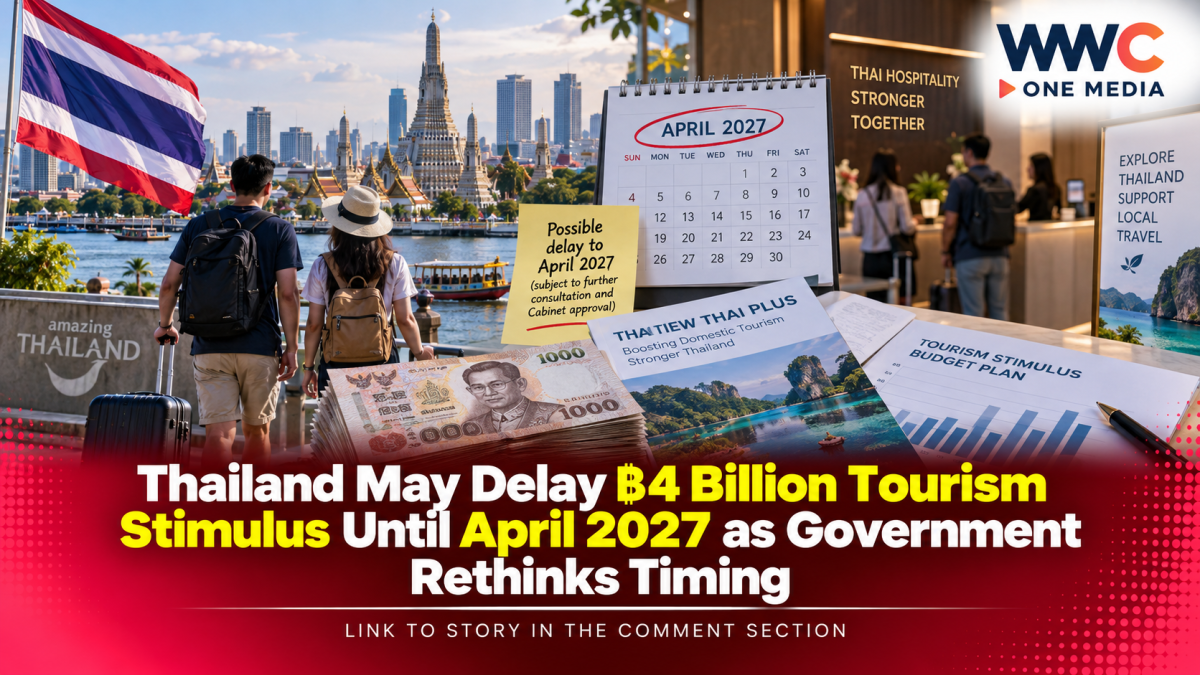
BANGKOK — Thailand may postpone its much-anticipated Thai Tiew Thai Plus domestic tourism stimulus programme until around April 2027, with the government reconsidering whether spending billions of baht during the country’s peak travel season would deliver enough additional economic activity.
Tourism and Sports Minister Surasak Phancharoenworakul said on Sept. 16 that the programme is likely to be shifted to the low season rather than launched under its original late-2026 schedule.
The proposed programme has a preliminary budget of about ฿4 billion and is designed to support up to 1 million travel entitlements. The funding has reportedly been reserved, meaning the issue is primarily when the programme should run, rather than whether it should proceed.
Why Thailand Is Considering the Delay
The government’s main concern is timing.
The original plan was designed around the period from November 2026 through February 2027, with a suspension during the New Year holiday peak. But ministers and tourism officials questioned whether subsidies would create enough new travel when many Thais were already planning holidays.
The Nation reported that the government believes deploying the money during the high season could produce a relatively limited additional economic impact because hotels and tourism businesses already receive strong demand during that period.
Moving the programme toward April 2027 would instead target the traditional low season, when government assistance could potentially generate more incremental trips and spending.
The Programme Has Not Been Cancelled
For travellers waiting for the scheme, the most important point is that postponement does not currently mean cancellation.
Surasak said the funding for the programme remains reserved, while the government continues consultations with tourism businesses before submitting a finalized timetable to the Cabinet.
The final start and end dates have therefore not yet been formally approved.
What Travellers Could Receive
Under the proposal, the basic benefits would remain broadly unchanged.
The Nation reported that participants could receive:
- ฿1,500 per night in government accommodation support
- Up to five nights of eligible accommodation
- Digital co-payment benefits for food and tourism-related services
- Higher daily digital benefits for destinations outside Thailand’s major tourism centres
The government has earmarked roughly ฿4 billion for the programme and intends to cover about one million entitlements.
Earlier Thai PBS reporting described the programme as providing hotel support and digital vouchers for restaurants and tourism services, with the government initially planning registration in October and travel beginning Nov. 1, 2026.
Why April Could Make More Economic Sense
The proposed shift reflects a basic economic principle: government subsidies are potentially more useful when they generate spending that would not otherwise happen.
During Thailand’s high season, domestic and international travellers already provide strong demand for hotels, restaurants and attractions.
A subsidy introduced at that time could end up supporting trips that consumers had already planned.
The Straits Times reported that Thai hotel-industry representatives had questioned the original timing for precisely this reason, with some arguing that the government should preserve the programme for the 2027 low season.
Thailand’s Tourism Industry Needs More Than a Stimulus
The timing debate comes as Thailand’s tourism industry deals with a more complicated recovery.
The Straits Times reported that Thailand had received 21.7 million foreign visitors through Sept. 12, 2026, down 3.4% from the same period a year earlier. Foreign-tourist spending was also down 1.9% to ฿1.06 trillion.
Domestic tourism has performed better, with Thai trips up 2% to 142 million and domestic tourism spending increasing 1.9% to ฿824.6 billion.
That makes domestic travellers increasingly important to Thailand’s tourism strategy.
Economists Question How Much Growth the Scheme Can Generate
The proposed programme is sizeable in terms of tourism policy, but economists caution against expecting it to transform Thailand’s overall economic growth.
The Straits Times cited Kasikorn Research Centre economist Nattaporn Triratanasirikul as saying the programme may have a greater effect on economic sentiment than on headline GDP growth.
Another economist, Kiatnakin Phatra’s Pipat Luengnaruemitchai, highlighted the key question: how much genuinely new travel will the subsidy create rather than simply paying for trips that would have happened anyway?
That distinction is central to the government’s decision to potentially move the programme to the low season.
Hotel Operators Could Feel the Difference
The postponement could also change when tourism-related businesses receive the benefit of the programme.
Finansia Syrus Securities said the original plan could have supported hotel earnings during the fourth quarter of 2026 and first quarter of 2027.
If implementation moves to April 2027, the potential benefit would instead be pushed toward the second and third quarters, when tourism demand is generally weaker.
Finansia also said the overall effect on hotel companies’ earnings would likely remain limited because the programme’s total budget would not increase simply because its timing changes.
A Separate Stimulus Could Support Year-End Spending
The government is also considering extending a separate Thais Help Thais Plus programme through the final quarter of 2026.
According to The Nation, officials see that programme as potentially supporting domestic spending and travel between October and December, while Thai Tiew Thai Plus could then be deployed during the following low season.
That would effectively divide the government’s support measures according to different economic conditions rather than concentrating the tourism-specific programme in the busiest travel months.
The Decision Now Moves to Consultation and Cabinet
The government still needs to settle the programme’s precise dates and details.
Tourism businesses have expressed differing views: some hotel operators support moving the programme away from the high season, while businesses with unused capacity could still prefer support sooner.
The Tourism and Sports Ministry is expected to consult the private sector again before seeking Cabinet approval.
For Thai travellers, that means there is not yet a confirmed April launch date.
What has changed is the government’s preferred direction: from a late-2026 rollout toward a low-season programme beginning around April 2027.
Thailand’s Tourism Stimulus Enters a New Waiting Game
The proposed Thai Tiew Thai Plus programme was originally presented as a way to inject fresh spending into domestic tourism.
Now, officials are questioning whether the best time to spend that money is when tourists are already travelling.
If the programme is moved to April 2027, the strategy would be clear: save the subsidy for the period when Thailand needs travellers most, rather than spending it during the busiest months.
But until the Cabinet formally approves the revised schedule, April remains a likely target rather than a confirmed launch date.



Leave a Reply