
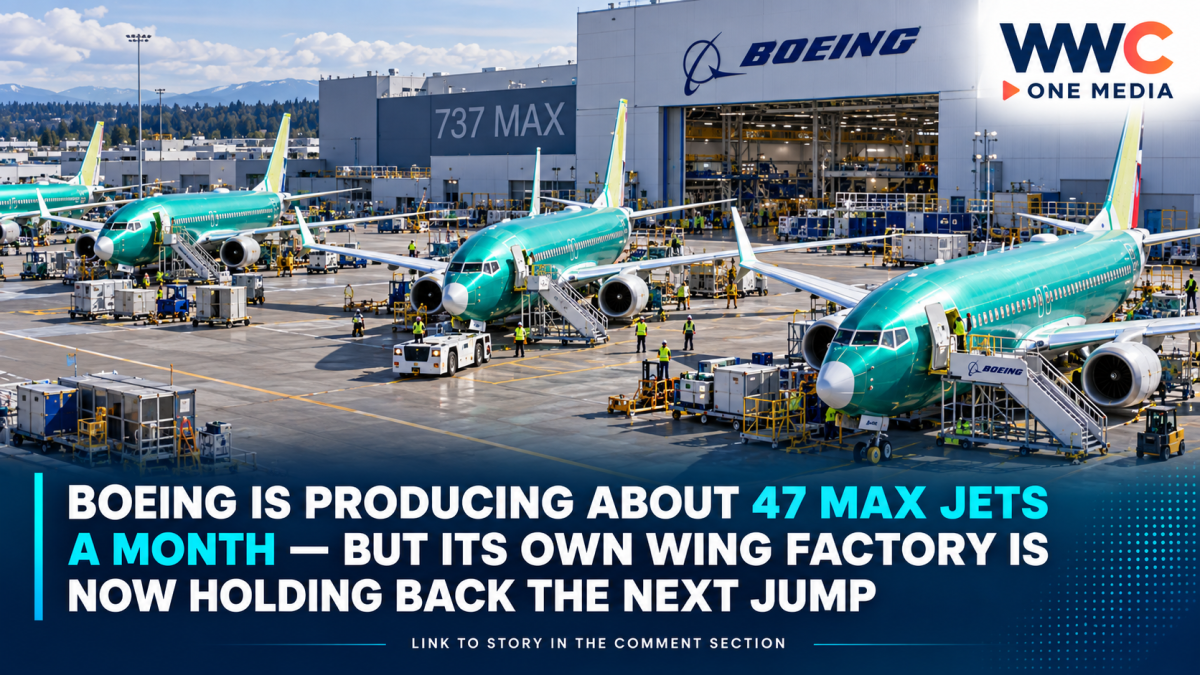
SEATTLE — Boeing has spent years trying to rebuild 737 MAX production after crashes, manufacturing failures, regulatory intervention and a near-catastrophic midair door-plug incident.
Now that the planemaker has finally pushed output to roughly 47 aircraft a month, another problem has appeared.
Boeing cannot yet produce 737 wings consistently enough to keep that rate stable.
Chief Executive Kelly Ortberg told investors Wednesday, September 16, that reaching a steady 47-aircraft monthly production rhythm is taking longer than the company expected, even though Boeing still plans to increase output again in 2027.
The problem sent Boeing shares sharply lower. The stock fell more than 5% during afternoon trading after Ortberg’s comments, according to CNBC, before closing roughly 4% lower for the session, according to Reuters.
But the deeper story is not simply another Boeing delay.
The 737 MAX is the company’s most important commercial aircraft program, and Boeing has thousands of jets waiting in its backlog.
Every month that production fails to stabilise means fewer deliveries, slower cash generation and frustrated airlines that have spent years waiting for new aircraft.
And this time, the main bottleneck is inside Boeing itself.
The wings are now the problem
Ortberg identified 737 wing production at Boeing’s Renton, Washington, factory as the immediate constraint.
Boeing has not been able to make wings quickly and consistently enough to feed all of its final assembly lines at the desired 47-aircraft monthly pace.
That is notable because Boeing executives say the broader supply chain is generally capable of supporting a higher production rate.
Ortberg said the company has plans to improve the wing operation and believes suppliers can support the eventual next step once Boeing resolves its internal flow problems.
The distinction matters.
Aircraft manufacturers depend on thousands of suppliers, and shortages of engines, castings, electronics and cabin equipment have repeatedly disrupted global aircraft production since the pandemic.
But for the 737 MAX right now, Boeing is saying the critical constraint is its own manufacturing flow.
In other words, demand is not the problem.
Orders are not the problem.
Making enough wings at the right pace is.
Boeing is at 47 a month — but “47” does not mean stable
A production rate can be misleading if interpreted too literally.
Boeing is currently building roughly 47 737 MAX aircraft per month, but Ortberg says it has not yet achieved the predictable, repeatable factory performance needed to call that rate fully stabilised.
That distinction is central to Boeing’s strategy under Ortberg.
The company has repeatedly said it does not want to repeat previous production ramps where output targets outran manufacturing stability and created extensive unfinished work, quality problems and aircraft needing additional fixes later in the process.
When Boeing outlined its latest ramp earlier this year, Ortberg said the company would not simply push aircraft through factories unless its production system demonstrated that it was ready.
That philosophy is partly a response to Boeing’s recent history.
Speed is no longer supposed to determine the next production increase.
Quality metrics are.
Boeing had originally hoped to move faster toward 52 a month
The immediate objective had been to stabilise the 737 program at 47 aircraft monthly and then move toward 52 aircraft per month.
That next increase is now expected in 2027, according to Ortberg.
Boeing must solve at least two important issues first.
It needs to increase wing output in Renton.
And it needs to complete the regulatory steps surrounding its new 737 production line in Everett, Washington, before that additional capacity can fully support the higher rate.
Industry publication Leeham News noted that Boeing reaching 52 aircraft monthly by the end of 2026 — an earlier target — now appears unlikely.
That pushes the company’s next meaningful production milestone into another year.
The Everett line was supposed to give Boeing room to grow
Boeing activated its new North Line in Everett on July 6, adding a fourth 737 production line.
It is the first time in more than five decades that Boeing has assembled the 737 outside Renton.
The new line is essentially additional capacity for a program whose backlog stretches well into the next decade.
Boeing says it has more than 4,000 737 aircraft in backlog, enough orders to keep current production running into the 2030s.
When the North Line was announced, Boeing described it as a way to improve both output and resilience.
Having four lines rather than three gives the company more room to handle aircraft requiring additional work without disrupting the normal flow of the entire system.
But opening a new assembly line does not instantly solve a component bottleneck.
If wings do not arrive fast enough, extra final-assembly capacity cannot operate at its full potential.
That is the problem Boeing is now confronting.
The contrast with 2024 could hardly be bigger
Boeing’s current challenge is how to increase production.
In early 2024, U.S. regulators were explicitly preventing it from doing so.
The Federal Aviation Administration froze further 737 MAX production expansion after an Alaska Airlines 737-9 MAX lost a mid-cabin door plug shortly after takeoff on January 5, 2024.
The aircraft suffered rapid depressurisation.
No one was killed, but the incident triggered an extraordinary escalation of FAA oversight of Boeing’s manufacturing operations.
The agency grounded affected MAX 9 aircraft, increased inspectors at Boeing and supplier facilities and conducted audits that found multiple examples of alleged failures to comply with manufacturing quality-control requirements.
The FAA then capped production around 38 737s per month, making clear that Boeing would not be permitted to increase output until regulators were satisfied that its quality system could handle it.
That cap remained one of the clearest signs of how badly trust between Boeing and its regulator had deteriorated.
Boeing had to earn its way from 38 to 42 — and then to 47
The FAA finally allowed Boeing to raise its 737 MAX production rate from 38 to 42 aircraft a month in October 2025, after months of enhanced inspections and production reviews.
Boeing then moved from 42 toward 47 per month in May 2026 after further discussions with the FAA.
That history makes the current bottleneck particularly interesting.
For more than two years, one of Boeing’s primary limitations was regulatory.
Now that regulators have allowed production to move higher, the limiting factor has shifted back toward factory execution.
The company has permission to make more aircraft.
It now has to prove it can make them consistently.
FAA oversight has eased — but it has not disappeared
Boeing has nevertheless regained some regulatory trust.
In July, the FAA restored Boeing’s authority to issue airworthiness certificates for all newly produced 737 MAX and 787 aircraft, following an eight-month review in which the agency said it saw comparable quality results whether certificates were issued by Boeing or the FAA.
That authority had previously been restricted after years of concern about certification and manufacturing quality.
But the FAA continues to maintain inspectors inside Boeing’s production facilities.
When the agency approved the 737 MAX 7 in August, it explicitly said FAA inspectors would remain on site and continue monitoring Boeing’s manufacturing process, Safety Management System and safety culture.
So Boeing has gained flexibility.
It has not returned to the looser oversight environment that existed before its recent crises.
The MAX 7 finally cleared one major hurdle
Boeing received another important victory on August 3, when the FAA certified the 737 MAX 7, the smallest member of the MAX family.
Certification came after almost a decade of review and extensive testing.
The FAA said the process included scrutiny of flight controls, human factors, safety assessments, pilot alerting and a redesigned engine anti-ice system.
Boeing said the MAX 7 certification campaign involved nearly 700 hours of flight testing across 440 flights, plus about 350 hours of ground testing.
Southwest Airlines is the launch customer.
Reuters reported that Southwest expects the first deliveries around the end of 2026, with the MAX 7 entering passenger service in early 2027.
Boeing has already built 27 MAX 7 aircraft for Southwest and is preparing them for delivery.
That removes one long-running headache.
The biggest MAX certification challenge, however, is still unresolved.
The 737 MAX 10 matters much more financially
Ortberg told investors that certification of the 737 MAX 10 — the largest aircraft in the family — should come “very soon.”
But the aircraft remains uncertified as of September 17.
The MAX 10 is several years behind its original schedule.
And unlike a niche derivative, it represents approximately 30% of Boeing’s entire 737 order book, according to Reuters.
That makes certification financially critical.
Airlines want larger narrowbody aircraft because they allow carriers to spread crew and operating costs across more passengers while retaining the lower trip costs of a single-aisle jet.
The MAX 10 is Boeing’s direct answer to Airbus’s highly successful A321neo family.
Every additional certification delay leaves Boeing unable to deliver a major portion of its narrowbody backlog.
Korean Air just ordered 50 MAX 10s
The scale of that demand was underlined on the same day Ortberg acknowledged the production delay.
Boeing and Korean Air finalised an order for 103 aircraft, including 50 737 MAX 10s, 20 777-9s, 25 787-10s and eight 777-8 Freighters.
The Boeing aircraft portion of the transaction was valued at US$36.2 billion at list prices, according to Korean Air.
That means Boeing was announcing one of its biggest customer commitments while simultaneously warning investors that manufacturing growth is taking longer than planned.
It perfectly illustrates the company’s unusual problem:
Boeing does not need more demand nearly as urgently as it needs more reliable production.
Turkish Airlines could add another 150 MAX jets
More potential demand is waiting.
Reuters reported this week that Boeing is close to salvaging a delayed agreement with Turkish Airlines for 150 737 MAX aircraft, part of a larger proposed 225-aircraft transaction.
The deal had been delayed by negotiations involving engine maintenance and pricing with CFM International.
If completed, it would add another enormous block of MAX aircraft to Boeing’s already deep order book.
Again, the commercial challenge is not finding customers willing to order airplanes.
It is delivering enough airplanes to them on time.
Production delays hit Boeing’s cash flow directly
For Boeing, every delivered aircraft is also a financial event.
Airlines typically make significant final payments when they take delivery.
That means production and delivery rates have a direct impact on Boeing’s cash generation.
Reuters reported that slower-than-expected ramps on both the 737 and 787 mean Boeing is now more likely to generate around US$2 billion in free cash flow in 2026, rather than reaching the US$3 billion high end of earlier guidance.
That matters because Boeing still carries nearly US$26 billion in net debt.
The company therefore needs production growth not only to satisfy airline customers but also to repair its own balance sheet.
Every delayed ramp pushes that financial recovery further out.
Boeing was already delivering substantially more aircraft this year
The setbacks should be viewed alongside genuine improvement.
Boeing delivered 314 commercial aircraft during the first half of 2026, including 243 aircraft from the 737 program, according to company figures.
Second-quarter commercial deliveries alone reached 171 aircraft, including 129 737s.
Revenue rose alongside those deliveries.
Boeing reported second-quarter 2026 revenue of US$24.6 billion, reflecting the higher commercial volume.
So Boeing’s recovery has not stopped.
The issue is that the next stage is proving harder than management had expected.
The 787 has a different bottleneck — engines and premium seats
The 737 is not Boeing’s only production problem.
Ortberg said the company’s effort to increase 787 Dreamliner production from eight aircraft a month to 10 is also moving more slowly than expected.
But the causes are different.
For the 787, Reuters said Boeing is facing engine shortages, while slow certification of premium aircraft seats is creating additional delivery complications.
Ortberg warned that Dreamliner deliveries may remain uneven from month to month even if factory output itself runs near eight aircraft.
That means two of Boeing’s most important commercial programs are experiencing ramp-up friction at the same time.
For the 737, it is wings.
For the 787, engines and cabin equipment are part of the problem.
Boeing’s production recovery matters to airlines too
The consequences stretch far beyond Boeing shareholders.
Airlines around the world are waiting for new aircraft while dealing with ageing fleets, strong travel demand and maintenance problems involving older jets and engines.
When Boeing or Airbus misses deliveries, carriers cannot always replace that capacity quickly.
Airlines may have to retain older aircraft longer, lease planes at higher prices or adjust their schedules.
That scarcity has contributed to unusually strong demand for both manufacturers.
It also means Boeing’s ability to stabilise production could influence airline growth plans for years.
Ortberg is trying to avoid the mistake Boeing made before
There is a reason Boeing is being cautious.
Before its recent crises, Boeing was heavily focused on increasing rates to meet enormous demand.
But investigations following the 2024 Alaska Airlines incident exposed manufacturing and quality-control weaknesses serious enough for the FAA to intervene directly.
Ortberg, who took over as Boeing CEO in 2024, has repeatedly argued that stability must come before another production increase.
Boeing said in June that its production system is now using specific safety and quality metrics — including reducing unfinished or “travelled” work — to determine whether factories are ready to move faster.
That is why being temporarily stuck at 47 is not necessarily the same thing as Boeing failing to improve.
It may also indicate that management is unwilling to declare the factory ready before the underlying data support it.
But investors clearly want that proof sooner.
China was another thing investors hoped could move faster
Ortberg also dampened expectations for another large Chinese aircraft agreement when U.S. President Donald Trump hosts Chinese President Xi Jinping in Washington on September 24.
China committed to purchase 200 Boeing aircraft when Trump and Xi met in Beijing in May, according to Reuters.
Some analysts had speculated that another large order could be announced around the Washington summit.
Ortberg said he was not expecting aircraft orders to necessarily be announced there, noting that airlines would reveal purchases on their own schedules.
That is another reminder that Boeing’s immediate story is less about collecting headline orders and more about converting the orders already in hand into delivered aircraft and cash.
The biggest test is no longer getting permission to build faster
Two years ago, the FAA effectively told Boeing:
Do not increase 737 production until your quality system improves.
Since then, Boeing has moved from roughly 38 aircraft a month to 42 and now toward 47.
The FAA has restored more certification authority.
The MAX 7 has finally been approved.
The fourth assembly line is running.
Major airlines are still placing enormous orders.
Those are real signs of recovery.
But they also expose Boeing’s next challenge.
The company finally has more regulatory room to increase production.
Now its factories have to keep up.
The immediate target is to make 47 MAX jets a month reliably.
Then comes 52.
And only after Boeing demonstrates that those rates can be achieved without compromising quality will the company be able to seriously pursue the much higher output levels Ortberg has discussed for the future.
That is why one production bottleneck in Renton matters so much.
Boeing’s comeback is no longer being measured only by how many airplanes airlines want to buy.
It is being measured by whether Boeing can build them at scale without recreating the problems that forced regulators to slow the company down in the first place.




Leave a Reply