
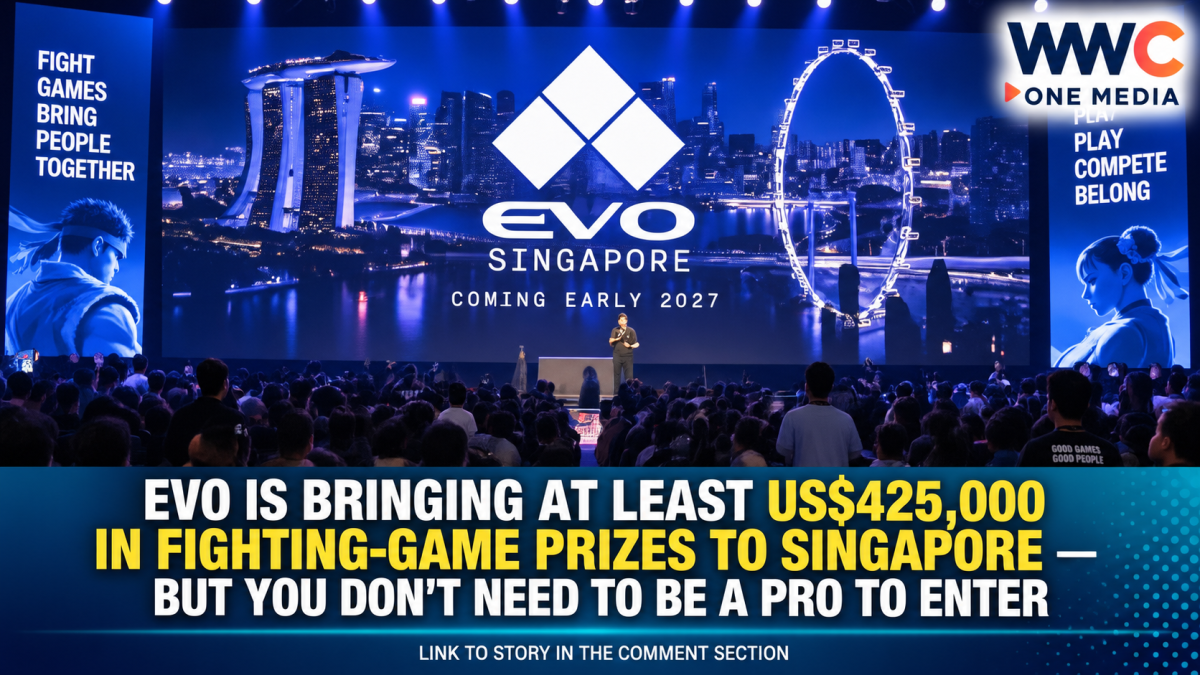
SINGAPORE — One of competitive gaming’s oldest institutions is finally coming to Southeast Asia, and its first stop will put casual players in the same building as some of the best fighting-game competitors in the world.
The Evolution Championship Series, better known as Evo, will stage Evo Singapore from January 15 to 17, 2027, across Halls E and F of the Marina Bay Sands Expo & Convention Centre.
Five games will headline the inaugural Singapore event:
Street Fighter 6, Tekken 8, Marvel Tōkon: Fighting Souls, Guilty Gear Strive and Granblue Fantasy Versus: Rising.
Together, their competitions carry a guaranteed minimum prize pool of US$125,000, or roughly S$160,000 at the conversion used in CNA’s report.
But another tournament taking place around the same weekend changes the financial scale substantially.
Singapore will also host the Tekken World Tour 2026 Global Finals, where the world’s leading Tekken 8 competitors will battle for a separate US$300,000 prize pool.
Combined, that means at least US$425,000 in announced prize money is attached to the Evo Singapore and Tekken World Tour competitions taking place around Marina Bay Sands.
And unlike many elite esports tournaments, Evo still leaves the door open to unknown players.
Evo’s biggest difference: you can actually enter
Evo describes itself as the world’s largest and longest-running open-invite fighting-game tournament series.
That “open” part is fundamental.
You do not have to belong to an esports organisation.
You do not need a professional contract.
And for Evo’s standard open brackets, you do not need to qualify through a league season.
Buy the required event pass, complete tournament registration and, assuming registration remains available and you meet the rules, you can enter.
That creates one of the unusual dynamics of fighting-game esports.
A player who spends most evenings competing online from a bedroom can theoretically arrive at Marina Bay Sands and be placed somewhere inside the same enormous bracket as internationally recognised champions.
Winning is another matter.
But entry itself is remarkably democratic.
Competitors need more than an ordinary ticket
Spectators and tournament players follow different procedures.
Evo’s official Singapore site says competitors must first purchase a three-day Evo Singapore pass, then separately register for their chosen competitions through Start.gg.
Spectators can purchase any appropriate event pass without entering a tournament.
CNA reports that single-day spectator passes start from S$25.
Current ticket listings put the early three-day pass at around S$55, although pricing changes depending on ticket category and sales period.
The published sales schedule is also tiered.
Early-bird pricing runs through October 16.
Regular pricing applies from October 17 through November 30.
Late-purchase rates begin December 1 and run through December 18, according to CNA.
So waiting can cost more.
Tekken is the complicated one
The Tekken 8 portion needs special explanation because Singapore is not hosting a conventional Evo Tekken open bracket in quite the same way as the other headline games.
Bandai Namco says the Tekken World Tour Last Chance Qualifier will replace the normal Tekken 8 open bracket at Evo Singapore.
The winner of that Last Chance Qualifier advances directly into the Tekken World Tour Global Finals bracket.
That makes Singapore especially important for Tekken competitors.
For one player who has failed to qualify through the entire 2026 world-tour season, January 16 represents one final route into the championship.
Win the LCQ.
Reach the global final bracket.
And suddenly an entire season can be rescued in one tournament.
The Tekken finals actually begin one day before Evo Singapore
Another date distinction matters.
Evo Singapore itself runs January 15 to 17.
The Tekken World Tour Global Finals programme begins on January 14.
Bandai Namco’s schedule currently breaks down like this:
January 14 features the Regional Group Stage.
January 15 brings the Global Group Stage.
January 16 is the Last Chance Qualifier.
January 17 concludes with the Final Bracket.
So serious Tekken followers may effectively treat Evo Singapore as a four-day event.
And premium passes offering access to portions of the January 14 action are being sold in limited quantities.
It is the first time a Tekken World Tour season will finish at Evo
That pairing is historically notable.
Evo Singapore will become the first official Evo event to host the conclusion of a Tekken World Tour season, according to both Evo and Bandai Namco.
Usually, Evo and publisher-run world tours intersect through ranking events.
Here, the relationship is tighter.
The entire Tekken season ends inside the wider Evo Singapore experience.
That could give the event international relevance even in its first year.
Street Fighter 6 leads a compact five-game lineup
The five official titles cover several distinct parts of the modern fighting-game scene.
Street Fighter 6 represents Capcom’s defining competitive fighting franchise.
Tekken 8 supplies the major 3D fighter.
Guilty Gear Strive brings Arc System Works’ established anime fighting series.
Granblue Fantasy Versus: Rising represents Cygames’ Granblue universe.
And Marvel Tōkon: Fighting Souls is the newcomer.
The latter is particularly interesting because it only launched in August 2026, about five months before Evo Singapore.
That means Singapore will be among the first major Evo stages on which Marvel Tōkon’s competitive hierarchy starts to become established.
Marvel Tōkon could be the wildcard
Marvel Tōkon is a 4-on-4 tag fighter developed by Arc System Works with PlayStation Studios and Marvel Games.
It launched with 20 playable characters and is designed to make team-based fighting relatively accessible while retaining enough mechanics for high-level competition.
Its inclusion puts characters from the Marvel universe onto the same Singapore tournament floor as Street Fighter and Tekken only months after release.
That gives competitors a very different opportunity.
Street Fighter and Tekken already have deeply established elite player pools.
A newly released fighter can be more volatile.
Its best strategies are still being discovered.
Matchups are less solved.
And the person who dominates six months after launch may not be the person who dominates two years later.
For ambitious competitors looking for a newer game in which the global hierarchy is still forming, Tōkon could therefore be one of the weekend’s most interesting brackets.
The US$125,000 main pool is split among the five games
Evo’s official site confirms a guaranteed US$125,000 total prize pool across the five main titles.
The official FAQ says prize money is shared among each tournament’s top eight finishers.
That figure should remain separate from the Tekken World Tour’s US$300,000.
They are different prize pools attached to different competitive structures.
So headlines saying “Evo Singapore’s prize pool is US$425,000” without explanation would be imprecise.
The more accurate formulation is:
US$125,000 for Evo Singapore’s five main competitions, plus a separate US$300,000 Tekken World Tour Global Finals pool held alongside the event.
The competition format is brutal but familiar
Evo Singapore’s standard tournaments use double elimination.
Every player begins in the winners bracket.
Lose once and you fall into the losers bracket.
Lose again and your tournament is finished.
Because brackets can contain hundreds or thousands of competitors, Evo separates early rounds into pools.
Each pool normally contains between 16 and 32 players, with advancing competitors returning for later phases.
Eventually the bracket contracts into semifinals and the main-stage finals.
That structure creates the stories Evo has built its reputation on.
A famous champion can disappear after two bad sets.
An unknown player can suddenly survive pool after pool and end up on stage.
And yes, players must bring their own controller
Evo Singapore is explicitly a Bring Your Own Controller event.
Competitors are responsible for carrying a tournament-legal gamepad, arcade stick or other approved controller.
Hardware macros and rapid-fire systems are prohibited.
Wireless-controller rules are also restrictive, with approved exceptions specified in Evo’s rules.
An accidental pause can even cost a player a round or potentially a game depending on the situation.
At a tournament where milliseconds matter, the equipment sitting in a player’s hands is almost part of the athlete’s identity.
Evo started with only 40 players
The scale of the Singapore event becomes more striking when compared with Evo’s origins.
In 1996, just 40 players gathered at Sunnyvale Golfland in California for Battle by the Bay, competing in Super Street Fighter II Turbo and Street Fighter Alpha 2.
That community tournament eventually evolved into the Evolution Championship Series.
Evo now describes its broader community as more than 10 million casual players, esports followers and industry professionals.
Its principal events expanded first from the United States to Japan and then France.
Singapore now becomes the next major geographic step.
Singapore was originally announced earlier
The road here has not been perfectly straight.
Singapore was initially announced as an Evo destination on an earlier schedule before organisers eventually confirmed the event for January 2027.
CNA notes that the revised dates were announced during Evo Las Vegas in June.
The official event now firmly lists January 15 to 17 at Marina Bay Sands.
That date correction is worth preserving because old posts and announcement graphics can still circulate with outdated timing.
Singapore already has its own Evo champion
Evo may be making its Southeast Asian event debut, but Singapore is not new to the fighting-game community.
One of the country’s best-known esports players, Kun Xian Ho, better known as Xian, became Evo’s Super Street Fighter IV: Arcade Edition champion in 2013.
CNA previously reported that Xian defeated a field of roughly 1,600 competitors to take the title.
His prize money?
Only around US$5,700.
That historical figure offers an extraordinary comparison with the sport today.
Singapore’s best-known Evo victory came at a time when reaching the top of the world could still pay less than three months of living expenses for a professional player.
The 2027 Singapore weekend now arrives with hundreds of thousands of dollars attached to its biggest tournaments.
But prize money still does not define Evo
That is partly because fighting-game competition grew differently from many major esports leagues.
Games such as League of Legends and Valorant developed heavily structured professional circuits with franchised organisations, salaries and invitation systems.
The fighting-game community retained much stronger roots in local tournaments, arcades and open brackets.
Evo’s rules explicitly frame its tournaments as places where players meet people from different countries and test themselves against unfamiliar opponents.
The open-bracket philosophy means a tournament can simultaneously be:
a world championship,
a convention,
a community gathering,
and somebody’s first competitive event.
Singapore is getting all four.
You do not even have to compete
Evo Singapore is being positioned as a broader festival rather than three days of people sitting at PlayStations.
The official programme includes dozens of arcade machines, casual gaming and community-run Bring Your Own Console tournaments.
There will also be an Evo Museum focused on fighting-game history, merchandise and vendor areas, cosplay activities and publisher and developer booths.
That means someone who has never entered a tournament can spend the weekend entirely outside the main competitive brackets.
For organisers, that broadens the addressable audience substantially.
The publisher booths could produce announcements too
Evo has increasingly become a marketing stage for game developers.
Fighting-game publishers know their most committed audience is watching.
Character announcements, downloadable-content reveals, gameplay trailers and competitive-season news therefore routinely appear around major Evo weekends.
Evo Singapore’s official programme promises publisher and developer booths focused on the “past, present and future” of fighting games.
No major Singapore-exclusive game announcements have been confirmed yet.
But having Capcom, Bandai Namco, Arc System Works-associated titles and a new Marvel fighter in the competitive lineup gives publishers a reason to use the event as more than a tournament.
Singapore is becoming unusually crowded with global gaming events
Evo is also arriving during a bigger push for international gaming events in the city.
CNA notes that Singapore is set to host other major gaming competitions in 2027, including the Pokémon World Championships and Yu-Gi-Oh! World Championship.
That places Singapore in a useful geographic position.
Japan and South Korea have enormous gaming markets.
Southeast Asia contains huge communities in the Philippines, Indonesia, Malaysia, Thailand, Vietnam and Singapore.
Australia is relatively accessible from the south.
A major tournament at Marina Bay Sands can therefore attract competitors across several gaming regions without requiring every Asian player to fly to Las Vegas.
Evo itself is expanding far beyond Singapore
Singapore is part of an even larger international expansion.
After a 2026 ownership restructuring, Evo announced plans to add events or championship activity in markets including Brazil, Morocco, Mexico, China and Saudi Arabia, while keeping existing events in the United States, Japan and France.
RTS now owns Evo, following its acquisition of the remaining ownership stake earlier this year, with backing connected to Saudi Arabia’s Qiddiya City. Evo has said its existing event policies, formats and community focus will remain unchanged while it expands internationally.
Singapore is therefore not simply another isolated tournament.
It is one of the first visible pieces of Evo’s attempt to turn what began as a Californian fighting-game gathering into a genuinely year-round global series.
Streaming means Singapore becomes a global stage
Fans unable to travel will still be able to watch.
Evo Singapore says competitions will be streamed through Twitch and YouTube.
Tekken’s Global Finals will likewise have dedicated online coverage.
That means a player sitting at a station in Marina Bay Sands can potentially go from relative anonymity to being watched by fighting-game fans around the world over the course of a weekend.
That possibility is a central part of Evo mythology.
The brackets are open.
The audience is global.
The path to the stage is unforgiving.
The real hook is not the US$425,000
The money grabs attention.
At least US$125,000 across five Evo competitions.
Another US$300,000 attached to Tekken’s world championship.
But the more distinctive part of Evo Singapore is not the prize pool.
It is who is allowed to try to reach it.
An event featuring world champions and full-time esports professionals will also accept tournament entries from ordinary players who buy the required pass and register before entry closes.
Thirty-one years after 40 players gathered around arcade cabinets in California, that same basic idea is arriving at Marina Bay Sands.
The stage has become much bigger.
The money has become much bigger.
But the person standing opposite a champion can still be somebody almost nobody has heard of yet.



Leave a Reply