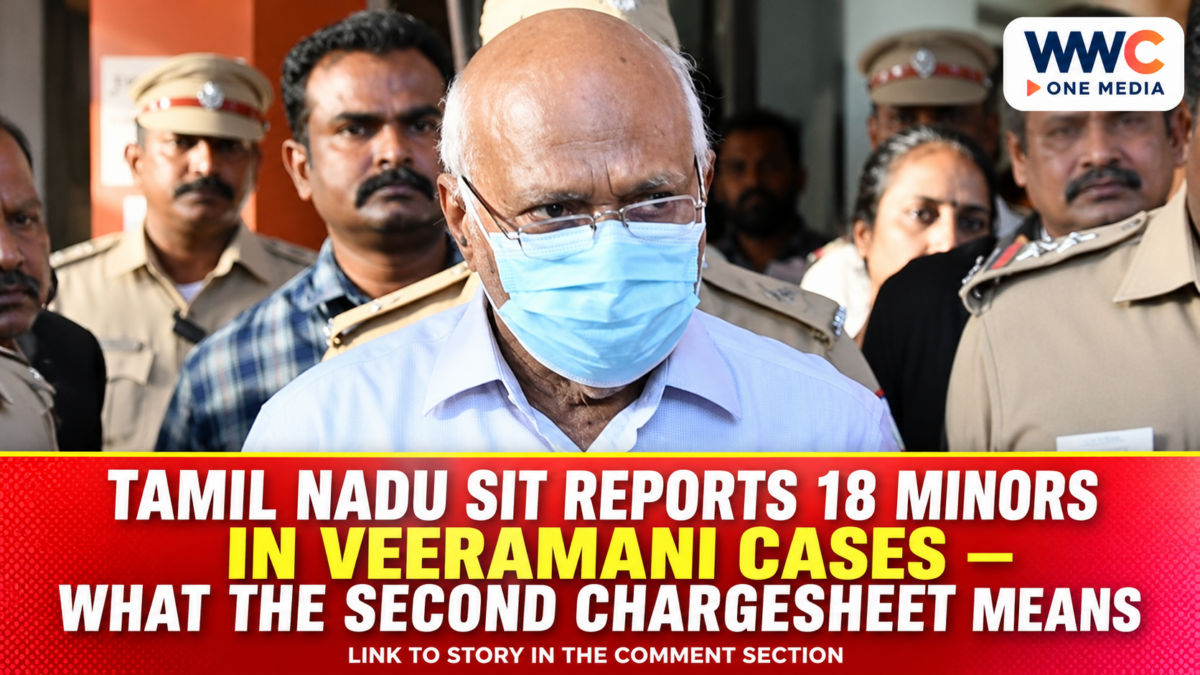
CHENNAI, India — November 26, 2026 — Tamil Nadu’s Special Investigation Team (SIT) has filed a second chargesheet in the cases involving Gem Granites founder R. Veeramani, while police say the investigation has identified 18 minor girls as victims of alleged sexual offences. The police update also places the investigation across nine registered cases, with 10 people arrested.
The development moves the investigation further into the judicial process, but it does not settle the allegations. Chargesheets record the investigating agency’s case against accused persons; the evidence must still be considered through court proceedings, and guilt must not be presumed before a judicial finding.
The case has also raised questions about the handling of earlier complaints and the responsibility of institutions expected to protect children. Those questions require careful separation: the allegations against the accused, the conduct of police personnel, and the court’s assessment of the evidence are related matters, but they are not interchangeable findings.
Veeramani investigation: What the latest police update says
The latest police update says the SIT has registered nine cases involving alleged offences against minors and identified 18 girls during the investigation. It also reports that 10 people have been arrested in connection with the cases.
The second chargesheet was submitted to the court on November 23, according to the update. The first chargesheet had been filed on November 11 in one of the cases. Police further said copies of that first chargesheet were provided to the accused on November 17 and that trial proceedings in that case had commenced.
These dates matter because they show that the investigation is no longer limited to the initial police inquiry. At least one case has entered the trial stage, while the second filing adds another formal investigative submission for judicial consideration.
The reported figure of 18 refers to the number of minors identified by investigators. It should not be read as a court finding or as proof that every allegation has been established. The chargesheet process gives the prosecution a formal basis to present its case; the defence has the opportunity to contest the evidence.
Nine cases, multiple accused and an outstanding arrest effort
The police update names 10 arrested accused: Veeramani, Mahendra Simhan, Shanthi, Lazar, Ganesan, Srinivasan, Sakthivel, Babu, Parthiban and Perumal, also known as Bala.
It separately identifies Prakash as an accused person who remains at large. Police said a court warrant had been issued and a Blue Corner Notice had followed. Such a notice is an international police-cooperation mechanism used to seek information about a person’s identity, location or activities. It is not a conviction, nor does its issuance establish the allegations against the person concerned.
The distinction is important in a case involving multiple people and separate criminal complaints. An arrest in one case does not automatically establish responsibility in another. The specific allegations and evidence must be assessed in each proceeding.
The case also illustrates why the public should distinguish between the number of people arrested, the number of cases registered and the number of children identified by investigators. Those figures describe different parts of the investigation and should not be combined into a single measure of guilt or proof.
Why the chargesheet is a procedural milestone, not a verdict
A chargesheet is the investigating agency’s formal report placing its findings and evidence before the court. It can identify accused persons, describe the alleged offences and set out material the prosecution intends to rely on.
It does not mean that the court has accepted every allegation as true. The prosecution must establish its case through the legal process, and the accused retain the right to challenge the evidence and present a defence.
Under India’s Protection of Children from Sexual Offences Act, 2012, commonly known as the POCSO Act, designated Special Courts handle offences under the law. The legislation also provides child-sensitive procedures, including safeguards for how a child is questioned and how the child’s identity is protected.
Section 33 requires the Special Court to maintain a child-friendly atmosphere and protect the child’s dignity during proceedings. It also restricts repeated testimony and aggressive questioning. These protections are central to ensuring that a child’s participation in a criminal case does not create additional harm.
The broader public-interest issue is therefore not simply how quickly chargesheets are filed. It is whether investigations are thorough, evidence is preserved, children receive appropriate protection and court proceedings follow the safeguards required by law.
The responsibility to protect children extends to media coverage
The POCSO Act places specific limits on reporting about children. Section 23 prohibits media reports from disclosing a child’s identity, including through names, addresses, photographs, family details, schools, neighbourhoods or other identifying information.
That restriction matters even when some details have appeared elsewhere. Repeating identifying information can expose a child to unwanted attention and undermine the privacy protections the law is designed to preserve.
The Supreme Court has also addressed the application of Section 23 in Gangadhar Narayan Nayak v. State of Karnataka, a 2022 judgment involving publication of a child victim’s identity. The judgment sets out the statutory restriction and the legal consequences attached to prohibited disclosure.
WWC’s reporting on child protection and responsible media coverage in Iloilo City has examined the wider responsibility of journalists when reporting cases involving children. The legal frameworks differ between India and the Philippines, but the editorial principle is shared: public interest does not require exposing a child’s identity.
The newsroom has also examined the need to distinguish a police action from a final legal finding in its coverage of the Ameenpur child rescue in India and a separate Muzaffarpur child death investigation. Those cases are not connected to the Veeramani investigation; they provide context for the importance of evidence-based reporting and careful treatment of children’s privacy.
What the case raises about institutional accountability
The investigation has drawn public attention not only to the allegations against the accused but also to questions about how earlier information was handled. Those questions should be answered through official records, including the relevant complaints, police action reports, court orders and any charges filed against public officials.
A finding that an official received information is not, by itself, proof that the official committed an offence. Establishing responsibility requires evidence about what information was received, what legal duties applied, what action followed and what the relevant court ultimately determines.
That distinction is especially important where an investigation examines possible failures by people entrusted with public responsibilities. Accountability should be pursued through verifiable records and due process, not through assumptions or public speculation.
For the same reason, the reported chargesheets should be read as procedural developments. They show that investigators have submitted formal reports in at least two cases; they do not resolve every question about the broader investigation or the conduct of every person named in public accounts.
What happens next
The immediate next steps are the continuation of court proceedings in the case covered by the first chargesheet, judicial consideration of the second chargesheet and further action to locate the accused person for whom police say a warrant and Blue Corner Notice have been issued.
The other registered cases remain important. The public will need reliable updates on whether further chargesheets are filed, whether additional evidence is presented and whether the court issues orders that clarify the status of the proceedings.
The original police release and the filed chargesheets should be made available for direct public scrutiny where legally permissible, with all information capable of identifying children withheld. That would allow the public to understand the procedural progress without compromising the privacy and safety of those involved.
For now, the reported 18-minor figure and the second chargesheet mark a significant stage in the investigation. The final measure, however, will be the quality of the evidence, the protection afforded to the children and the fairness of the judicial process.
Frequently asked questions
How many minors have been identified in the Veeramani investigation?
Police said the SIT had identified 18 minor girls during its investigation. This is an investigative figure, not a court finding.
How many cases have been registered?
The latest police update says nine cases have been registered in connection with alleged offences involving minors.
Has a second chargesheet been filed?
Yes. Police said the second chargesheet was submitted to the court on November 23, 2026. The first chargesheet was filed on November 11.
Does filing a chargesheet mean the accused are guilty?
No. A chargesheet is the investigating agency’s formal report. The allegations must still be considered through the judicial process, and guilt must be established in court.
Why are the children’s identities being withheld?
Section 23 of India’s POCSO Act restricts publication of information that could identify a child involved in a case. The restriction covers names, photographs, addresses, family details, schools and other identifying particulars.