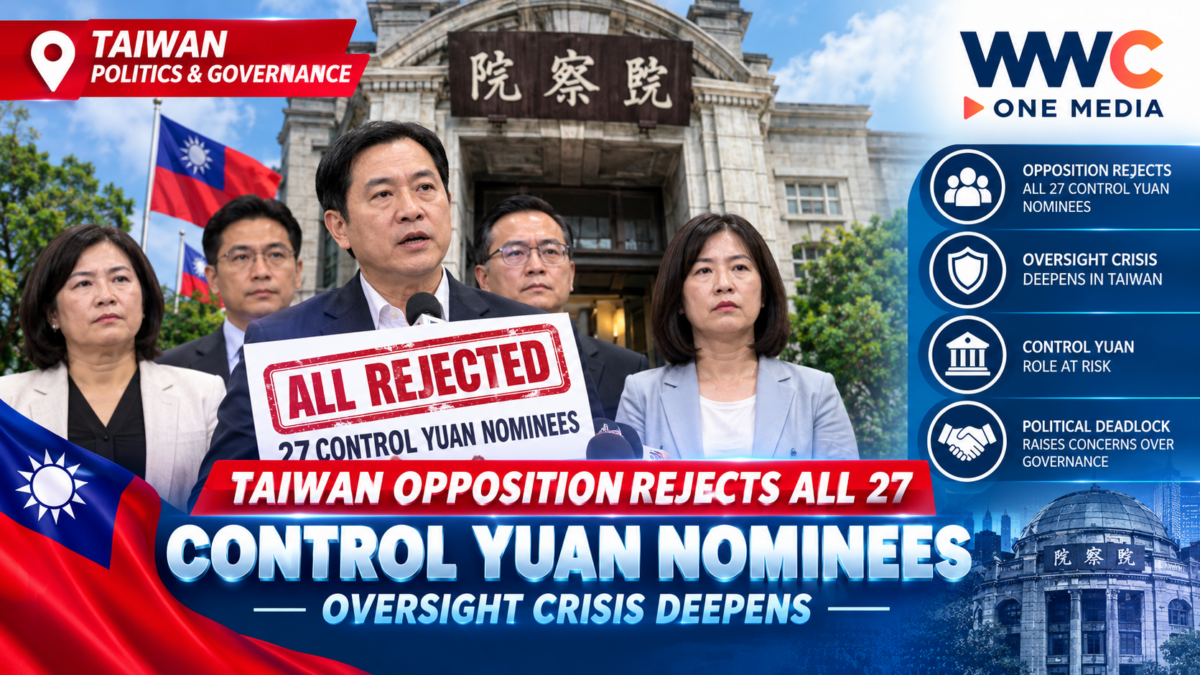
TAIPEI — Taiwan’s opposition parties have rejected all 27 nominees put forward by President Lai Ching-te for the Control Yuan, extending a political standoff that has left the constitutional oversight body without members.
The Control Yuan has warned that the absence of members prevents it from carrying out key constitutional responsibilities, including accepting public petitions and investigating potential misconduct by government officials.
The dispute is also affecting institutions operating under the Control Yuan, including the National Human Rights Commission and the Central Integrity Committee, according to the oversight body.
All 27 Nominees Rejected
The latest rejection means none of Lai’s 27 nominees will take seats on the Control Yuan.
The decision has deepened disagreement between the ruling Democratic Progressive Party (DPP) and opposition lawmakers over how the oversight institution should operate and who should serve on it.
The Presidential Office said it respected the legislature’s decision but expressed concern about the consequences for Taiwan’s democratic institutions and constitutional order.
DPP lawmakers argued that repeatedly rejecting nominees could prevent the Control Yuan from functioning.
Opposition Questions the Institution
Opposition lawmakers have offered a different explanation for the rejection.
Taiwan People’s Party legislator Hung Yu-hsiang argued that the Control Yuan has applied its investigative powers unevenly and questioned its efficiency.
He cited the institution’s handling of public petitions and argued that its performance did not justify its increasing budget. These are opposition criticisms of the institution and are not independent findings established by the report.
Kuomintang Legislative Caucus Secretary-General Hsu Yu-chen also argued that lawmakers are not required to approve every nominee proposed by the president.
She called for changes that would allow the Control Yuan to carry out its constitutional responsibilities and hold powerful officials accountable.
Government Warns of Institutional Consequences
The Control Yuan says the lack of members has consequences beyond the nomination dispute.
Without members, it cannot perform functions that include receiving petitions from citizens and investigating potential dereliction of duty by officials.
The institution has also emphasized that it considers itself politically neutral while rejecting accusations that it is biased.
The Presidential Office and DPP lawmakers have urged legislators to consider the broader impact of the continuing vacancy.
The Bigger Issue: Reform or Restoration?
The dispute is increasingly focused on two competing questions.
The ruling camp has emphasized the need to restore the Control Yuan’s ability to function, while opposition lawmakers have used the rejection to call for changes to the institution and the nomination process.
The disagreement therefore goes beyond the 27 individuals whose nominations were rejected. It raises questions about how Taiwan’s constitutional oversight system should operate and how disagreements over nominees should be resolved.
For now, the Control Yuan remains without members, leaving its constitutional functions constrained.
The next question is whether Taiwan’s political parties can reach agreement on new nominees — or whether the prolonged standoff will push the debate toward broader reform of the oversight system.
WWC ONE MEDIA G,A