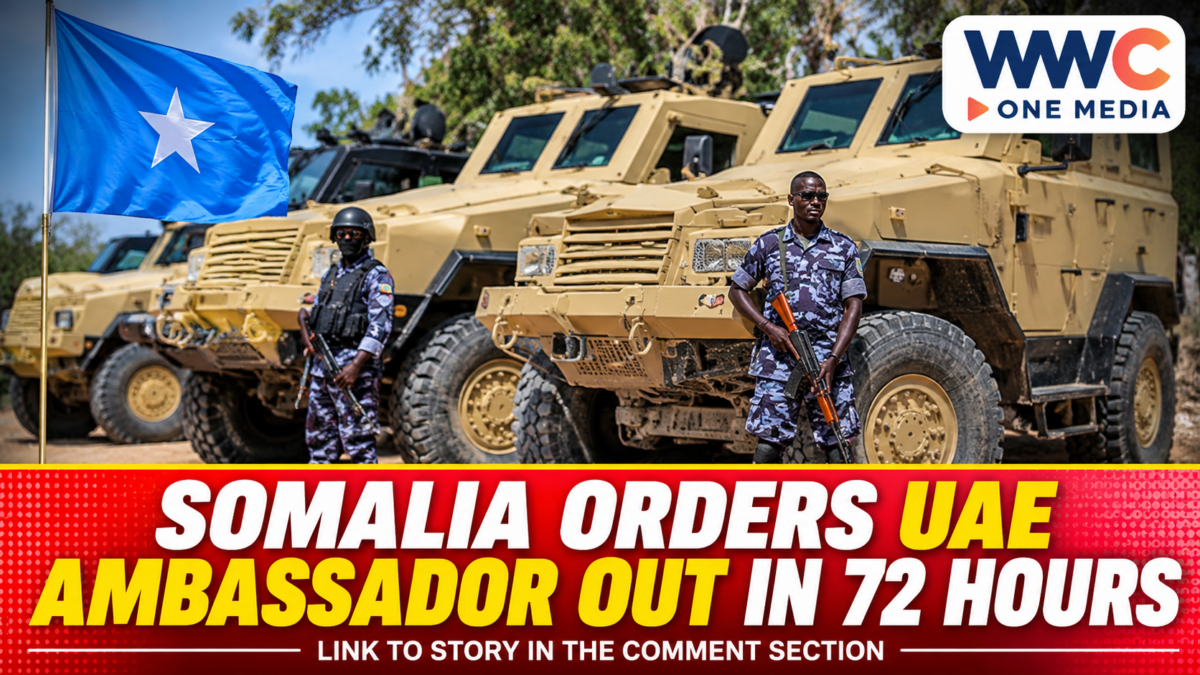
Somalia’s Cabinet has ordered the United Arab Emirates’ ambassador to leave within 72 hours and recalled Somalia’s own envoy from Abu Dhabi, sharply escalating a dispute over foreign involvement in the country’s ports, security arrangements and regional political affairs.
The decisions were announced in Mogadishu on Nov. 19, 2026, after a meeting of the Council of Ministers chaired by Prime Minister Hamza Abdi Barre. The UAE rejected Somalia’s approach as hostile and accused the government of bringing its internal political disputes into bilateral relations.
The confrontation is about more than the removal of a diplomat. It exposes a continuing disagreement over who has the authority to negotiate foreign port, economic and security arrangements involving Somali territory — the federal government in Mogadishu or regional administrations with their own relationships abroad.
Five Cabinet decisions deepen the diplomatic confrontation
The Somali National News Agency reported that the Council of Ministers adopted five measures following its review of the dispute.
The first was to recall Somalia’s ambassador to the UAE for consultations and instruct the UAE ambassador in Mogadishu to return to his country within 72 hours.
The government also directed the Foreign Ministry to pursue further measures to defend Somalia’s unity, sovereignty and security. It instructed the ministry to present the government’s position to foreign governments and international organisations.
Another decision warned people against cooperating with the UAE in actions that the Somali government considers aggression against the country. The Cabinet also called on Somali leaders and citizens to participate in defending national unity.
The announcement is a substantial diplomatic escalation, but it should not be confused with a formal declaration that all diplomatic relations have been severed. The published measures concern the two ambassadors and further government action; they do not announce a complete termination of diplomatic relations.
That distinction matters because diplomatic expulsions and recalls can be used to signal serious objections while leaving room for governments to maintain communication.
The dispute began with agreements over strategic ports
The latest confrontation follows Somalia’s Jan. 12 decision to terminate agreements with the UAE.
In a statement published by Somalia’s Ministry of Foreign Affairs, the federal government said the decision covered port operations, government institutions and security and defence cooperation. It specifically identified arrangements involving Berbera, Bosaso and Kismayo.
The government said it considered the agreements incompatible with the protection of Somalia’s sovereignty, territorial integrity and national unity.
The three ports are strategically important because of their coastal locations and their potential roles in trade, logistics and access to maritime routes. Arrangements involving these facilities can therefore carry economic and security implications beyond the immediate interests of port operators.
The disagreement also reflects Somalia’s federal political structure. Regional administrations have their own political and economic interests, while the federal government maintains that foreign relations and agreements affecting national sovereignty must be handled through the constitutional authority in Mogadishu.
In practical terms, the dispute is about the limits of regional autonomy when foreign governments negotiate arrangements involving infrastructure and security.
Somalia’s president sets out allegations against Abu Dhabi
President Hassan Sheikh Mohamud addressed the nation on Nov. 17, setting out the federal government’s reasons for its position.
He accused the UAE of supporting regional administrations in ways that weaken the federal government and of entering into port arrangements without the approval of Mogadishu.
He also alleged that the UAE had helped establish military facilities and security forces outside Somalia’s national command structure. The president argued that parallel security arrangements could undermine the cohesion of national institutions.
These are allegations made by Somalia’s president. The public statements reviewed do not independently establish that every alleged activity occurred as described.
The distinction is essential. A government’s official accusation is evidence of its position in a diplomatic dispute, not by itself proof of the conduct it alleges.
Somalia’s Foreign Ministry had already issued a statement on Nov. 18 rejecting foreign engagement and security arrangements that bypass the federal government. It said the country would take lawful measures to protect its sovereignty and emphasised that its objections concerned UAE government policy, not the Emirati people.
That distinction suggests Mogadishu is seeking to frame the dispute as one between governments rather than between the populations of the two countries.
The UAE rejects Somalia’s approach
The UAE’s Ministry of Foreign Affairs issued its response on Nov. 19.
It condemned what it described as the Somali government’s hostile and escalatory approach, arguing that decisions affecting bilateral relations should reflect shared interests and remain separate from domestic political conflicts.
The UAE also said it had closed its embassy in Mogadishu and withdrawn its diplomatic personnel in January 2026. It linked that earlier decision to what it described as hostile actions by the Somali government, including the cancellation of bilateral agreements.
This detail is significant when assessing the latest order. The UAE’s own statement says its diplomatic staff had already been withdrawn, while Somalia’s announcement refers to an ambassador being instructed to leave. The two governments’ public statements do not fully explain the practical diplomatic arrangements behind that apparent difference.
The UAE did not publicly address every allegation raised by Somalia’s president in the statement reviewed. Instead, it defended its relationship with the Somali people and argued that the dispute should not damage the interests of both populations.
The two positions remain far apart: Mogadishu insists that foreign engagement must respect federal authority, while Abu Dhabi rejects what it sees as the Somali government’s attempt to draw internal political struggles into bilateral relations.
Why the ports matter beyond Somalia
Somalia’s coastline gives the country an important position along the Gulf of Aden and the wider western Indian Ocean. Its ports sit within a region where international trade, shipping routes and security interests overlap.
Foreign investment in port infrastructure can bring commercial opportunities, jobs and improved logistics. But agreements involving ports can also raise questions about access, control, security responsibilities and the authority of the government granting permission.
The wider region has become increasingly important to major powers seeking access and influence along strategic maritime corridors. WWC has examined the military significance of China’s communications and surveillance-related infrastructure in Djibouti, near the Bab el-Mandeb Strait. That context helps explain why infrastructure and security partnerships around the Horn of Africa attract international attention.
The dispute also illustrates how defence relationships can extend beyond military equipment and training. WWC previously examined the Philippines’ expanding defence cooperation with the UAE. The Philippine arrangement is separate from Somalia’s dispute, but it demonstrates the range of security partnerships Abu Dhabi pursues with foreign governments.
For countries with long coastlines, the central issue is how to attract investment and security assistance while maintaining clear national oversight. The importance of regional maritime coordination is also reflected in ASEAN’s planned maritime centre in the Philippines, although Southeast Asia’s institutional framework differs from Somalia’s federal arrangements.
What happens next
Somalia’s Foreign Ministry has been instructed to communicate the government’s position to foreign governments and international organisations. The government has also indicated that further lawful measures may follow.
The immediate diplomatic questions concern the ambassador’s departure deadline, the status of Somalia’s recalled envoy and whether either government will establish a channel to prevent further deterioration.
A longer-term resolution would require agreement on how foreign governments should engage with Somalia’s federal institutions and regional administrations, particularly on ports and security cooperation.
The UAE’s position will also matter. Its statement leaves open the possibility of maintaining relations with the Somali people, but it does not announce a reversal of the embassy closure or a new agreement with Mogadishu.
For now, the two governments have publicly stated opposing positions, and no settlement has been announced. The central test will be whether they can separate their disagreement over political authority and security arrangements from the broader relationship between their populations.
Frequently Asked Questions
Why did Somalia order the UAE ambassador to leave?
Somalia’s Cabinet said the decision followed concerns over the UAE’s alleged interference in the country’s sovereignty, territorial integrity and internal affairs.
How long does the UAE ambassador have to leave?
The Somali government gave the UAE ambassador 72 hours to leave the country, as announced on Nov. 19, 2026.
Did Somalia also recall its ambassador to the UAE?
Yes. The Cabinet instructed Somalia’s ambassador to the UAE to return to Mogadishu for consultations.
What are Berbera, Bosaso and Kismayo?
They are ports named in Somalia’s January 2026 decision to terminate agreements with the UAE. Their strategic coastal locations make them important to trade, logistics and maritime access.
Has Somalia cut diplomatic relations with the UAE?
The published Cabinet measures order the UAE ambassador to leave and recall Somalia’s envoy. They do not announce a complete severing of diplomatic relations.