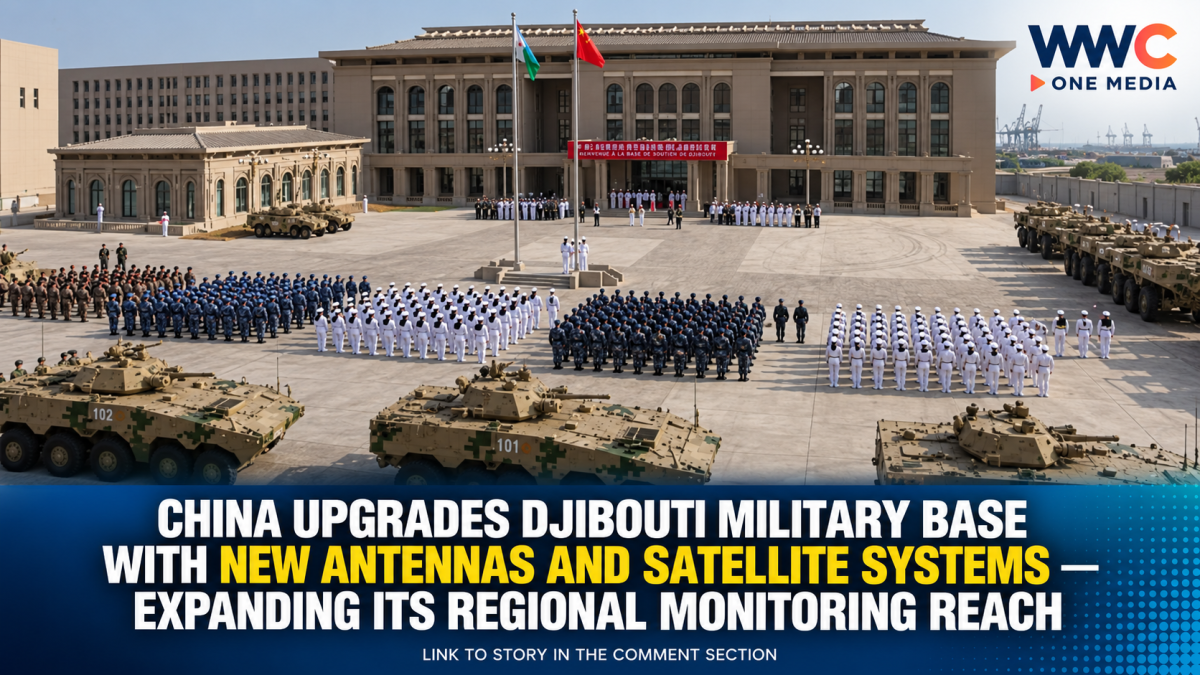
WASHINGTON — China has upgraded its only formally acknowledged overseas military base in Djibouti, adding communications and antenna infrastructure that analysts say could significantly expand the People’s Liberation Army’s ability to communicate with forces operating across the Middle East and Africa—and potentially monitor military activity in one of the world’s most strategically important maritime corridors.
The new assessment comes from the Center for Strategic and International Studies (CSIS), which analyzed commercial satellite imagery of China’s People’s Liberation Army Support Base in Djibouti.
The upgrades include new antennas, satellite communications equipment and two communications compounds that have emerged at the facility since mid-2024. CSIS says the equipment is likely part of a broader command, control, communications, computers, intelligence, surveillance and reconnaissance (C4ISR) architecture.
The development matters because the base sits near the Bab el-Mandeb Strait, a critical maritime chokepoint connecting the Red Sea with the Gulf of Aden and a major route for global shipping.
New communications compounds change the picture
According to CSIS, two new communications facilities have been constructed at the Djibouti base since the middle of 2024.
One of the larger compounds includes:
- Three approximately 30-meter high-frequency dipole antennas
- Two smaller very-high/ultra-high-frequency antennas
- Three mobile satellite-communications dish antennas
- Four probable 5G towers
- A radome enclosing an unidentified piece of equipment
Another facility contains additional high-frequency antennas and a similar radome. Reinforced cable trenches installed in 2025 could also support additional antenna infrastructure in the future, according to the CSIS analysis.
CSIS says the variety and orientation of the equipment would allow the Chinese military to transmit and detect signals across a broad range of frequencies.
The organization assesses that the two compounds likely operate together as part of a larger communications and intelligence architecture.
The key distinction: monitoring capability is not proof of interception
The satellite imagery has generated headlines about Chinese surveillance, but there is an important limitation.
CSIS says the new equipment could improve China’s ability to monitor activity and collect signals in the region. However, imagery alone cannot establish whether the antennas are currently being used to actively intercept particular communications.
Reuters likewise reported that the facilities would likely allow China to monitor nearby military activity, while noting that it was not possible to determine whether communications were actually being intercepted.
That distinction is important because antennas can have multiple functions, including communications, receiving signals, transmitting signals and supporting broader command-and-control systems.
Why Djibouti is strategically important
China’s base opened in 2017 and is located close to the Bab el-Mandeb Strait.
The chokepoint is one of the world’s major maritime routes, connecting shipping moving between the Indian Ocean and the Mediterranean through the Red Sea and Suez Canal.
CSIS estimates that the strait handles approximately 16% of global maritime trade, making the surrounding region strategically important not only to militaries but also to global commerce.
China’s base supports People’s Liberation Army Navy operations in the Gulf of Aden and Red Sea, including the country’s longstanding naval escort missions.
Its location also puts it close to military installations operated by several other countries.
China is surrounded by foreign military facilities
The Djibouti base is part of an unusually concentrated military environment.
The United States, France, Italy and Japan all operate military facilities in Djibouti, with some located less than 16 kilometers from the Chinese installation, according to CSIS and Reuters.
That proximity gives the Chinese facility potential access to a dense electromagnetic environment generated by military communications, aircraft, ships and other systems operating in and around the country.
CSIS says the new infrastructure could give the PLA a substantially more detailed picture of military activity in the surrounding region.
The potential intelligence value is particularly notable because the region has experienced significant military activity involving the Houthis, Iran, Israel and the United States, while conflicts in Yemen, Sudan and Somalia have also increased the importance of regional military monitoring.
The upgrade could connect Chinese forces thousands of kilometers away
The new infrastructure isn’t necessarily about watching Djibouti alone.
CSIS assesses that the facilities could provide more reliable communications between Chinese ships and aircraft operating across the region and military headquarters in China.
That would give Beijing a more resilient communications architecture for operations far beyond China’s immediate neighborhood.
The report describes the new facilities as providing redundant, over-the-horizon communications and secure links to Chinese command headquarters.
This is consistent with the broader evolution of the Djibouti base since it opened.
What initially served primarily as a logistical and naval support facility has gradually developed capabilities that support increasingly sophisticated overseas military operations.
China’s first acknowledged overseas military base
Djibouti holds another distinction: it is China’s only formally acknowledged overseas military base.
The facility was officially opened in August 2017 and was established to support China’s military activities, particularly naval escort missions in the Gulf of Aden.
U.S. Defense Department assessments have also documented the development of the facility’s infrastructure, including its large naval pier. A 2024 Pentagon report noted that the pier was operational and could accommodate large Chinese naval vessels.
The base has therefore evolved well beyond a simple resupply point.
Its development reflects China’s broader effort to give the People’s Liberation Army the ability to conduct sustained operations farther from mainland China.
The Red Sea crisis makes the location even more valuable
The timing of the upgrades is significant.
The Red Sea and Gulf of Aden have experienced heightened military activity amid attacks by the Iran-backed Houthi movement on shipping and subsequent international military operations.
That has increased the strategic importance of monitoring naval movements, air activity and communications across the region.
Reuters reported that CSIS considers the recent regional conflicts to have increased the potential value of intelligence collection from China’s Djibouti facility.
For Beijing, better communications and signals awareness could provide information about the operational environment while Chinese naval forces continue operating in waters surrounding the Horn of Africa and the Arabian Peninsula.
Beijing rejects the framing of its role as destabilizing
China has defended its overseas military presence as part of its broader contribution to international security.
According to Reuters, Chinese Foreign Ministry spokesperson Guo Jian said Beijing was not aware of the specific situation described in the report but reiterated that China presents itself as a contributor to international peace and development and says it follows principles of mutual respect and equality.
The CSIS assessment, meanwhile, focuses on what the physical infrastructure indicates about China’s military capabilities rather than making a judgment about Beijing’s intentions.
That distinction matters.
The imagery provides evidence of new infrastructure and its likely capabilities. It does not, by itself, establish how Beijing intends to use every component or what specific communications may have been collected.
A bigger Chinese military footprint beyond Asia
The Djibouti base is also significant because it represents China’s expanding ability to sustain military operations outside East Asia.
For years, the People’s Liberation Army Navy has conducted anti-piracy and escort operations around the Horn of Africa.
Those missions have provided Chinese naval forces with operational experience far from home waters.
The base gives those deployments a permanent logistical and communications hub.
CSIS says the facility’s capabilities have continued to evolve, helping the PLA Navy establish a growing operational foothold in the region.
The latest communications upgrades add another layer: the ability to connect deployed forces, headquarters and intelligence systems across a much wider geographic area.
Why the upgrade matters beyond the military
The implications extend beyond military strategy.
The Bab el-Mandeb Strait is directly connected to global supply chains. Disruptions in the Red Sea can affect shipping routes between Asia and Europe, increasing transit times and costs when vessels are diverted around Africa.
A military facility overlooking such a strategically important region therefore has significance for international commerce as well as security.
China is also one of the world’s largest trading nations, giving Beijing a direct economic interest in maintaining awareness of developments along major maritime routes.
Its Djibouti presence combines those economic and security interests in one strategically located facility.
The bigger story is what comes next
The latest satellite imagery suggests China’s Djibouti base is becoming more technologically sophisticated.
New high-frequency antennas, satellite communications equipment, probable 5G infrastructure and other communications assets indicate a facility increasingly designed not simply to support ships but to connect military forces, command centers and intelligence capabilities.
Yet analysts caution against going beyond what the imagery can establish.
The evidence shows that China has upgraded the infrastructure.
It strongly suggests expanded communications and potential signals-intelligence capabilities.
But it does not conclusively demonstrate that Beijing is currently intercepting specific encrypted military communications.
What is clear is that China’s only officially acknowledged overseas military base is becoming more capable at precisely the time when the Red Sea, Gulf of Aden and surrounding Middle East and African regions have become more militarily active.
And that means the strategic value of the Djibouti base is likely to extend well beyond the small African country where it sits.