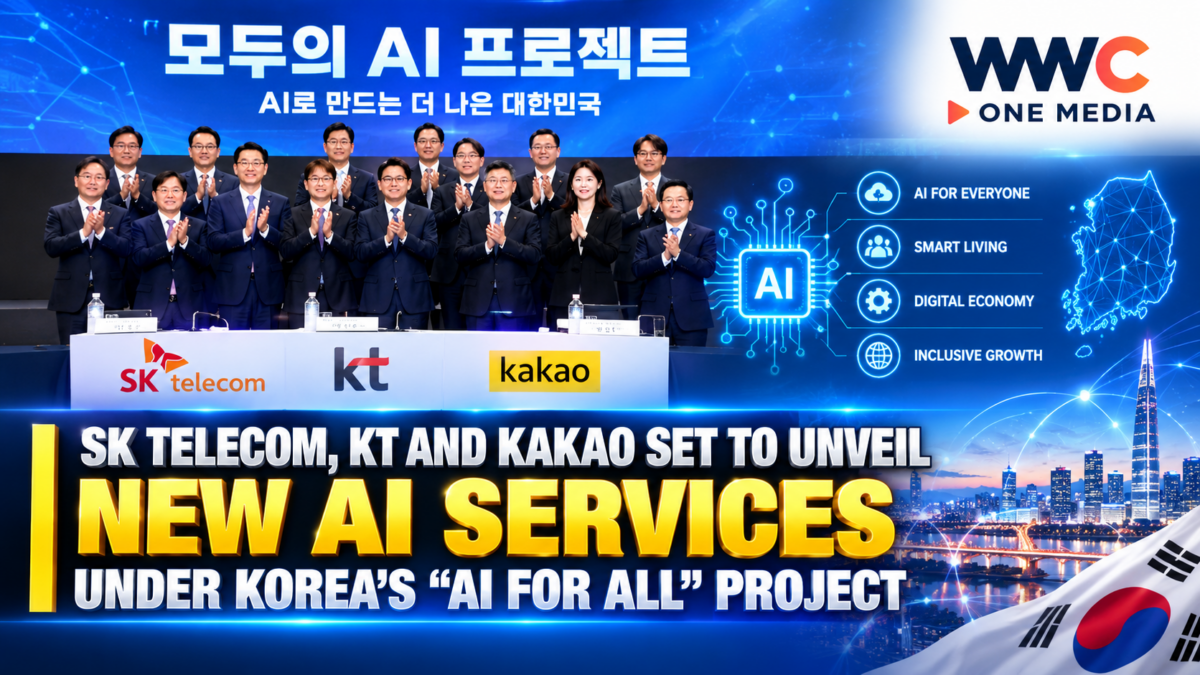
South Korea’s push to make artificial intelligence more accessible to the public is moving into its next stage, with SK Telecom, KT and Kakao preparing to unveil new AI services this month under a government-led initiative.
The three Korean technology giants are leading separate consortia selected for the government’s “AI for All” project, with closed-beta versions of their services expected to launch in October, according to government and industry sources cited by Yonhap.
The initiative represents a major effort to expand public access to AI while encouraging the development and use of Korean AI technology.
Three Korean Tech Giants, Three AI Strategies
The three consortia are being led by SK Telecom, KT and Kakao, with each group developing its own approach to delivering AI services to the public.
Under the government program, the services are intended to provide broad access to AI tools, including general-purpose chatbot functions and specialized AI agents.
The government selected the three consortia in August following an evaluation of their proposed services and technological capabilities. The selected operators were also set to receive government support, including access to Nvidia B200 graphics processing units.
The services are being developed with the expectation that they will eventually become available to people across Korea.
Korea Wants More Homegrown AI
The “AI for All” project comes as South Korea seeks to strengthen its domestic artificial intelligence industry and reduce reliance on foreign AI models.
Developers participating in the initiative are required to use domestic AI models for at least 50 percent of their AI services, according to the latest report.
Government funding and GPU support are being provided as part of the effort to accelerate development.
That requirement puts Korean AI models at the center of the project while allowing participating companies to combine technologies from multiple developers.
Millions of Users Are Part of the Bigger Goal
The ambitions extend well beyond a limited beta test.
The participating developers have been given a target of reaching 5 million monthly active users for their envisioned services.
Kakao has set even larger internal goals, saying it aims to expand usage to 10 million monthly active users by 2027 and 30 million by 2030.
Those numbers illustrate the scale of the government’s attempt to move AI from a technology used primarily by early adopters and businesses into a service accessible to the broader public.
How SK Telecom, KT and Kakao Are Approaching AI
The three companies are taking different routes into the project.
SK Telecom’s consortium plans to make use of its A.X K2 large language model alongside models developed by other Korean AI companies. Its partners include firms and organizations spanning finance, mobility, education, healthcare and AI technology.
KT’s consortium is building its service around KT’s Mi:dm K Pro 2.5 model while also incorporating technology from other Korean AI developers. Its partners include companies connected to online platforms, payments, retail and real estate.
Kakao’s consortium plans to use its messenger ecosystem as a major access point for AI services. Its partners include Lunit, Seoul National University Hospital, Shinhan Bank, LG AI Research, LG CNS, LG Uplus, LG Electronics and FuriosaAI.
The different approaches could give users several ways to interact with domestically developed AI services.
Naver’s Absence Adds Another Layer
One notable feature of the project is the absence of Naver, Korea’s largest mobile platform operator.
Naver considered participating but ultimately chose to focus on its existing AI businesses. The company already operates AI services and has developed its own foundation model, HyperCLOVA X.
The decision means three other major Korean technology groups will take the lead in the government’s latest effort to bring AI services to the public.
What Happens After the Beta?
The October closed-beta launches will provide an important early test of how the government-backed AI strategy performs outside the development stage.
The immediate questions will involve service quality, user adoption, reliability and the ability of Korean AI models to support services at massive scale.
The government originally planned for the “AI for All” services to move toward an official nationwide launch by the end of 2026 following the beta period.
If the services attract millions of users, the project could become a major new distribution channel for Korea’s domestic AI industry.
But before those ambitious user targets can become reality, the first challenge is much closer: getting the October beta launches into the hands of real users — and seeing how they respond.
WWC ONE MEDIA G,A