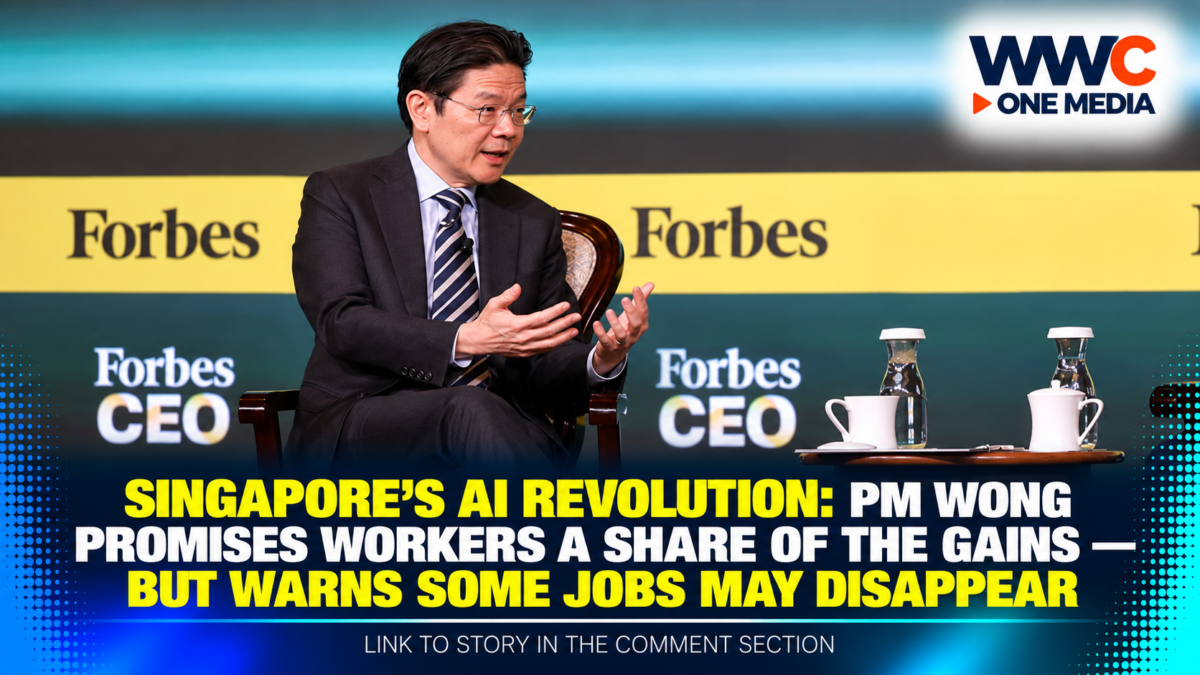
Singapore is pushing ahead with artificial intelligence while promising to help workers navigate the disruption it brings. Prime Minister Lawrence Wong says the goal is to spread AI’s benefits widely, protect workers affected by automation and create better jobs—but he warns that companies cannot be expected to preserve every existing role.
Singapore wants to seize the economic opportunities created by artificial intelligence (AI) without leaving workers behind, Prime Minister Lawrence Wong said, outlining how the country plans to balance technological progress with employment security.
Speaking at the Forbes Global CEO Conference at the Shangri-La Singapore hotel on October 8, Mr Wong said the country’s approach is to ensure that the benefits of AI adoption are shared widely, while giving workers support when technology changes the nature of their jobs.
The strategy relies on cooperation between the Government, employers and trade unions, alongside retraining opportunities and fair treatment for employees affected by retrenchments.
The message comes as AI reshapes industries around the world, raising questions about which jobs will survive, what new opportunities will emerge and whether workers can adapt quickly enough.
For Singapore, the challenge is not simply to adopt AI faster. It is to ensure that the economic gains translate into better opportunities for its people.
PM Wong: Protect Workers, Not Every Job
During a dialogue with Forbes Media chairman and editor-in-chief Steve Forbes, Mr Wong was asked how Singapore intended to manage job displacement as businesses increasingly adopt AI.
He explained that the country takes a different approach from places where trade unions are viewed as obstacles to technological change.
In Singapore, unions are treated as partners in helping workers and businesses navigate the transition.
The Government, employers and unions have developed a working relationship over decades, which Mr Wong said could help the country achieve outcomes that benefit businesses and employees.
However, he acknowledged that automation can eliminate certain positions.
Companies receiving government support to transform their operations are expected to help employees develop new skills. If retrenchments become unavoidable, employers are expected to treat affected workers fairly, provide appropriate benefits and advance notice, and inform the unions so that support can be arranged.
The distinction is important: Singapore’s approach is not to prevent all job losses, but to help workers move through the disruption and find new employment opportunities.
How Singapore Plans to Help Workers Adapt to AI
The Government’s strategy involves more than encouraging companies to introduce new technology.
Mr Wong pointed to government grants for enterprise transformation, which are administered through unions, as one way to connect business upgrading with employee development.
Companies seeking support to strengthen their technological capabilities are expected to help their workers reskill as their operations change.
This approach is intended to reduce the risk that businesses benefit from automation while employees bear the full cost of the transition.
For workers, acquiring new skills could open opportunities in roles that require different technical knowledge, problem-solving abilities or experience working alongside AI systems.
For employers, investing in their workforce could help them adopt new tools while retaining valuable experience and operational knowledge.
The effectiveness of this approach will depend on how well training programmes match actual employer needs and whether affected workers can successfully move into suitable jobs.
Singapore’s AI Boom Is Already Benefiting Multiple Industries
Mr Wong said the current AI boom has supported Singapore’s semiconductor industry and related businesses.
Although Singapore does not manufacture the most advanced AI chips, it has companies such as GlobalFoundries and Micron that produce memory and specialised chips in demand as AI infrastructure expands.
The country has also developed an ecosystem of precision-engineering companies, equipment suppliers and other businesses connected to semiconductor manufacturing.
According to Mr Wong, the economic benefits are extending beyond technology manufacturing.
Industries such as logistics and professional services have also experienced positive spillovers from the AI boom.
These developments demonstrate why Singapore wants to strengthen its position as businesses worldwide invest in AI infrastructure and applications.
However, the Prime Minister cautioned that the boom should not be taken for granted.
He said economic expansions eventually encounter corrections, although the timing, severity and effects of any future downturn remain uncertain.
Singapore’s priority, he explained, is to use the current opportunity to build capabilities and create better jobs before conditions change.
Could AI Disruption Leave Some Workers Behind?
While AI offers opportunities to improve productivity and create new services, its adoption can also change the demand for certain types of work.
Some tasks may be automated, while other roles may require workers to use AI tools as part of their daily responsibilities.
This creates a challenge for employees whose existing skills no longer match employers’ needs.
Mr Wong’s emphasis on retraining and fair retrenchment reflects an effort to manage those changes without holding businesses back from adopting useful technology.
However, retraining alone does not guarantee that every displaced worker will find a comparable job immediately. The availability of suitable vacancies, the relevance of training and the pace of technological change will all influence outcomes.
The policy challenge is therefore twofold: helping businesses remain competitive while ensuring workers have practical pathways into new employment.
The Government’s partnership with employers and unions is intended to help bridge that gap.
Why Singapore Is Also Looking at AI Safety
Beyond employment, Mr Wong addressed the risks associated with increasingly powerful AI systems.
He said international cooperation is necessary to manage the potential dangers posed by advanced or autonomous AI systems, as well as the possibility that malicious actors could misuse the technology.
No single country can adequately address every risk on its own, making international collaboration important for developing safeguards.
Mr Wong also highlighted the need for regulation that reflects how AI is used in different industries.
Rather than assuming that every application presents the same risks, Singapore intends to consider sector-specific requirements.
Autonomous vehicles provide one example. Singapore is testing self-driving cars, but their wider introduction will take place under regulatory oversight to ensure safety.
The rollout will also be progressive, allowing authorities to manage the effects on existing drivers and the wider transport industry.
The approach reflects a broader principle: technological adoption should be accompanied by safeguards appropriate to the risks involved.
Singapore Wants to Stay Open to Global Opportunities
Mr Wong also discussed the importance of maintaining Singapore’s international connections and competitiveness.
As businesses and economies adjust to technological change, Singapore will need to continue attracting investment, building capabilities and developing partnerships with markets around the world.
Expanding connections with regions such as Latin America and Africa is part of the wider ambition to keep Singapore engaged with emerging opportunities beyond its traditional economic relationships.
For a small, internationally connected economy, maintaining access to markets, talent, capital and technology is an important part of sustaining growth.
The challenge will be to translate these international connections into opportunities that benefit businesses and workers at home.
What This Means for Singaporeans
The Prime Minister’s remarks point to a future in which AI adoption is expected to continue, even as its effects on individual jobs remain uncertain.
For employees, adapting may involve learning new tools, upgrading technical knowledge or preparing for different responsibilities as businesses reorganise their operations.
For employers, the message is that technological transformation should be accompanied by efforts to support employees whose work is affected.
For policymakers, the challenge is to maintain a balance between economic competitiveness, worker protection and appropriate safeguards against AI-related risks.
The strategy does not promise that every job will remain unchanged. Instead, it focuses on helping workers respond to change and ensuring that the benefits of technological progress are not concentrated solely among businesses or particular industries.
Whether that ambition is achieved will depend on the quality of retraining, the availability of new jobs and how effectively businesses, unions and the Government work together.
The Bigger Question: Can Singapore Turn AI Growth Into Better Jobs?
Singapore’s current AI boom offers opportunities in semiconductor manufacturing, logistics, professional services and other sectors connected to the technology.
But Mr Wong’s warning that no boom lasts forever underscores the need to prepare for a future in which market conditions and business demands may change.
Building new capabilities now could help Singapore strengthen its economic position while preparing workers for the next stage of technological development.
At the same time, the transition will require more than investment in technology. Workers will need relevant training, businesses will need to manage organisational changes responsibly, and regulators will need to address the risks associated with new applications.
WWC ONE MEDIA G,A