
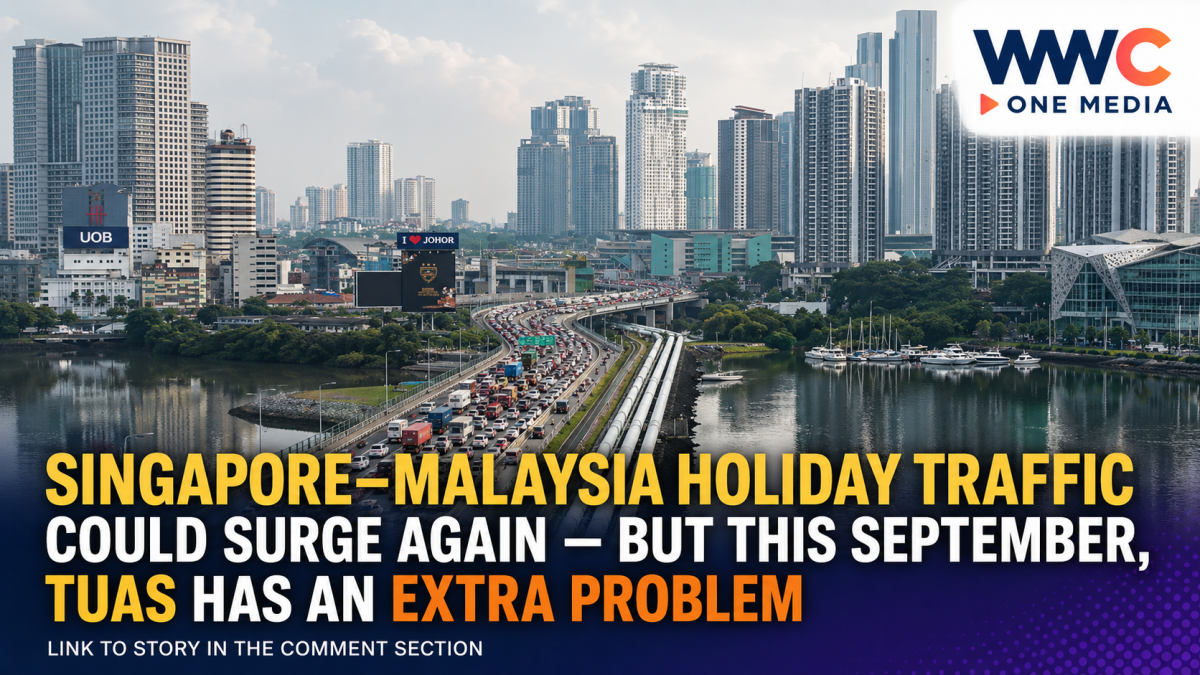
SINGAPORE — Travellers planning a September school-holiday escape to Johor may want to rethink not only when they leave, but which checkpoint they use.
Singapore’s Immigration and Checkpoints Authority has warned that heavy traffic and longer immigration waiting times are expected at both Woodlands and Tuas checkpoints from Sept 4 to Sept 14, 2026, as families head across the border during the school break.
But this year’s warning comes with an added complication: some departure car lanes at Tuas Checkpoint will begin closing in phases from Sept 1 as construction starts on Singapore’s next-generation automated immigration clearance system. The works are expected to continue until late 2027.
That overlap could make journey planning especially important for motorists hoping Tuas will automatically offer an easier alternative to the traditionally crowded Woodlands Causeway.
September holiday rush begins
ICA’s advisory covers Sept 4 through Sept 14 and urges travellers to plan ahead, monitor traffic conditions and, where possible, cross during less busy periods such as the early morning or late evening.
Singapore’s Term 3 ends around this period, with Teachers’ Day falling on Friday, Sept 4, followed by the school vacation from Sept 5 to Sept 13. Term 4 resumes on Monday, Sept 14.
That creates the familiar conditions for a border surge: families leaving Singapore at the start of the break and another wave returning as school resumes.
ICA is advising motorists to check live traffic conditions before setting off. The Land Transport Authority’s OneMotoring service provides live camera views of traffic approaching Woodlands and Tuas, allowing drivers to compare conditions before committing to a route.
The numbers show how quickly queues can explode
The warning is not hypothetical.
During Singapore’s recent National Day weekend from Aug 7 to Aug 10, more than 2.1 million travellers crossed through Woodlands and Tuas checkpoints.
Traffic peaked at more than 593,000 crossings on Aug 7 alone, according to ICA figures reported by CNA. Some motorists travelling during the busiest periods experienced immigration waits of up to three hours, with congestion compounded by traffic tailbacks from Malaysia.
Those numbers underline how a relatively short holiday window can put extraordinary pressure on two of the world’s busiest land-border connections.
The broader trend is also heading upward. During the Hari Raya Haji, Vesak Day weekend and June school-holiday period earlier in 2026, ICA recorded more than 18 million traveller crossings, with a record of more than 598,000 travellers in a single day on June 19.
Tuas construction creates a new variable
The more unusual element this September is what is happening at Tuas.
From Sept 1, parts of the checkpoint’s departure car zones will be temporarily closed in phases while existing officer-manned counters are progressively removed and replaced with the Automated Passenger Clearance System, or APCS.
Once operational, APCS is designed to allow drivers and passengers to complete immigration clearance without leaving their vehicles, combining QR-code identification with biometric verification.
The technology is expected to begin rolling out progressively at Tuas from early 2027 before eventually expanding to the redeveloped Woodlands Checkpoint.
In the long run, that should mean faster, more automated border clearance.
In the short run, however, motorists will be travelling through Tuas while portions of its departure infrastructure are undergoing construction.
ICA has installed signage, safety markers and hoardings around affected areas, and motorists have been urged to obey lane instructions and traffic rules.
QR codes could make a measurable difference
Travellers are also being strongly encouraged to generate immigration QR codes using the MyICA mobile app.
ICA says QR-code clearance, together with facial-recognition clearance for motorcyclists and pillion riders, has helped lift immigration throughput during departure peaks by more than 35 per cent compared with pre-pandemic 2019 levels.
That represents capacity for roughly 7,600 additional travellers per hour during peak departure periods.
QR-code immigration clearance has been fully implemented at Singapore’s land checkpoints since January 2025.
The improvement, however, does not eliminate the physical limitation of roads, bridges and vehicle queues. Immigration may clear passengers faster, but traffic can still back up when thousands of vehicles arrive within the same window or when congestion develops on the Malaysian side.
Security checks could also add waiting time
Travellers have another reason to build additional time into their journeys.
ICA has maintained stepped-up security checks at Singapore’s checkpoints since Feb 28 amid a heightened global security environment, and the authority has warned that these measures can contribute to longer waits during peak travel periods.
Border authorities have also become increasingly strict about dangerous driving and queue cutting.
During the National Day weekend enforcement operation, 13 motorists were caught for traffic offences or dangerous road behaviour at Woodlands Checkpoint. Eleven vehicles were ordered to make a U-turn and rejoin the queue, while two foreign-registered vehicles were subjected to entry bans into Singapore.
ICA has warned that motorists caught queue cutting during the coming rush can similarly be ordered to turn around and return to the back of the queue.
The bigger picture
September’s congestion warning is therefore about more than another school-holiday traffic jam.
Singapore’s land borders are simultaneously dealing with rising traveller volumes, tighter security requirements and a major transition toward automated immigration clearance.
The technology being installed at Tuas could eventually make border crossings significantly faster and less manpower-intensive. But before travellers see those benefits, motorists may have to navigate temporary disruption while the new system is built.
For anyone planning a Johor getaway between Sept 4 and Sept 14, the practical message is simple: check the cameras before leaving, prepare the MyICA QR code, avoid the traditional peak periods where possible and do not assume Tuas will necessarily be the faster route simply because Woodlands looks crowded.
This September, timing could matter more than ever.




Leave a Reply