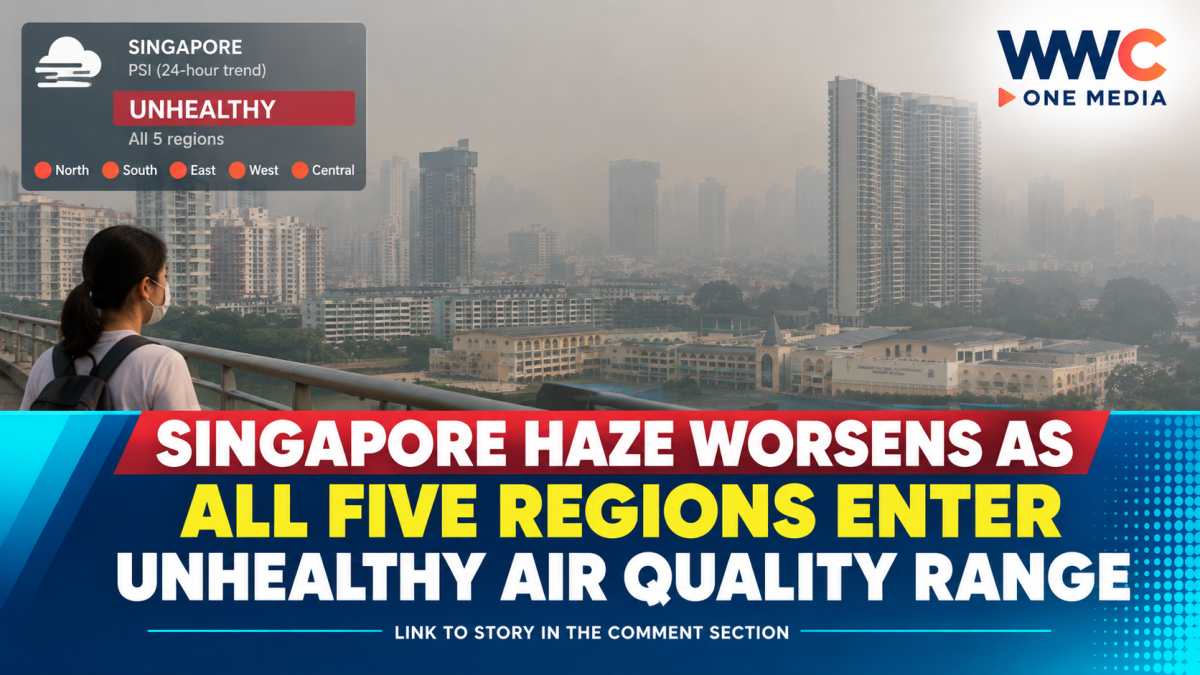
SINGAPORE — Singapore’s haze situation deteriorated overnight, with all five regions recording unhealthy 24-hour Pollutant Standards Index (PSI) readings by 7am on Sept. 29, as elevated concentrations of fine particles were recorded across the island.
The central region recorded the highest PSI at 155, followed by the west at 139, south at 129, east at 128 and north at 101.
Singapore classifies a 24-hour PSI reading of 101 to 200 as unhealthy.
PM2.5 Readings Remain Elevated Across Singapore
The haze was also reflected in the island’s one-hour PM2.5 readings, which measure concentrations of fine particulate matter in the air.
At 7am, readings stood at:
- Central: 123 µg/m³
- West: 122 µg/m³
- East: 86 µg/m³
- North: 66 µg/m³
- South: 60 µg/m³
Singapore’s National Environment Agency (NEA) classifies one-hour PM2.5 concentrations of 56–150 µg/m³ as elevated.
The readings had improved slightly from earlier overnight levels but remained elevated across all five regions.
How the Haze Spread Across the Island
The deterioration began Monday evening.
The south and central regions entered the unhealthy PSI range at around 8pm on Sept. 28, with readings of 103 and 104 respectively. The west followed at about 9pm, while the east crossed the threshold around midnight.
The north was the last region to enter the unhealthy band, reaching 101 at 7am on Sept. 29.
The development marked another sharp deterioration after air quality had improved across much of Singapore earlier in the week.
Smoke Haze Drifting From Indonesia
According to the NEA, moderate to dense smoke haze from fires in southern Sumatra and Kalimantan drifted toward Singapore.
Dry conditions are expected to persist over southern Sumatra and parts of Kalimantan. Although showers are forecast over Singapore, prevailing winds from the east or southeast mean there remains a risk of haze affecting the island.
The latest conditions follow several episodes of unhealthy air quality in Singapore during September.
The PSI first returned to the unhealthy range on Sept. 4, the first such occurrence since October 2023, according to The Straits Times. The central region subsequently reached a September peak of 154 on Sept. 15.
NEA Issues Outdoor-Activity Guidance
NEA advises people to check one-hour PM2.5 readings when deciding about immediate outdoor activities, while the 24-hour PSI forecast can be used when planning activities for the following day.
During periods when the PSI is unhealthy, NEA advises healthy people to reduce prolonged or strenuous outdoor activities. It recommends that vulnerable groups, including children, older adults, pregnant women and people with chronic heart or lung conditions, minimize or avoid such activities.
For now, the combination of elevated PM2.5 readings, dry conditions in parts of Indonesia and winds favorable to haze transport means Singapore’s air-quality situation remains closely watched.
With all five regions now in the unhealthy PSI range, the next updates from NEA will be closely monitored to see whether the haze eases or persists across the island.
WWC ONE MEDIA G,A