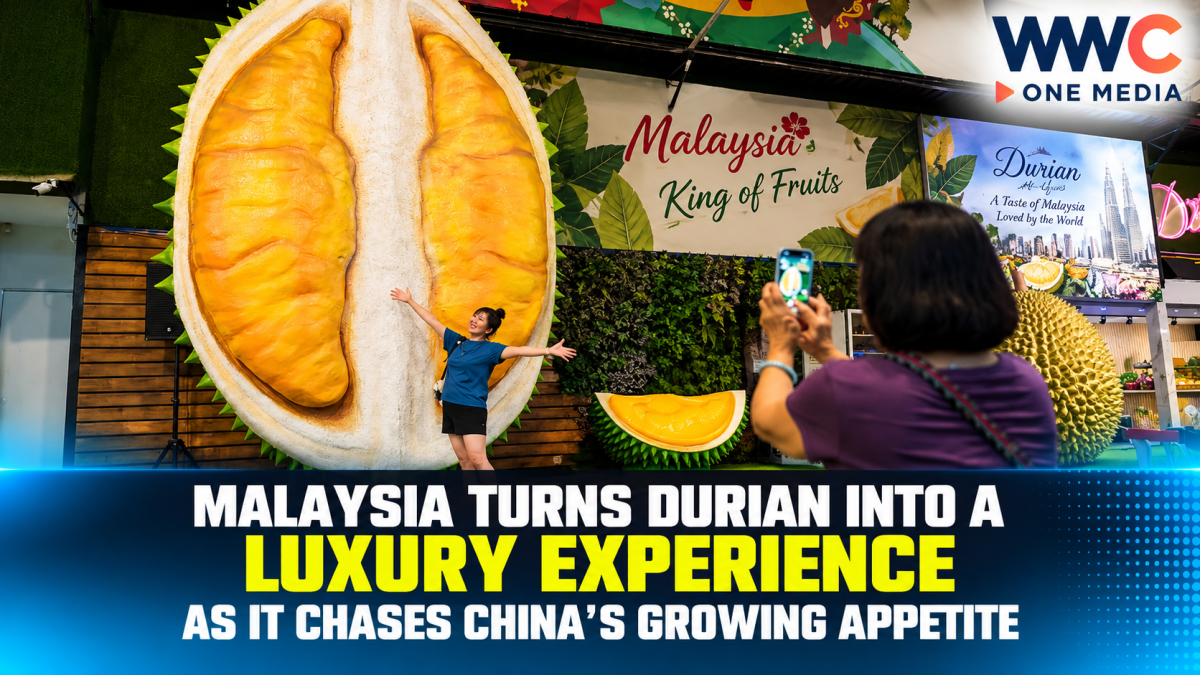
Malaysia is trying to transform durian from a famously pungent seasonal fruit into a premium food and tourism product, with businesses investing in dedicated attractions, processed foods and new experiences aimed at winning a larger share of the booming Asian durian market.
At the centre of the strategy is the Kuala Lumpur Durian Experience Centre, a new two-storey attraction near the Petronas Twin Towers that combines durian culture, history, tourism and food. Opened after an investment of nearly US$2 million, the centre features a replica orchard, theatrical presentations, tasting experiences and a shop operating from morning until midnight.
Founder Edison Ang said the goal is not necessarily to persuade people who have never eaten durian to try it. Instead, the bigger opportunity is convincing consumers already familiar with durian to choose Malaysian varieties over fruit from competing producing countries.
That competition is particularly important in China, the world’s largest durian importer. Chinese customs data show that the country imported 1.87 million tonnes of fresh durian worth US$7.5 billion in 2025, with import volumes increasing more than sixfold over the previous decade.
Thailand has built a dominant position in that market after entering it earlier, accounting for more than half of China’s fresh-durian import value in 2025. Malaysia only began exporting fresh durian to China in 2024, leaving it far behind its regional rival.
But Malaysia’s position has started changing quickly. During the first half of 2026, the value of China’s fresh-durian imports from Malaysia quadrupled compared with the same period a year earlier, suggesting that demand for Malaysian varieties is expanding rapidly.
One of Malaysia’s selling points is the way its growers handle the fruit. Malaysian durians are generally allowed to ripen naturally before being collected when they fall, rather than being harvested early for transportation.
The practice can produce fruit with rich, creamy flavours that vary significantly between varieties. Some are known for sweet custard-like flesh and fruity notes, while others have bitter, alcoholic or even peanut-butter-like flavours. For enthusiasts, tasting different varieties can resemble the way wine drinkers compare grapes and vintages.
But natural ripening also creates a major logistical problem. Fresh durian has a shelf life of only around two to three days, meaning exporters have little room for delays. Customs checks, transportation problems or interruptions in the supply chain can quickly affect quality and increase refunds.
The industry is therefore looking beyond fresh fruit to reduce its dependence on a highly perishable product. Malaysian businesses are turning durian into paste, chocolate, mochi, ice cream, dried snacks, desserts and even coffee flavoured with Musang King.
Some companies are going even further. DurianBB, founded by Adrian Choy, has introduced durian-themed tourism and food experiences, while also launching a durian flower perfume. The strategy is to turn the fruit into a broader lifestyle product rather than relying solely on seasonal sales of whole durians.
That approach could also help businesses deal with intense price competition. Leron Yee, founder of DKing, noted that durian demand is sensitive to economic conditions because consumers can treat it as a luxury rather than a necessity. A weaker economy in China could therefore force Malaysian sellers to look for alternative markets.
Demand for Malaysian durian is also becoming more visible inside China. Specialty shops have appeared in cities such as Beijing, with some focusing specifically on Malaysian varieties. One Beijing retailer sells tasting platters ranging from about 300 to 1,000 yuan, depending on the varieties and amount of edible flesh.
For Malaysian producers, the challenge now is to convert growing curiosity into long-term brand loyalty. The country is competing not only on flavour but also on freshness, natural ripening, tourism experiences and the distinctive reputation of varieties such as Musang King.
The strategy reflects a broader shift in how Malaysia is marketing durian. Rather than treating the fruit simply as an agricultural commodity, businesses are attempting to build an ecosystem around it — combining farms, tourism, premium tasting, processed foods and lifestyle products.
Malaysia’s durian push is therefore about more than selling more fruit. It is an attempt to convince consumers that Malaysian durian deserves its own place in the global premium-food market, even as producers race against the clock to deliver a product that can spoil within days.
The bigger challenge will be whether Malaysia can turn its rapidly growing exports to China and its expanding durian tourism industry into a durable international brand — one where the unmistakable smell is no longer a barrier, but part of the attraction.